
Will AI Recommend Your Clinic?
A growing share of families now ask ChatGPT and Gemini the questions they used to type into Google - including where to get an autism evaluation. Generative engine optimization (GEO) is how a practice earns a place in those answers. Here is how AI answers are assembled, and what to fix first.


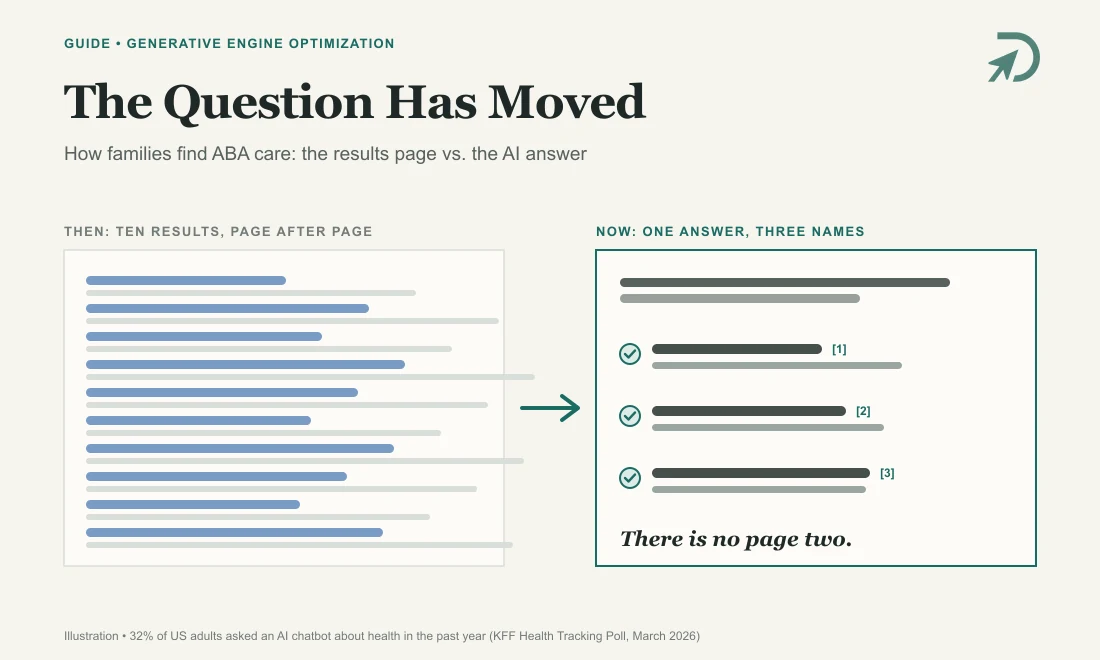
Illustration: how AI answers replace the results page. There is no page two.
- 32%
- US adults who used an AI chatbot for health information in the past year (KFF, 2026)
- 17% to 29%
- Monthly AI health-information use, June 2024 to March 2026 - nearly doubled
The question has moved
For fifteen years, the family journey started with a search box: aba therapy near me, ten blue links, a few calls. That journey still exists - but a second one now runs beside it. A parent types a paragraph into ChatGPT: their child's age, the diagnosis, their insurance, their town - and asks what to do next. The answer comes back as three or four named recommendations with reasons. There is no page two.
By KFF's polling (opens in a new tab), 32% of US adults used an AI chatbot for health information in the past year, and monthly use has nearly doubled in under two years - from 17% to 29%. Being absent from those answers is not like ranking on page two. It is like not existing.
How an AI answer chooses you
Generative engines do not browse the way people do. When a question needs current, local facts, the model retrieves - it runs searches, reads the pages it can parse, weighs what independent sources say, and composes an answer with citations (see Google's documentation on AI features (opens in a new tab)). Which means the decision about whether your clinic gets named happens in three places, none of them inside the chatbot: your pages, as parseable text and structured data; your reviews; and what independent sources say about you.
Notice what is absent from that picture: tricks. There is no secret phrase that makes a model recommend you. The engine is doing a colder version of what a careful parent does - reading what you publish, checking whether others corroborate it, and preferring sources that show their work. GEO is search discipline, held to a higher standard of legibility and proof.
Free 90-second visibility check
Complete your 90-second visibility check.
Answer seven quick questions. We will flag the weak spots, inspect your public homepage, and email your human-reviewed score and three priorities.
- See where qualified search demand may be leaking
- Reviewed by a person before it reaches your inbox
- No patient or clinical information requested
Service visibility
Does every service you want to grow have a dedicated page built around what families and referral sources actually search?
Choose an answer to continue
The seven things an AI answer needs from your site
These are the same seven dimensions our 90-second visibility assessment checks - because AI readiness and search readiness have converged into one standard:
- Service visibility: a dedicated, well-structured page for every service you want to be recommended for. An engine cannot cite a service that only exists as a homepage bullet.
- Local visibility: a unique page per clinic and service area with address, services, insurance, and a clear next step - the local facts an answer needs to name you for a town.
- Indexability: if Google cannot crawl and index a page, no retrieval-based engine will read it either. Indexing errors are now AI-visibility errors.
- ABA content: substantive pages that answer real family questions, reviewed for clinical accuracy. Thin content does not get cited; wrong content should not be.
- AI answer readiness: question-shaped headings, direct answers high on the page, supporting detail below, structured data throughout - written so a machine can lift the answer cleanly.
- Trust signals: who wrote the page, who reviewed it, their credentials, when it was updated, and the sources behind claims. Engines weight demonstrated expertise.
- Qualified-inquiry measurement: referral traffic from AI assistants is already in your analytics. If you are not segmenting it, you cannot see this channel forming.
What to fix first
- Make your entity unambiguous. One consistent name, address, phone, and service list across your site, Google Business Profile, and directories - plus organization and medical-service schema. Engines recommend entities they can resolve.
- Answer the question at the top of the page. Rewrite key pages so the first two sentences under each heading actually answer it - insurance accepted, ages served, wait time, next step - then elaborate.
- Put names on your pages. Author and clinical-reviewer bylines with credentials, visible update dates, and cited sources. This is the trust layer engines are explicitly tuned to look for.
- Earn corroboration. Reviews per location and mentions on credible healthcare publications are the independent evidence an engine weighs before naming you.
- Segment AI referrals now. A GA4 channel group for AI assistants costs an hour and gives you the baseline every future decision will be measured against.
About the contributors

Written by
Michael Pavlovskyi
Managing Partner
Michael leads growth and partnerships across Breaking News ABA and Ripley Fieldwork Tracker. His background spans digital marketing, audience development, automation, and building ABA-focused products. He connects campaign strategy to distribution and the operating systems required to turn attention into measurable demand.
View contributor profile
Data analysis by
Caleb Mukasa
Data Analyst
Caleb works on the data behind Digital Marketing ABA's case studies and benchmarks - analytics exports, measurement, and the verification that keeps every published number tied to a documented source. He came to the team through UWC and Lake Forest College, where he studies data science and computer science, and brings a builder's approach to analytics tooling and reporting.
View contributor profileSeven questions, ninety seconds
Would an AI answer name your clinic today?
Take the visibility assessment - a person reviews your answers and your public homepage, and emails your score and top three priorities.