
Employer Branding for ABA Companies
Employer branding is what an RBT or BCBA can find out about working for you before they apply: your careers page, your reviews, what your staff post and what they tell friends. For an ABA company that hires all year, it decides whether applicants arrive already wanting the job. This guide covers each piece, what the research says about why ABA staff leave, and how a stronger brand lowers hiring cost.
By Digital Marketing ABA
Published
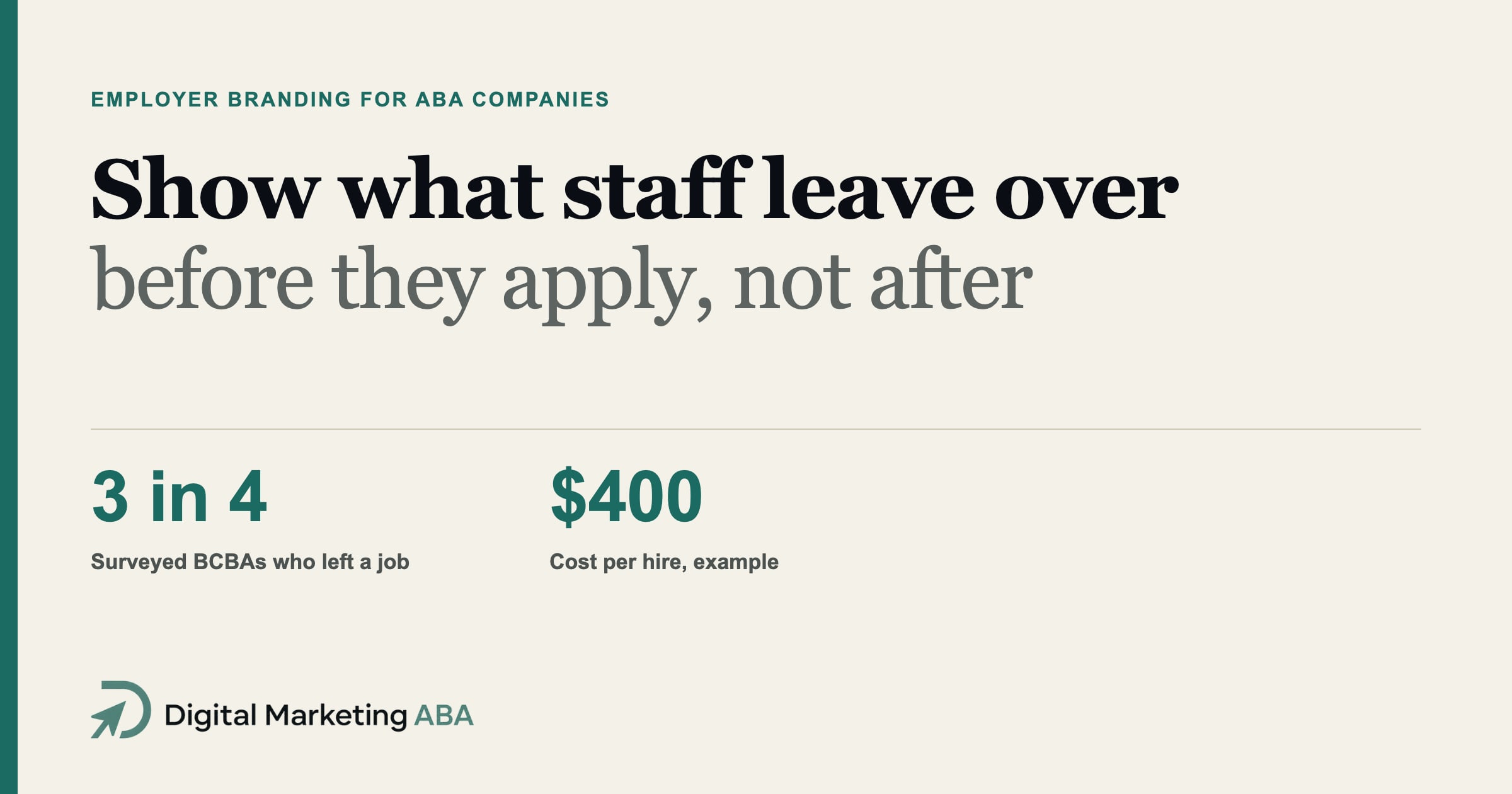
- 3 in 4
- BCBA survey respondents who had left a previous BCBA job, with burnout the top contributor (Blackman et al., Behavior Analysis in Practice, 2025)
- 1,900
- Monthly US searches for "employer branding" (Semrush, Nov 2026)
What employer branding means for ABA
It is the evidence a candidate can find about working for you, and whether that evidence matches the job. For an ABA company, the audience is mostly RBTs, many new to the field, and BCBAs comparing several offers. Both check you before they reply to a recruiter.
The searches are real. Semrush estimates about 1,900 US searches a month for "employer branding", 720 for "aba careers" and 590 for "aba therapy careers" (US database, November 2026). The last two are candidates looking for a place to work, and your careers page should be one of the answers.
Why ABA staff leave, according to research
Employer branding cannot fix pay or workload, but it should describe them honestly, because they drive departures. In an anonymous survey of BCBAs published in Behavior Analysis in Practice (opens in a new tab) (Blackman et al., 2025), nearly three-quarters of respondents (roughly 3 in 4) had left a previous BCBA job. Burnout was the top contributor, followed by pay and benefits, supervision and mentorship, collegiality, ethical violations, and training and professional development.
For RBTs, a qualitative study of 11 RBTs in Florida (opens in a new tab) (Nastasi et al., 2025) found four themes behind burnout and turnover: challenges establishing and maintaining competency, difficult working conditions, a career that felt transient or unknown, and dissatisfaction with pay and benefits. The authors note that RBTs' experiences differed widely across organizations.
Read together, the lesson for branding is simple. Show candidates the things they leave over: training, supervision, pay, workload and a path forward. A candidate who knows them before day one is less likely to be surprised in month three.
What an ABA careers page should include
One page per role and location, carrying the facts candidates leave over, in plain language. It is where every job ad, social post and referral link should land.
Use the templates in our RBT job description and BCBA job description and interview questions guides for the posting itself. Then add what a posting cannot hold:
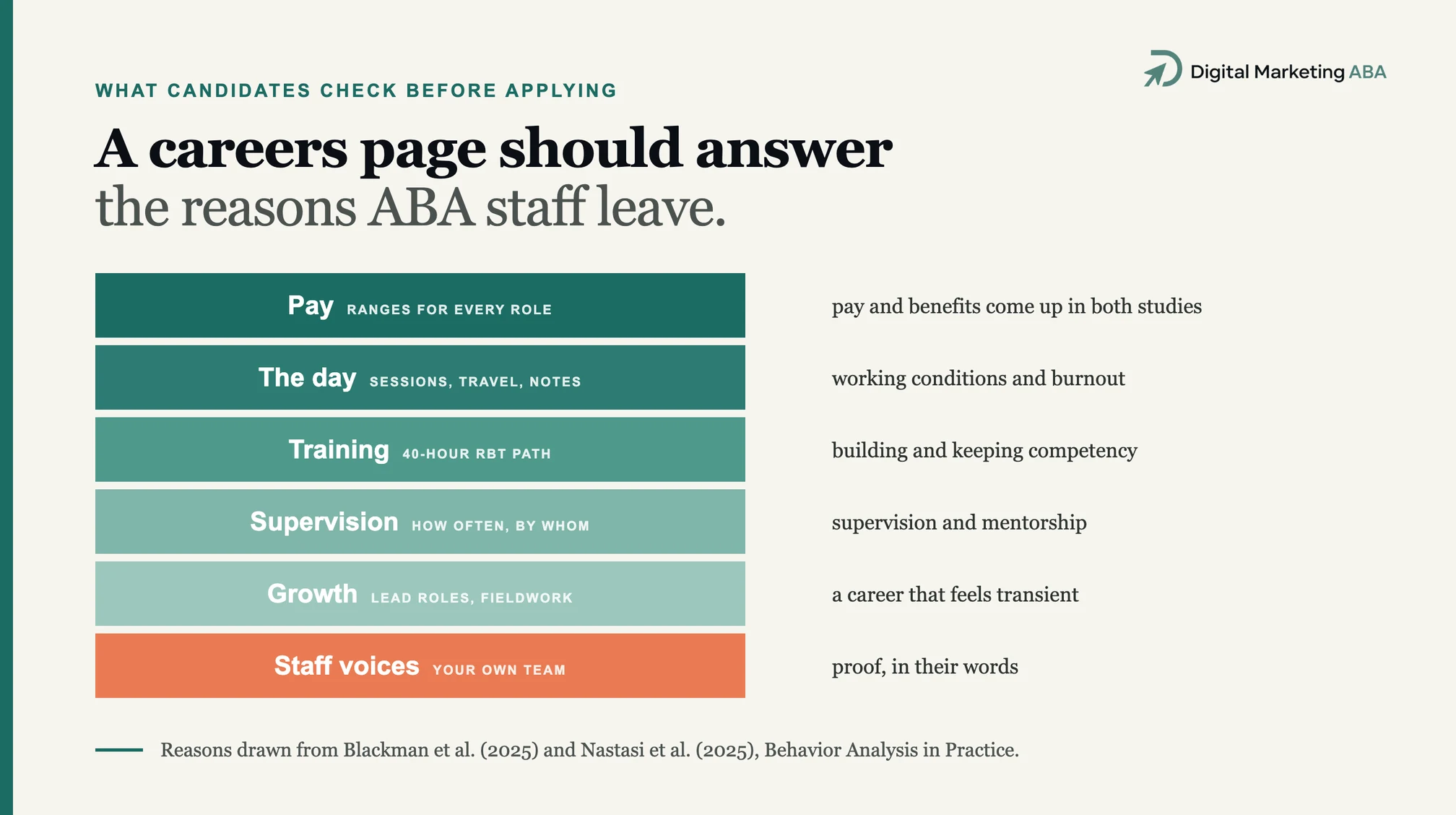
- Pay ranges for every role, and how pay changes after RBT certification.
- A real day in the role: session length, breaks, travel, documentation time.
- The training path, including who delivers the 40-hour RBT training.
- How supervision works, in numbers your BCBAs actually meet.
- Growth: lead RBT roles, BCaBA or BCBA fieldwork support, CEU budgets.
- Staff voices: short quotes or videos from your own team.
Make each job findable
Give each open role its own page with JobPosting structured data. Google's job posting documentation (opens in a new tab) says the markup must only be used on pages that contain a single job posting, recommends a baseSalary, and does not allow expired postings. A careers page that lists every role, with each linking to its own page, covers both.
How to use staff stories safely
Real staff, in their own words, with written permission. A 60-second clip of an RBT explaining why they stayed does more than a paragraph of values. Ask about the first month, the supervisor who helped, and what they would tell a friend applying.
Keep clients out of it. No client names, faces, voices, session footage or stories that could identify a family, even in the background of a clinic tour. Our guide to HIPAA-compliant marketing for ABA covers what counts. Have staff sign a release for their own image and agree what happens to the content if they leave.
How to handle Indeed and Glassdoor reviews
Claim your company pages, read every review, and reply to the critical ones calmly and specifically. Candidates read the replies as closely as the complaints.
Indeed's own employer help on managing company reviews (opens in a new tab) says a claimed Company Page lets you respond to reviews, that reviews are not removed unless they break Indeed's content guidelines, and that only the reviewer can delete their own post. It encourages employers to ask current employees to leave honest reviews. Ask for honest reviews at natural moments, such as a work anniversary, and never pay, reward or pressure anyone for one. Check each site's own policy, including Glassdoor's, before you run any review request.
Free website visibility check
Get your free visibility check.
Share your name, website, and email. We will inspect your public homepage and email your human-reviewed score and three priorities.
- See where qualified search demand may be leaking
- Reviewed by a person before it reaches your inbox
- No patient or clinical information requested
What to post on LinkedIn
LinkedIn is where BCBAs and graduate students in behavior analysis look you up. Keep the company page current with the clinics you run, the roles you hire, and proof of the things BCBAs leave over: supervision structure, CEU events, fieldwork support, promotions from within.
Your clinical leaders count more than the company page. A clinical director who posts about a staff training or a new clinic opening reaches the BCBAs in their own network, which is the audience you are trying to hire.
How to run an employee referral bonus
Pay it in two parts, one when the new hire starts and one after a retention milestone such as 90 days, so the bonus rewards referrals who stay. Publish the amounts, pay on time, and thank referrers publicly if they agree.
Track every referral as a source, the same way you track job boards and ads. Our article on RBT hiring as a marketing funnel explains cost per retained hire, the number that shows whether referrals are working.
How employer branding cuts hiring cost
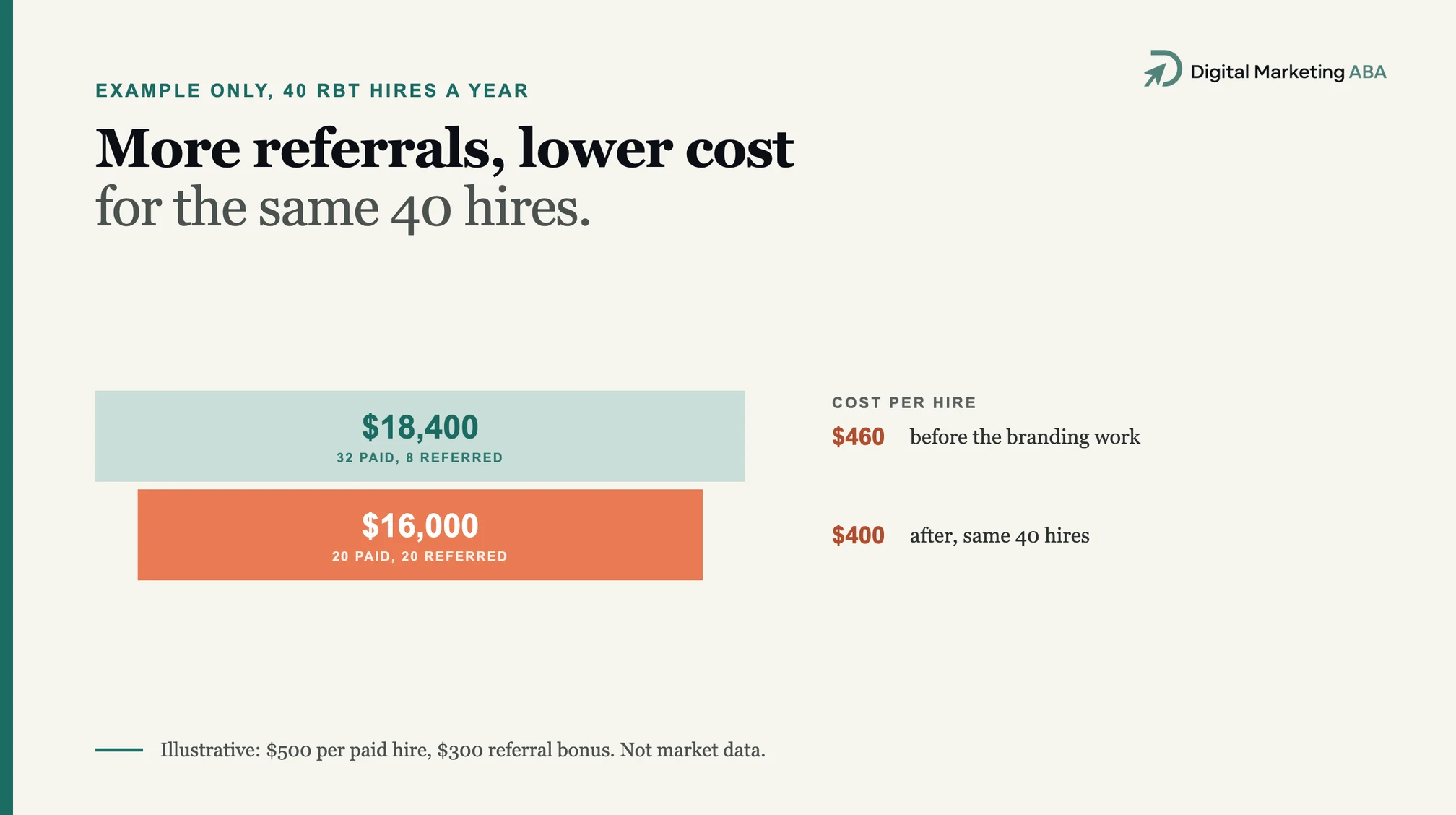
Mostly by moving hires from paid channels to referrals and direct applicants who found you on their own. An illustrative example, not market data, with assumed costs.
Suppose a company makes 40 RBT hires a year. Today, 32 come from paid job ads at $500 per hire and 8 from staff referrals at a $300 bonus each: $16,000 plus $2,400, or $18,400 a year, about $460 per hire. After a year of careers page work, staff stories and a referral program, suppose 12 of the paid hires come through referrals instead: 20 from paid ads and 20 from referrals. That is $10,000 plus $6,000, or $16,000, and $400 per hire.
The saving in this example is $2,400 a year, before counting the larger prize: referred and well-informed hires who stay longer save a second round of hiring. Run the same arithmetic with your own channel costs and 90-day retention.
What to do this week
- Read your last 20 Indeed and Glassdoor reviews and reply to the critical ones.
- Add pay ranges, the training path and the supervision model to your careers page.
- Record two short staff videos, with signed releases and no clients in frame.
- Restructure your referral bonus into a start payment and a 90-day payment.
- Add a required source field to every application and review cost per hire by source monthly.
Sources
Blackman, Ruby, Wine, Reed and Li, An Analysis of Variables Contributing to Board Certified Behavior Analyst Turnover (opens in a new tab) - Behavior Analysis in Practice, 2025. Peer-reviewed; figures from the abstract.
Nastasi, McGarry, Peters, León, Bacotti and Gravina, A Qualitative Analysis of Variables Contributing to Registered Behavior Technicians' Burnout and Turnover in Florida (opens in a new tab) - Behavior Analysis in Practice, 2025. Peer-reviewed; themes from the abstract.
Indeed, Managing Company Reviews (employer help) (opens in a new tab) - read November 16, 2026. Primary platform guidance.
Google Search Central, Job posting structured data (opens in a new tab) - read November 16, 2026. Primary.
Semrush, US database, November 2026 - monthly search volume estimates.
Frequently asked questions
What is employer branding for an ABA company?
It is the evidence candidates can find about working for you before they apply: your careers page, Indeed and Glassdoor reviews, LinkedIn presence, staff stories and what employees tell friends. It decides whether applicants arrive already wanting the job.
Why do BCBAs and RBTs leave ABA jobs?
In a 2025 survey, nearly three-quarters of BCBA respondents had left a previous BCBA job, with burnout the top contributor. A 2025 study of Florida RBTs found themes of competency challenges, difficult working conditions, an unclear career and pay dissatisfaction.
Can I ask employees to review us on Indeed?
Indeed's employer help encourages asking current employees for honest reviews. Never pay, reward or pressure anyone for a review, and check each site's own policy, including Glassdoor's, before running a request.
What should an ABA careers page include?
Pay ranges, a real day in the role, the training path to RBT certification, how supervision works, growth options such as fieldwork support, and short stories from your own staff. Give each open role its own page.
How does employer branding lower hiring cost?
By moving hires from paid channels to referrals and direct applicants. In the article's illustrative example, shifting 12 of 40 annual hires from paid ads to referrals cuts cost per hire from about $460 to $400.
Keep reading
- RecruitingRBT Hiring Works Like Marketing. Here's How to Fill Seats Faster
RBT hiring works like a marketing funnel. Where candidates search, what ABA job posts should say about pay and training, and how to track hires by source.
- RecruitingBCBA Job Description and Interview Questions
A copy-ready BCBA job description for ABA companies, the BACB requirements behind it, and 15 BCBA interview questions with what a good answer shows.
- RecruitingAn RBT Job Description That Gets More Applicants
A copy-ready RBT job description for ABA companies, and why each line is there: pay range, BACB training to certification, supervision and schedule.
Hire from a stronger position
Want candidates to choose you before they apply?
We build careers pages, staff content, review programs and recruiting campaigns for multi-clinic ABA companies, with every applicant tracked to a source and a start date.