
Is Your ABA Marketing HIPAA Compliant? Start With the Pixels
HIPAA compliant marketing for an ABA company is mostly a tracking problem. The ads and the blog are rarely where the risk sits. It sits in the code on your intake form, your insurance check and your portal login, which can pass what a parent types to an ad platform. Here is what HHS, a federal court and the FTC have actually said, and a checklist to work through with your team and your counsel.
By Digital Marketing ABA
Published
What HIPAA compliant marketing means for ABA
In practice it means two things. Your website and ad tools must not send protected health information (PHI) to a vendor without a permission the HIPAA Privacy Rule (opens in a new tab) recognizes, and you must not use client information in promotion without the family's written authorization. Search ads, blog posts and billboards are ordinary marketing.
HIPAA applies to covered entities. OCR's tracking guidance (opens in a new tab) notes that a health clinic is covered if it transmits health information electronically in connection with a transaction covered by HIPAA's standards (45 CFR part 162). An ABA company that bills insurers electronically should assume it is covered and confirm with counsel.
This article is not legal advice. It reports what the rule text, the agency guidance and the court said, and labels which is which, because the three carry different weight.
Rule, guidance and court ruling are different
The Privacy Rule is regulation with the force of law. OCR's bulletin on tracking technologies is guidance, and its own disclaimer says it does "not have the force and effect of law." A 2024 court decision struck one part of that guidance and left the rest in place.
- Rule: 45 CFR Part 164, including the marketing authorization requirement at 164.508(a)(3).
- Guidance: OCR's bulletin on the use of online tracking technologies by HIPAA covered entities and business associates, first issued in December 2022 and revised on March 18, 2024.
- Court ruling: American Hospital Association v. Becerra, U.S. District Court for the Northern District of Texas, decided June 20, 2024.
- FTC: a separate agency enforcing the FTC Act and its Health Breach Notification Rule, which covers companies HIPAA does not.
What the court changed in June 2024
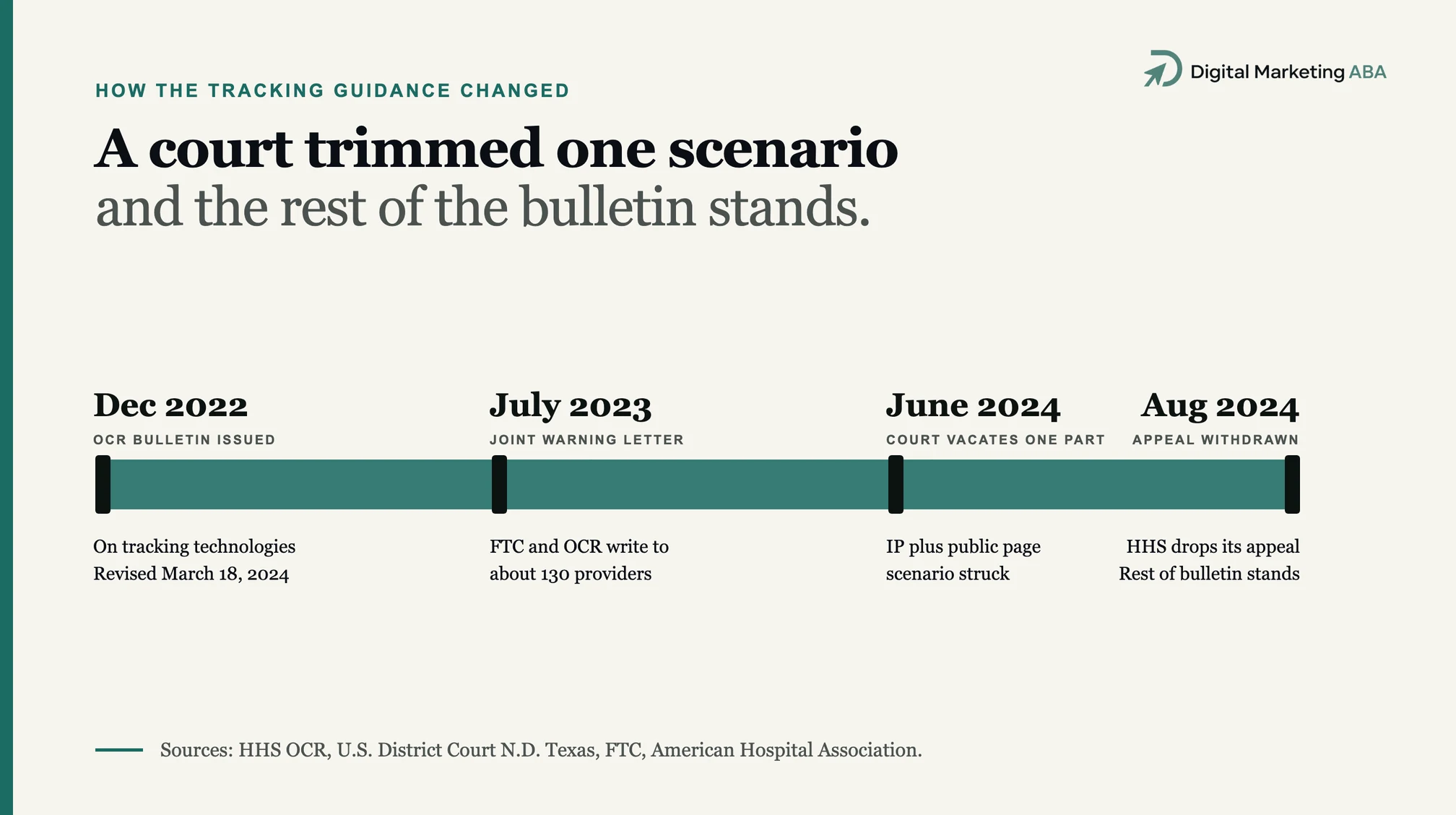
The court vacated one scenario from the bulletin: that HIPAA is triggered when tracking connects a visitor's IP address with a visit to a public, unauthenticated page about specific health conditions or providers. The rest of the bulletin still stands.
Judge Mark Pittman declared that portion, which the opinion calls the "Proscribed Combination," unlawful as beyond HHS's authority under HIPAA, and vacated it. A footnote says the vacatur should not be read as limiting the other guidance in the document. OCR now carries a note at the top of the bulletin describing the order. The American Hospital Association, the lead plaintiff, reported that HHS withdrew its appeal on August 29, 2024.
For an ABA clinic the practical effect is narrow. A pixel that only logs a page view on your "What is ABA therapy" page can no longer be treated as a HIPAA disclosure on the strength of that vacated scenario. A pixel on any page where a parent types or selects information about their child is a different matter.
When a tracking pixel becomes a HIPAA problem
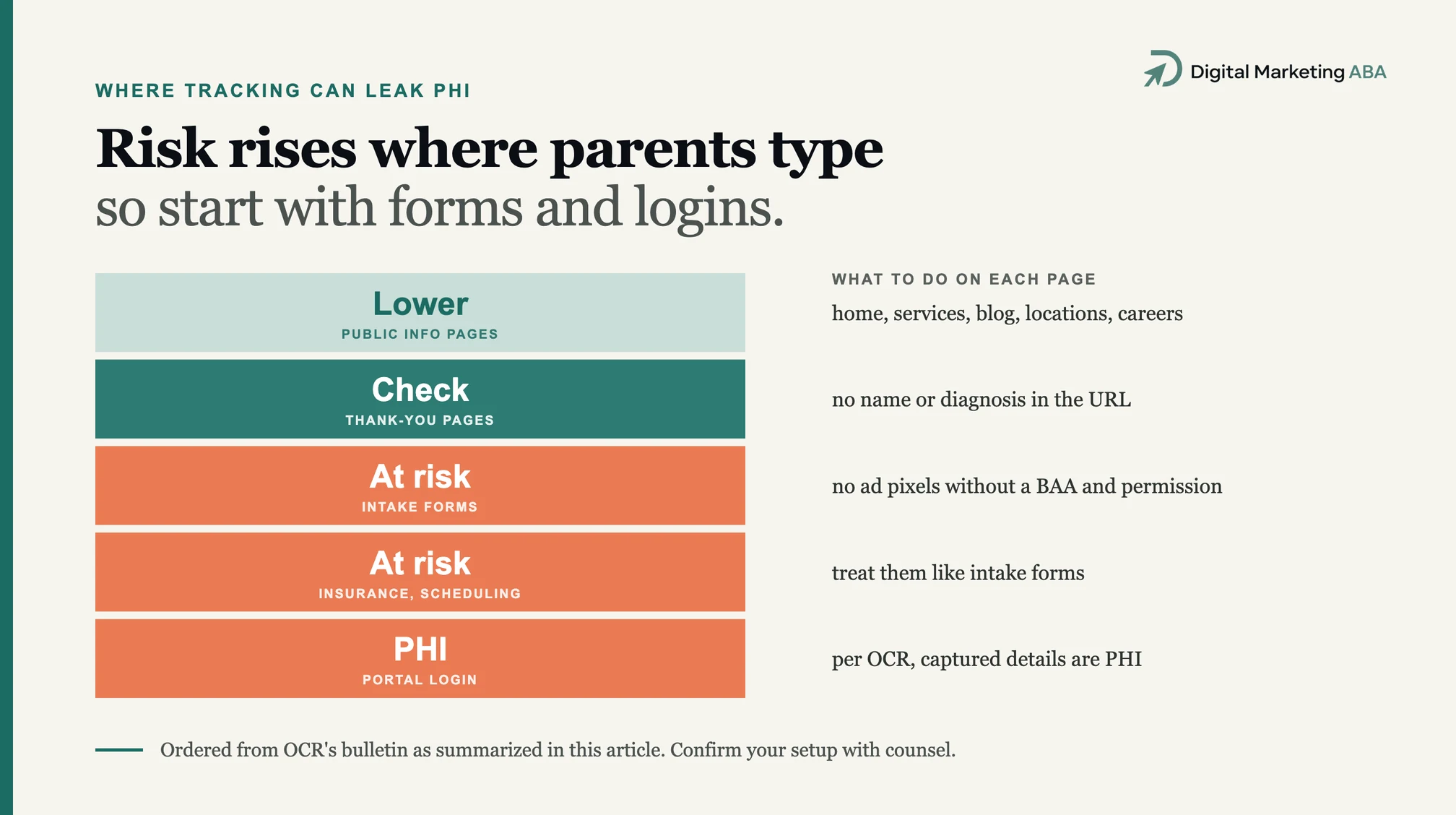
According to OCR's bulletin, tracking on logged-in pages generally has access to PHI, and so can tracking on public pages where someone books an appointment or enters symptoms. A parent filling in an intake form with a child's name, diagnosis or insurance is the closest match to OCR's appointment example.
The bulletin also covers patient portal login and registration pages: if tracking there collects the credentials or registration details someone enters, that is a disclosure of PHI. It defines a tracking pixel as a tiny graphic placed on a page that lets the site owner or a third party collect information about its use.
In July 2023, the FTC and OCR sent a joint letter to about 130 hospital systems and telehealth providers about tools such as the Meta/Facebook pixel and Google Analytics. If your site runs either, that letter describes your setup.
Two points in the bulletin trip up marketing teams. First, banners asking users to accept or reject cookies "do not constitute a valid HIPAA authorization." Second, a vendor's promise to remove or de-identify PHI after it arrives is not enough. A disclosure of PHI without authorization requires a signed business associate agreement (BAA) and a Privacy Rule permission.
If an ad or analytics vendor will not sign a BAA, OCR describes an alternative: a customer data platform that signs a BAA, de-identifies the tracking data, and passes on only de-identified information.
Where the FTC fits in
The FTC acts on health data sharing too, mostly where HIPAA does not reach. Its Health Breach Notification Rule applies to personal health record vendors and related entities not covered by HIPAA. Amendments effective July 29, 2024 confirmed it covers health apps and that an unauthorized disclosure counts as a breach.
Its cases show what regulators look for. In March 2023, the online counseling service BetterHelp agreed to pay $7.8 million (opens in a new tab) after the FTC said it shared email addresses, IP addresses and health questionnaire information with Facebook, Snapchat, Criteo and Pinterest for advertising. The FTC said BetterHelp used clients' email addresses to have Facebook find similar people to target.
That last practice, uploading a client list to build a lookalike audience, is the one to watch. OCR's bulletin says disclosing PHI to a tracking vendor for marketing without each person's HIPAA authorization is impermissible. A list of your clients' parents tells the platform who receives ABA services from you, so treat it as PHI and ask counsel before it leaves your systems.
Free website visibility check
Get your free visibility check.
Share your name, website, and email. We will inspect your public homepage and email your human-reviewed score and three priorities.
- See where qualified search demand may be leaking
- Reviewed by a person before it reaches your inbox
- No patient or clinical information requested
Using client stories, photos and testimonials
Under 45 CFR 164.508(a)(3), a covered entity must obtain an authorization for any use or disclosure of PHI for marketing, except face-to-face communication and promotional gifts of nominal value. Treat a client photo, video or story in an ad or on your site as needing a signed authorization, and have counsel review the form.
HIPAA's definition of marketing at 164.501 excludes some communications, including describing your own health-related services, unless a third party pays you to send them. An email to current families about a new social skills group is generally outside that definition. A client video in a Facebook ad is not.
A valid authorization has required elements, including a description of the information, each purpose, an expiration date or event, and a signature. If a parent or guardian signs for a child, the form must describe their authority to act for the individual.
Online reviews raise a separate risk: replying in a way that confirms someone is a client. We cover that in how ABA clinics get more Google reviews.
A page-by-page tracking checklist
List every tag on every page, then sort pages by what a visitor can type or select there. Forms, scheduling, insurance checks and logins are where PHI can leak.
If you are rebuilding the site, put this list in the brief. It is easier to design forms without third-party tags than to remove them later, a point we return to in therapy website design for ABA companies.
- Public information pages (home, services, locations, blog, careers): lower risk after the June 2024 ruling, but confirm no tag reads form fields or URL parameters.
- Intake, contact and start-services forms: no third-party ad pixels unless a BAA and a Privacy Rule permission cover that vendor. Record conversions from a server you control, without the form contents.
- Thank-you and confirmation pages: check the URL. A name, email or diagnosis in a query string can be passed to every tag on the page.
- Insurance verification and scheduling tools: treat them like intake forms, and ask the tool's vendor what it sends to analytics.
- Portal login and registration pages: per OCR, credentials or registration details collected by tracking are PHI. Remove ad tags.
- Session replay and heatmap scripts: OCR lists session replay, which records clicks and typing, as a tracking technology. Keep it off any page with a form.
- Chat widgets and call tracking: if a parent describes their child in a chat or a recorded call, that vendor holds PHI and needs a BAA.
Questions to ask every marketing vendor
Any vendor that touches your site, ads or client data should answer these in writing. If the answers are vague, the risk stays with you.
Conversion tracking is what makes Google Ads for ABA therapy measurable, so the goal is to keep it while keeping form contents out of it. Judging lead quality, as in what a qualified ABA lead costs, does not require sending a parent's answers to an ad platform. It is part of our Tracking & Analytics service.
- Will you sign a BAA? If not, what data from our site reaches you, and how do you keep PHI from reaching you?
- Which tags do you install, on which pages, and what parameters do they send?
- Do you upload any client or lead lists to ad platforms?
- Can conversions be sent server-side with only an event name and a value, and no form contents?
- Who on your team can see form submissions, and where are they stored?
- Is our use of tracking covered in our HIPAA risk analysis? OCR's bulletin expects it to be.
What to do this week
Five steps, in order. None needs new software.
- Export the tag list from your tag manager and check the source of your intake, contact and thank-you pages.
- Remove ad pixels and session replay from forms, scheduling, insurance and portal pages until a BAA and a permission cover them.
- List every vendor that receives site or client data and send them the questions above.
- Pause client-list uploads to ad platforms, and check that every testimonial, photo and case story has a signed authorization on file.
- Book time with healthcare counsel to review what you found and update your risk analysis.
Sources
Use of Online Tracking Technologies by HIPAA Covered Entities and Business Associates (opens in a new tab) (HHS Office for Civil Rights, revised March 18, 2024, last reviewed June 26, 2024). Agency guidance, partly vacated.
American Hospital Association v. Becerra, Opinion and Order (opens in a new tab) (U.S. District Court, N.D. Texas, No. 4:23-cv-01110-P, June 20, 2024). Court ruling, copy hosted by the plaintiff.
45 CFR 164.508, Uses and disclosures for which an authorization is required (opens in a new tab) (eCFR). Regulation text; the marketing definition is at 45 CFR 164.501.
Health Breach Notification Rule, final rule (opens in a new tab) (Federal Trade Commission, Federal Register, May 30, 2024). Regulation, effective July 29, 2024.
FTC to Ban BetterHelp from Revealing Consumers' Data, Including Sensitive Mental Health Information, to Facebook and Others for Targeted Advertising (opens in a new tab) (FTC press release, March 2, 2023). Enforcement action.
FTC and HHS Warn Hospital Systems and Telehealth Providers about Privacy and Security Risks from Online Tracking Technologies (opens in a new tab) (FTC press release, July 20, 2023). Joint warning letter.
Frequently asked questions
Is the Meta Pixel HIPAA compliant?
No tool is compliant or not on its own. Under OCR's guidance, the question is whether the pixel sends PHI, such as what a parent enters on an intake form, to a vendor without a BAA and a Privacy Rule permission. Keep ad pixels off forms, portals and scheduling pages.
Did a court strike down HHS's tracking guidance?
Partly. On June 20, 2024, a federal court in Texas vacated the part saying an IP address plus a visit to a public health-related page triggers HIPAA. The court said the rest of the guidance was not limited, and OCR's bulletin remains posted with a note about the order.
Does a cookie consent banner make tracking HIPAA compliant?
No. OCR's bulletin says banners asking users to accept or reject cookies do not constitute a valid HIPAA authorization.
Can an ABA clinic post client success stories?
Get a signed HIPAA authorization first. Under 45 CFR 164.508, using or disclosing PHI for marketing requires one, and if a parent signs for a child, the form must describe their authority to act. Have counsel review the form.
Can we use Google Analytics on an ABA website?
On public information pages, generally yes. On pages where visitors enter information about their child, OCR's guidance requires a BAA and a Privacy Rule permission before PHI goes to any vendor. Ask your analytics vendor whether it will sign a BAA, and keep it off those pages if not.
Keep reading
- ABA Intake FormWhat Your ABA Intake Form Should Ask
What an ABA intake form on your website should ask, what to leave for the intake call, and why form length and callback speed decide which families start.
- Paid MediaWhat Google Ads for ABA Therapy Really Cost in 2026
What Google Ads for ABA therapy cost per click, from Semrush estimates, how a click becomes a started client, and the settings that stop wasted ABA ad spend.
- Reputation ManagementHow to Get More Google Reviews From ABA Families, the Right Way
How to get more Google reviews for ABA clinics: who to ask, when to ask, what Google and the FTC prohibit, and how to reply without disclosing PHI.
Tracking & Analytics
Not sure what your website sends to ad platforms?
We help multi-clinic ABA companies inventory their tags, take ad pixels off intake forms, and keep measuring leads without sending families' answers to Meta or Google.