
What It Costs to Recruit a BCBA in 2026
The salary is the part of a BCBA hire everyone budgets for. The bigger costs sit around it: the bonus it takes to get noticed, the weeks a caseload sits uncovered, and recruiting spend nobody measures by source. Here is what 742 live ABA job listings show about the first, and a way to put numbers on the rest.


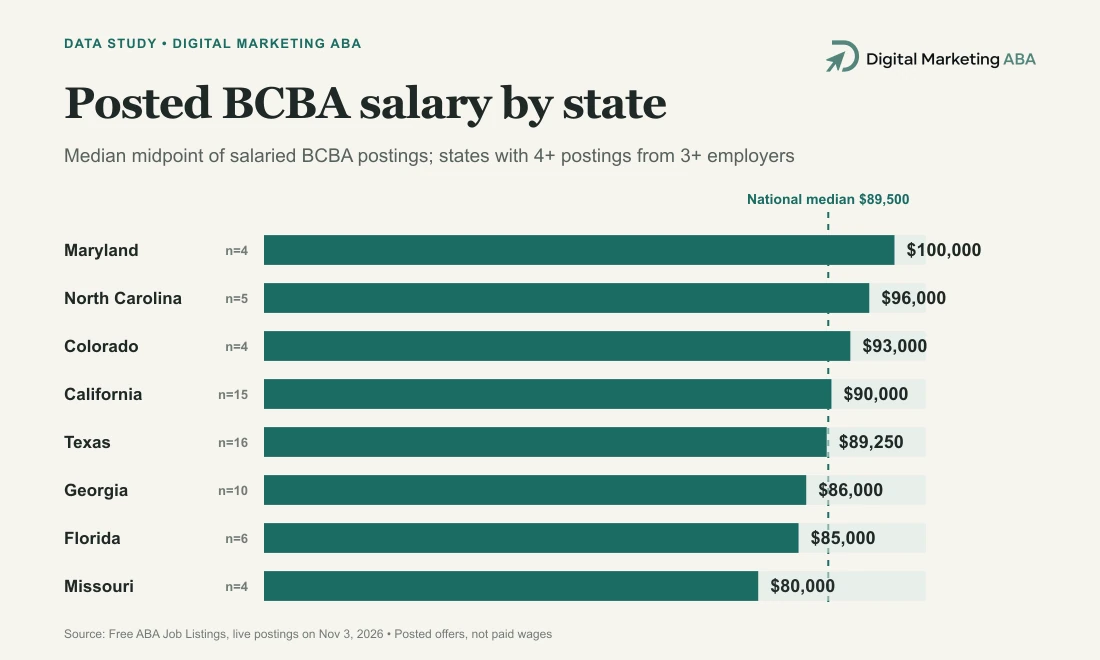
Most states land within a few thousand dollars of the $89,500 national median. Base pay alone rarely sets an offer apart.
- $89,500
- Median posted BCBA salary, 107 distinct postings from 52 employers
- 26%
- BCBA postings that mention a sign-on bonus (median $5,000)
The offer you are competing against
We pulled every listing live on Free ABA Job Listings (opens in a new tab) on November 3, 2026: 742 postings from 195 employers across 41 states. Among 107 distinct salaried BCBA postings, the median offer was $89,500, and the middle half fell between $82,500 and $93,500. BreakingNewsABA (opens in a new tab) is publishing the full state-by-state breakdown, including RBT pay.
That band is narrow. When most offers sit within about $11,000 of each other, base pay alone rarely sets a posting apart - so employers reach for other levers. Half of BCBA postings mention a CEU stipend. About a third mention a flexible or four-day schedule. A quarter offer a sign-on bonus, with a median of $5,000 and a top offer of $20,000.
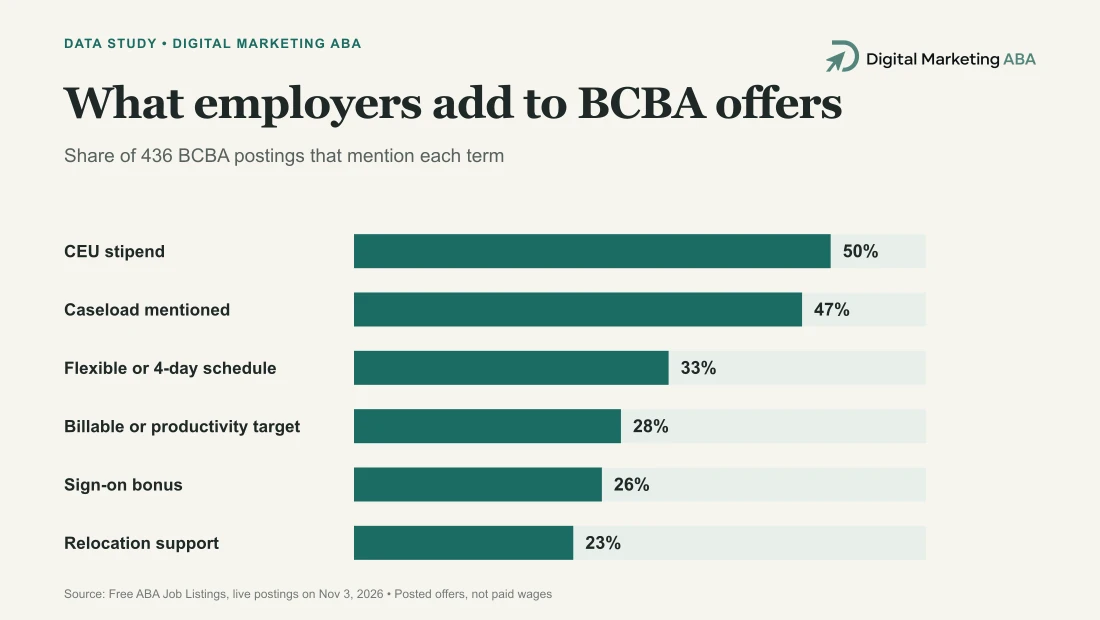
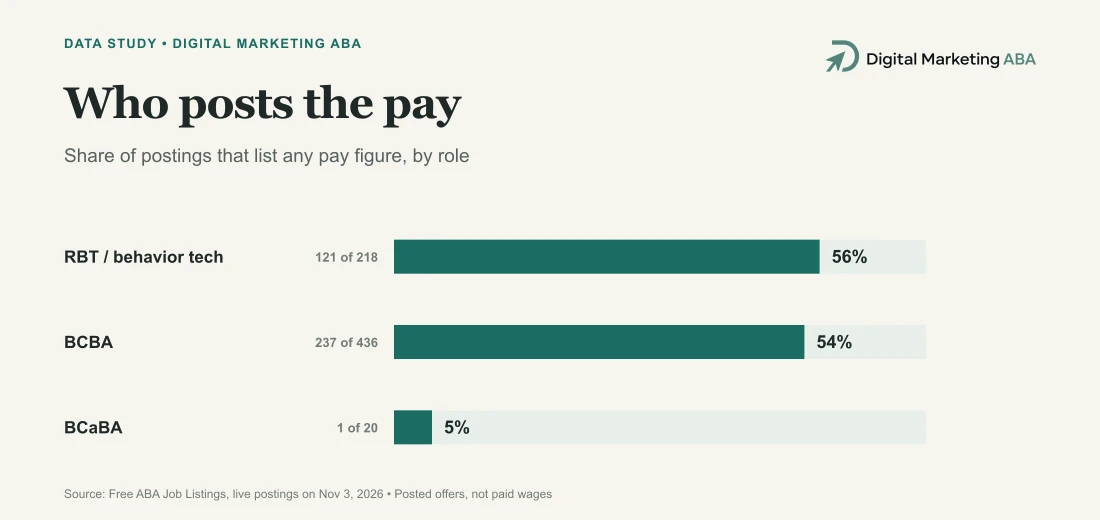
Just over half of postings name a number
Pay transparency is the cheapest recruiting lever there is, and it is still optional for most of the field. Only 237 of 436 BCBA postings listed any pay figure. RBT postings were similar, at 121 of 218. For BCaBA roles, it was one posting in twenty.
A posting without a range is competing against postings that answer a candidate's first question before the click. It also attracts applicants whose expectations do not fit, and every one of those costs recruiter time to screen out.
The cost that never shows up on the offer letter
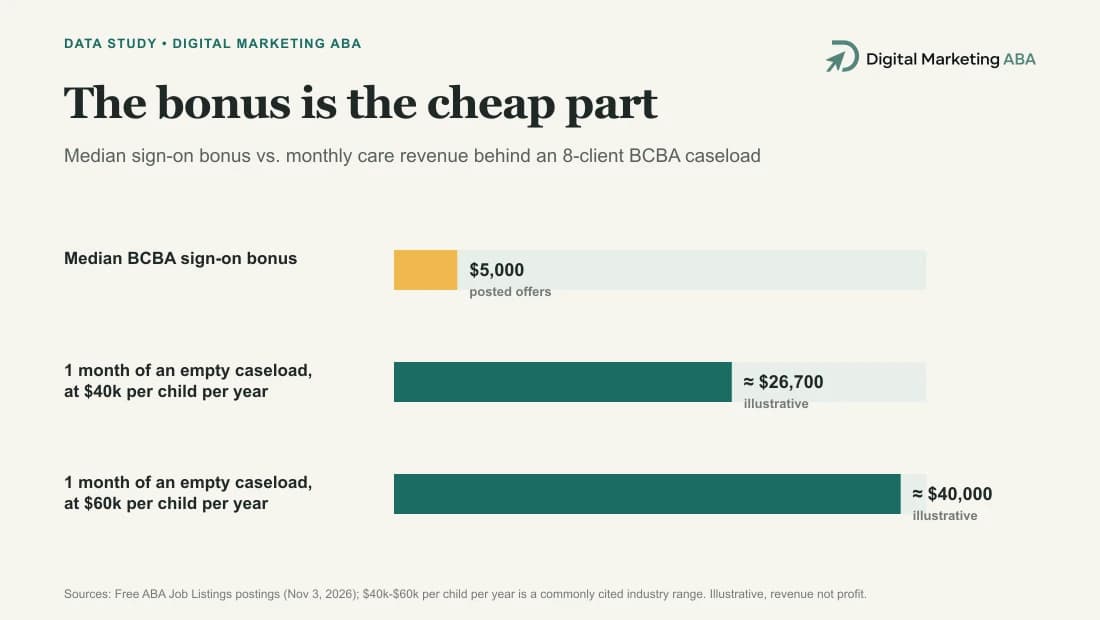
An open BCBA seat is not only a hiring cost. It is a caseload that cannot start. Postings that state a caseload put the median at eight clients.
Intensive ABA is commonly cited across the industry at $40,000 to $60,000 per child per year before insurance adjustments - the same range we used in What Does a Qualified ABA Lead Cost in 2026? Run the pencil test: eight clients at that range is $320,000 to $480,000 a year in care, or roughly $26,700 to $40,000 a month (an illustration, not a forecast - run it with your own caseload, authorizations, and rates).
Three caveats keep that number honest. It is revenue, not profit: RBT wages, overhead, and payer mix all come out of it. It only counts if those families are waiting on your hire; if another BCBA on your team can absorb them, the cost is lower, and if they go to a competitor, it is higher and lasts longer. And it varies with your own payer contracts.
Even at the low end, the care revenue at stake in one month of vacancy is about five times the median sign-on bonus. That changes which recruiting costs are worth paying to fill a seat faster.
Free website visibility check
Get your free visibility check.
Share your name, website, and email. We will inspect your public homepage and email your human-reviewed score and three priorities.
- See where qualified search demand may be leaking
- Reviewed by a person before it reaches your inbox
- No patient or clinical information requested
Where recruiting spend actually goes
Most practices can say what they spent on recruiting last year. Far fewer can say which channel produced the BCBAs who stayed. The useful numbers are the same ones we use for client acquisition as an ABA digital marketing agency - measured by source, not in aggregate:
- Cost per qualified applicant, by source: job boards, LinkedIn, referrals, university and fieldwork pipelines, your own careers page.
- Time to fill, by source. The channel that fills a seat three weeks faster can be worth more than the cheapest one.
- Twelve-month retention, by source. A hire who leaves in six months costs the full amount again.
What to do with these numbers
None of this needs new software. It needs a source field on every application and a monthly look at which sources turn into started, retained hires. The same discipline we describe for families in How AI Can Fill Your ABA Clinic's Waitlist applies to candidates: answer the questions they are actually asking, and answer them first.
- Post the pay range. Close to half of BCBA postings still do not, and a clear range filters out mismatched applicants before they cost recruiter time.
- Lead with the specifics candidates compare: caseload size, billable-hours target, supervision ratio, schedule. Only 19 distinct BCBA postings in this set state a weekly billable-hours number.
- Make the careers page do the work. One page per role and location, carrying the same facts as the posting, so search engines and AI answers can find and quote it.
- Target people who already fit. Paid social aimed at BCBAs and fieldwork students inside your hiring radius beats broad job-board boosts that reach everyone.
- Measure by source, then reallocate. Cut what produces applicants but not hires; fund what fills seats fastest.
Sources
Free ABA Job Listings, live job postings (opens in a new tab) (pulled Nov 3, 2026) - 742 listings from 195 employers, first posted Apr 22 - Nov 3, 2026; pay read from posting text, sign-on and other bonuses excluded from base pay. Primary dataset, posted offers rather than paid wages.
BreakingNewsABA, BCBA and RBT Pay by State From 742 Live ABA Job Listings (opens in a new tab) (forthcoming, Nov 2026) - full state-by-state and RBT breakdown of the same dataset. Companion analysis.
Behavioral Innovations, Cost of ABA Therapy (opens in a new tab) (2026) - the $40,000-60,000 annual range is a commonly cited industry figure without a single primary source. Provider-published.
About the contributors

Written by
Michael Pavlovskyi
Managing Partner
Michael leads growth and partnerships across Breaking News ABA and Ripley Fieldwork Tracker. His background spans digital marketing, audience development, automation, and building ABA-focused products. He connects campaign strategy to distribution and the operating systems required to turn attention into measurable demand.
View contributor profile
Data analysis by
Caleb Mukasa
Data Analyst
Caleb works on the data behind Digital Marketing ABA's case studies and benchmarks - analytics exports, measurement, and the verification that keeps every published number tied to a documented source. He came to the team through UWC and Lake Forest College, where he studies data science and computer science, and brings a builder's approach to analytics tooling and reporting.
View contributor profileRecruiting is a marketing problem
Want to know what each hire actually costs you?
We help multi-clinic ABA practices build the careers pages, targeted campaigns, and source tracking that show which channels fill seats and which only fill inboxes.