
How Marketing Data Shapes ABA Practice Valuation
ABA practice valuation starts with profit, and a buyer pays for the profit it can verify. Marketing data rarely sets the price on its own, but it is the evidence behind the growth story you tell, and a source of risk a buyer will look for. Here is what to have ready on referral sources, cost per client, intake conversion, reviews and account ownership before anyone asks.
By Digital Marketing ABA
Published

How ABA practice valuation works
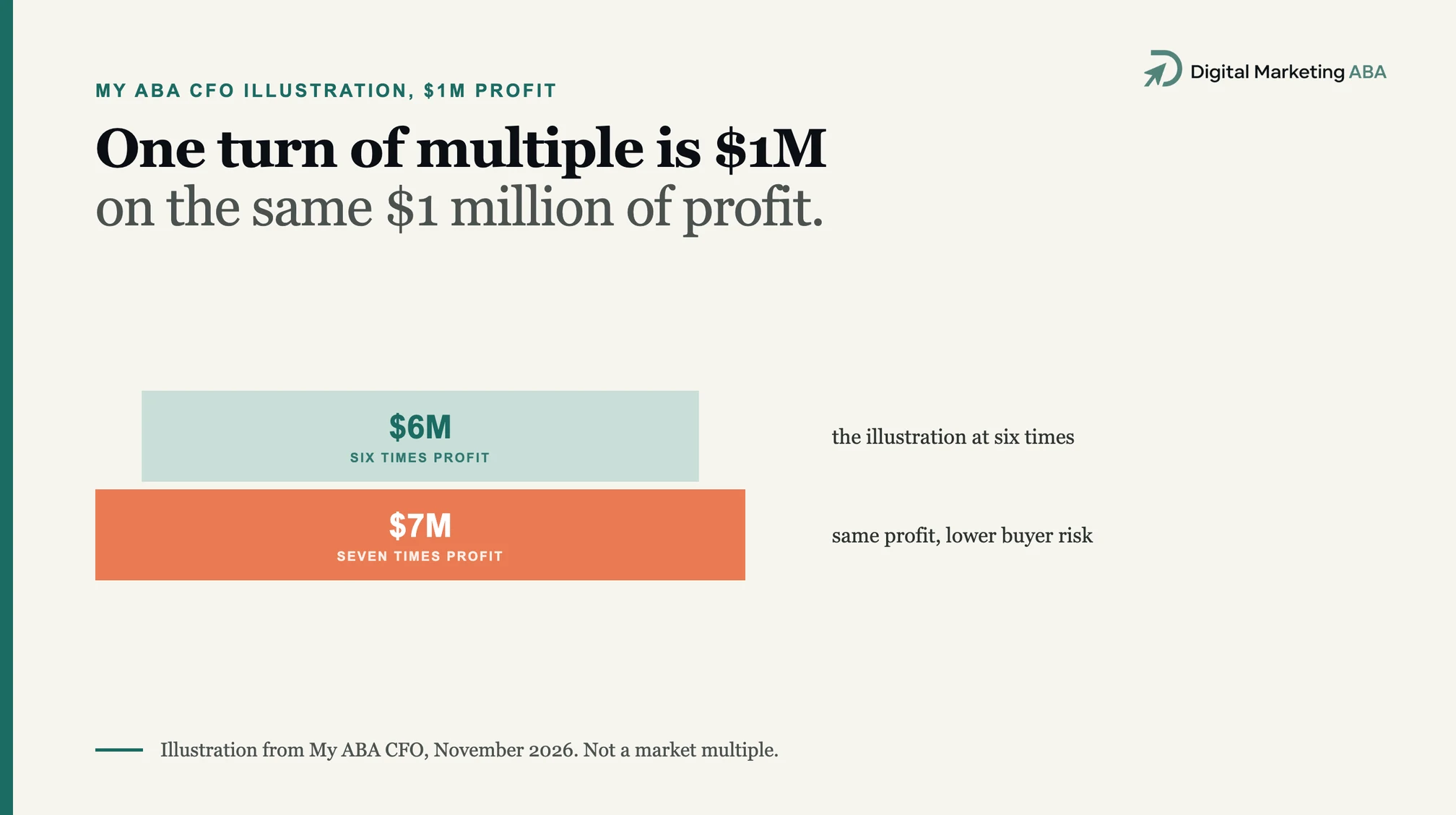
In simple terms, the price is profit times a multiple, and preparation raises the multiple by lowering the buyer's risk. That is how My ABA CFO frames it in Getting Sale-Ready (opens in a new tab) (November 2026), with an illustration: a company earning $1 million a year sells for $6M at six times and $7M at seven times.
The same article says buyers commission a quality of earnings review that rebuilds profit from the ground up, and want 24 to 36 months of monthly accrual results. We do not quote market multiples here. Ask your banker or CFO for current ranges in your market.
Where marketing data fits in diligence
Mostly as evidence. The ABA diligence guidance we read focuses on earnings, payers, billing compliance and clinical staff, not marketing. But a buyer who pays a multiple for growth will want to know where new clients come from, what they cost and whether that will continue after the sale.
Marketing data answers those questions, or fails to. Five areas carry most of the weight.
- Referral sources. How many there are, and how much depends on one of them.
- Cost to acquire a client. By source, by clinic, over at least two years.
- Intake conversion. How inquiries turn into starts, and where they stall.
- Online reputation. Reviews per clinic, and how they were collected.
- Owned accounts. Who controls the website, domain, ad accounts and profiles.
Is referral source concentration a risk
It can be, for the same reason payer concentration is. My ABA CFO's article on payer concentration risk (opens in a new tab) says heavy concentration is one of the first things buyers check. A company whose new clients come mostly from one pediatric group carries a similar dependency on the demand side.
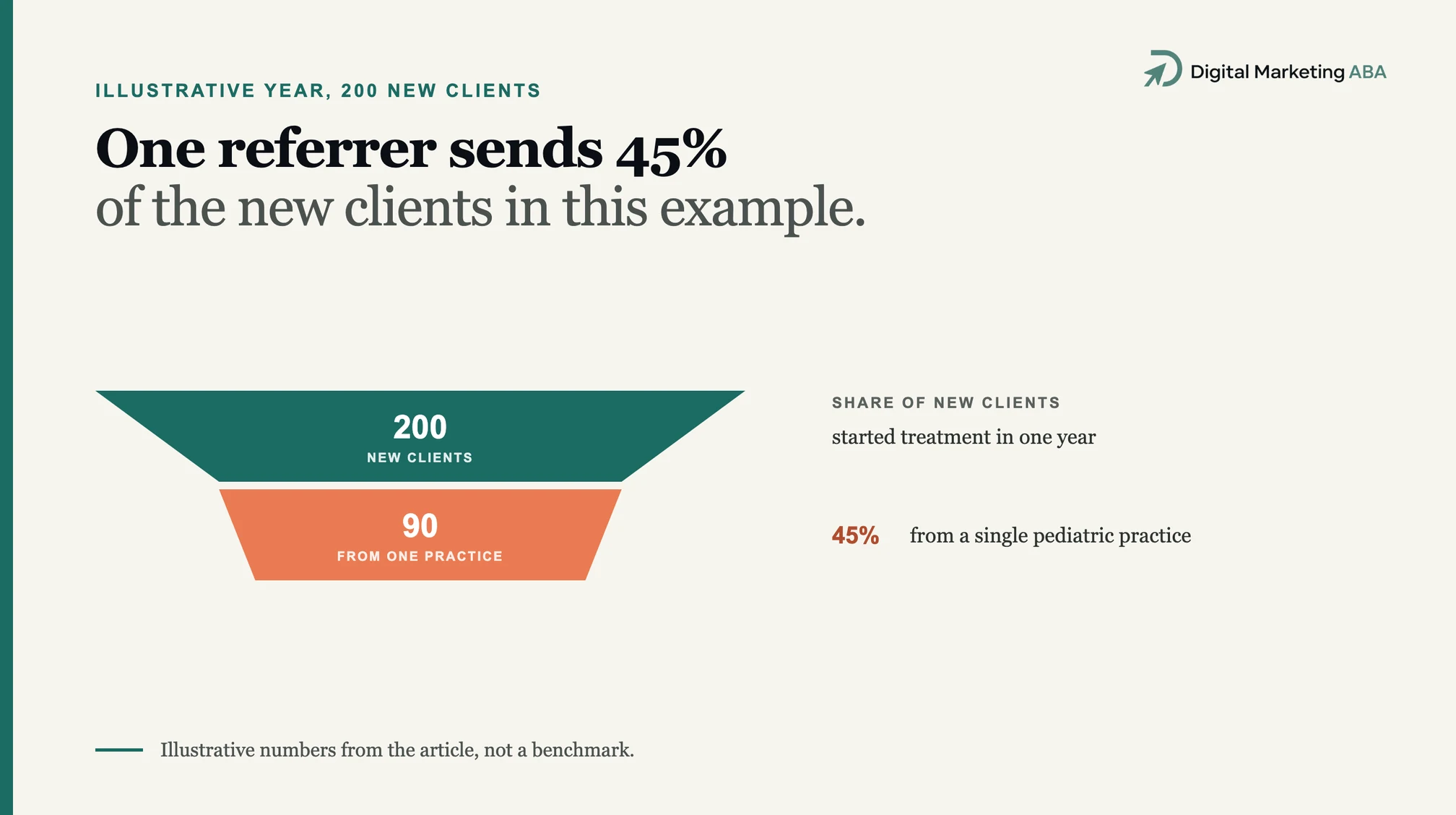
Here is an illustrative example. A company starts 200 new clients in a year, and 90 of them came from one pediatric practice. That single referrer is 45% of new clients. If that practice changes its referral habits, retires or joins a health system, growth slows, and a buyer will price that in.
The arithmetic is simple once each intake record names its referrer: count new clients per referring practice for the last 12 months and divide by all new clients. Keep the list by clinic as well, because one clinic can depend on a single practice even when the company as a whole does not.
The fix is the same as with payers: widen the base before you need to. Our guide to ABA referrals from pediatricians covers building more physician relationships, and the same tracking shows schools, therapists and digital channels side by side.
What buyers ask about client acquisition cost
Whether growth can be bought at a known price. Marketing spend divided by started clients, by source and by clinic, answers that, and a steady or falling trend over two years is easier to believe than one good quarter.
Most owners can produce spend. Fewer can produce starts by original source, because the source was never stored in the intake record. The marketing KPIs ABA owners should track set out a monthly page that builds this history as you go.
Show the blended figure and the split. A blended cost per start can look stable while one source gets more expensive every quarter and another quietly carries the growth. Splitting by clinic matters too: a buyer weighing a new market will want to know what it cost to fill your most recent clinic, not your oldest one.
Why intake conversion supports the growth story
A growth plan says more families will start. Intake data shows whether the company can turn demand into starts today, and at which clinics it cannot.
Keep monthly counts of inquiries, qualified inquiries and starts per clinic, plus speed to first response. If one clinic converts far below the others because of staffing or payers, say so and show the plan. ABA patient acquisition from inquiry to first session lists the steps worth counting.
Free website visibility check
Get your free visibility check.
Share your name, website, and email. We will inspect your public homepage and email your human-reviewed score and three priorities.
- See where qualified search demand may be leaking
- Reviewed by a person before it reaches your inbox
- No patient or clinical information requested
Does online reputation affect a sale
Reviews are public, so a buyer can read them without asking. What matters is the count and rating per clinic, the trend, and whether reviews were collected in a way that holds up.
That last point has federal rules behind it. On August 14, 2024 the FTC announced a final rule banning fake reviews and testimonials (opens in a new tab). Among other things it bars fake reviews, buying reviews that must express a particular sentiment, insider reviews without a clear disclosure, and suppressing negative reviews through threats or intimidation. A review program that breaks those rules is a liability that transfers with the company. How ABA clinics get more Google reviews covers asking families in a way that stays inside the rules.
Who owns your marketing accounts
The company should, and the records should show it. The website, the domain, the ad accounts, analytics, call tracking and every Google Business Profile are assets a buyer expects to receive on closing day.
Fix gaps early. Google's help page on transferring primary ownership of a Business Profile (opens in a new tab) says only the primary owner can transfer primary ownership, and that a new owner or manager must wait 7 days before they can manage all features. If a former employee or an agency is the primary owner of a clinic's profile, that is a task to finish long before a sale.
The same goes for ad and analytics accounts opened under an agency's login. Our checklist for choosing an ABA marketing agency includes asking who owns the accounts.
What to keep in a marketing data room
Keep it current, not assembled in a rush. For what founders actually received in roll-up deals, Breaking News ABA's report What ABA Founders Who Sold to Roll-Ups Actually Got (opens in a new tab) is worth reading alongside your CFO's advice.
- Monthly inquiries, qualified inquiries and starts by source and clinic, for at least 24 months.
- Marketing spend by source and clinic for the same months.
- New clients by referring practice, with each referrer's share.
- Review count and rating per clinic by month, and the written review request process.
- A list of every marketing account, its owner of record and who has admin access.
What to do this year
- Confirm the company is the owner of record on the domain, website, ad accounts and every Business Profile.
- Add a required source field and a referrer field to every intake record.
- Calculate each referrer's share of new clients for the last 12 months.
- Start a monthly report of inquiries, starts and cost per start by source and clinic.
- Review how reviews are requested against the FTC rule, with counsel if in doubt.
Sources
My ABA CFO, Getting Sale-Ready (opens in a new tab) (November 12, 2026) - price as profit times a multiple, the $1 million illustration, quality of earnings and 24 to 36 months of accrual results.
My ABA CFO, One Payer, Too Much Power (opens in a new tab) (November 12, 2026) - concentration as an early buyer check.
Federal Trade Commission, Final Rule Banning Fake Reviews and Testimonials (opens in a new tab) (August 14, 2024) - prohibited review practices. Primary government source.
Google Business Profile Help, Transfer primary ownership of a Business Profile (opens in a new tab) (read November 16, 2026) - who can transfer ownership and the 7-day wait.
Frequently asked questions
How is an ABA practice valued?
In simple terms, profit times a multiple. A buyer rebuilds profit through a quality of earnings review, and lower risk supports a higher multiple. In My ABA CFO's illustration, $1 million of profit sells for $6M at six times and $7M at seven times.
Does marketing data affect ABA practice valuation?
Mostly as evidence for growth and as a source of risk. Buyers want to know where new clients come from, what they cost and whether that will continue, which referral, cost and intake data can show.
Is relying on one referral source a problem when selling?
It can be. In the article's illustrative example, one pediatric practice sends 90 of 200 new clients, or 45%. If that practice changes its habits, growth slows, and a buyer will weigh that.
Do online reviews matter in an ABA sale?
Yes, because buyers can read them and because review practices carry legal risk. The FTC's 2024 final rule bans fake reviews, buying reviews with a required sentiment, undisclosed insider reviews and review suppression.
Who should own an ABA company's marketing accounts?
The company. The website, domain, ad accounts, analytics and Google Business Profiles should list the company as owner. On Google Business Profile, only the primary owner can transfer primary ownership.
Keep reading
- Independent ABA ClinicsHow Independent ABA Clinics Beat Corporate Centers
Independent ABA clinics can beat larger chains on intake speed, clinical continuity, local referrals and honest wait times. How to position a multi-site firm.
- AgencyChoosing an ABA Marketing Agency? Ask These 10 Questions First
How to choose an ABA marketing agency: 10 questions on reporting, HIPAA and tracking, account ownership, contract terms and ABA know-how to ask any agency.
- ABA ReferralsHow to Earn ABA Referrals From Pediatricians, and Keep Them Coming
How ABA companies earn ABA referrals from pediatricians, schools, OTs and SLPs, and keep them. What referrers need, outreach cadence and tracking by source.
Growth a buyer can verify
Could you show two years of cost per client by source?
We help multi-clinic ABA companies build tracking, reporting and account ownership that hold up when someone else reads the numbers.