
How to Get More Google Reviews From ABA Families, the Right Way
Working out how to get more Google reviews is different for an ABA clinic. Your client is usually a child, the person who can review you is a parent, and a careless reply can disclose health information. Here is who to ask, when to ask, what Google and the FTC prohibit, and how to answer reviews without confirming that anyone is a client.
By Digital Marketing ABA
Published
How to get more Google reviews for ABA
Ask caregivers directly, at moments of real progress, with a link to the right clinic's profile, and ask every family the same way. Google allows businesses to ask for reviews. It does not allow incentives, and it does not allow asking only the families you expect to be happy.
Reviews sit on each clinic's Google Business Profile, which is half of local visibility for a multi-clinic group, as we set out in local SEO for multi-clinic ABA practices. A profile with few or old reviews is also what a parent sees when comparing you with the provider down the road.
Ask caregivers, not clients
In ABA the person receiving services is often a young child. The parent or guardian is the one who sat through intake, juggles the schedule, attends parent training and reads the progress reports, so they are the reviewer you want and the one who can speak to the experience.
Do not ask staff. Google treats reviews based on a conflict of interest, including current or former employment, as rating manipulation and removes them. That covers RBTs and BCBAs reviewing their own clinic. Under the FTC's rule, an insider review also needs a clear disclosure of the relationship.
Do not ask families to mention their RBT or BCBA by name either. Google's policy says businesses should not request that specific content be included in a review, and names content that identifies a staff member as an example.
When to ask for a review
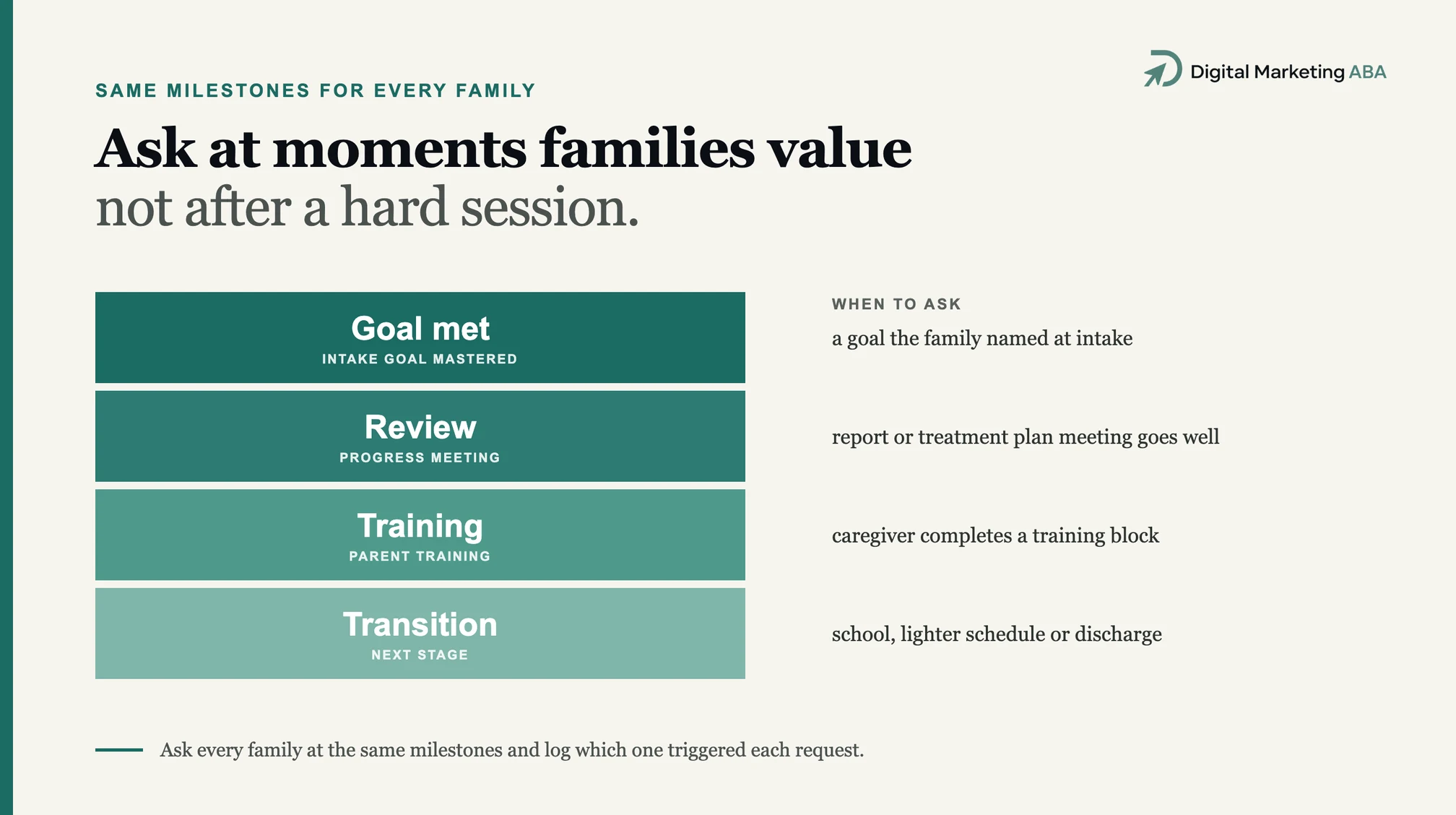
Ask at a milestone the family cares about, not at the end of a hard session or in the middle of an authorization dispute. Then ask every family at the same milestones, so you are not choosing who gets asked based on how you think they feel.
Log which milestone triggered each request. After a few months you will see which moments produce reviews and which do not, clinic by clinic.
- A goal the family named at intake is mastered.
- A progress report or treatment plan review meeting goes well.
- The caregiver completes a parent training block.
- The child moves to school, a lighter schedule or discharge.
Send the request after the visit
Google's policy says businesses should not require or pressure people to leave ratings or reviews while on the premises. Handing a parent a tablet in the lobby fails that test. A short text or email after the meeting, with one link, does not.
Keep the message short and neutral. For example: thank you for being part of our clinic this year, and if you have a minute, we would value a Google review of your experience, followed by the link. It names no goal, no staff member and no star rating, and every family gets the same wording.
Google's own tips page says you can ask customers to visit a Google link or scan a QR code to leave a review. Each clinic's profile has its own, so a family at your north clinic should never get the south clinic's link. Store the links in your scheduling or CRM tool by location so the front desk cannot mix them up.
A review-request tool that receives your families' names and phone numbers is handling information about who your clients are. Ask the vendor whether it will sign a business associate agreement, and check it against the questions in HIPAA compliant marketing for ABA clinics.
What Google and the FTC prohibit
Google's Maps content policy (opens in a new tab) and the FTC's rule on consumer reviews (opens in a new tab) overlap, and Google's policy is the stricter of the two on incentives. For Google reviews, follow Google's.
The FTC's rule, at 16 CFR Part 465, took effect on October 21, 2024. Announced on August 14, 2024, it bans fake reviews and testimonials, buying reviews on the condition that they are positive or negative, undisclosed insider reviews, and suppressing reviews through threats or intimidation. It lets the FTC seek civil penalties against knowing violators. FTC staff note the rule has no specific ban on asking only happy customers, but say the practice could violate the FTC Act.
- No incentives: Google prohibits payment, discounts, free goods or services in exchange for posting any review, or for revising or removing a negative one. A gift card raffle for reviewers is out, even if any rating is welcome.
- No review gating: Google prohibits discouraging negative reviews or selectively soliciting positive ones. A satisfaction survey that sends only happy parents to Google is selective soliciting.
- No staff quotas: Google lists businesses asking staff to solicit a certain number of reviews as a violation.
- No insider reviews: employees, former employees and contractors should not review the clinic.
Free website visibility check
Get your free visibility check.
Share your name, website, and email. We will inspect your public homepage and email your human-reviewed score and three priorities.
- See where qualified search demand may be leaking
- Reviewed by a person before it reaches your inbox
- No patient or clinical information requested
Replying to reviews without disclosing PHI
Write every reply so it would be equally true if the reviewer had never been a client. Do not confirm they are a client, and do not mention their child, services, schedule, insurance or anything from the record, even to correct something unfair.
In June 2023, HHS's Office for Civil Rights announced a $30,000 settlement with Manasa Health Center (opens in a new tab), a New Jersey practice providing adult and child psychiatric services. OCR said the practice posted a reply to a patient's negative online review that included information about the patient's diagnosis and treatment, and that it had disclosed the PHI of three other patients in replies to their reviews. OCR's director said simply that "this is not allowed."
Decide who replies before the next review lands. One trained person per region, working from approved wording, is safer than every clinic director writing their own. Send every negative review to the clinic director first, so the family can be contacted privately before anything is posted.
Google's tips page asks for replies that are short, relevant and professional, without promotional offers. Two examples that confirm nothing:
- Positive: Thank you for taking the time to write this. Our team works hard to make every family feel supported.
- Negative: We take every concern seriously. Privacy rules mean we cannot discuss anyone's care online, and we would welcome a call with our clinic director at the number on this profile.
- Never: a child's name, a goal, a diagnosis, a session detail, an insurance issue, or a line like "as we discussed at your intake."
How many reviews a steady ask produces
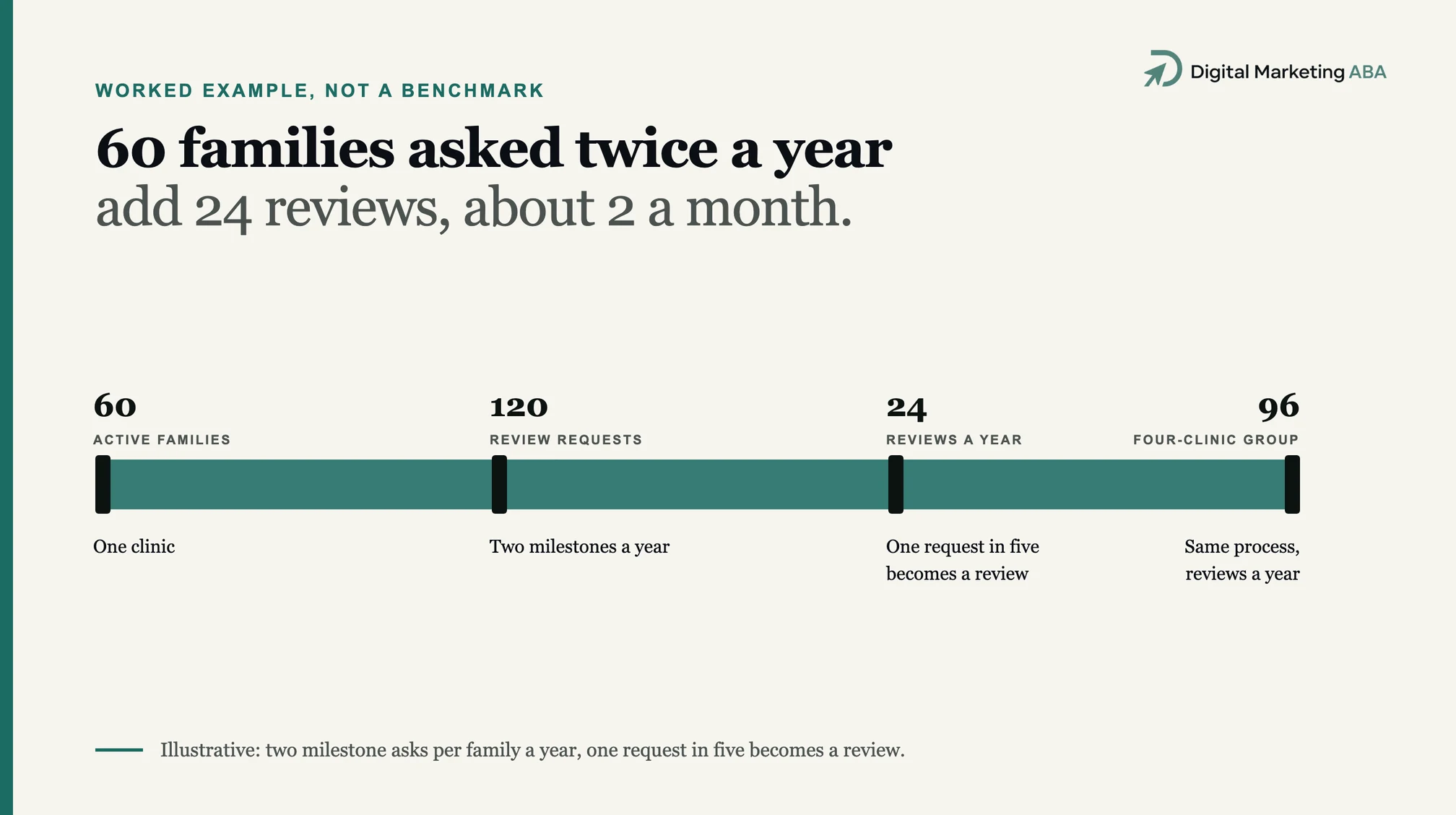
Here is a worked example, with assumptions stated, not a benchmark. Take a clinic with 60 active families, each asked at two milestones a year. That is 120 requests. If one request in five turns into a review, the clinic gains 24 reviews a year, about 2 a month. A four-clinic group running the same process gains 96.
Swap in your own family count and response rate. The point is that a fixed process beats a one-off push, and it is easy to report by clinic. Review volume and replies are part of our Reputation Management service, and reviews do their work at the moment a parent compares providers during ABA intake.
What to do this week
Five steps for each clinic.
- Create the review link or QR code for every clinic profile and store it by location.
- Pick two or three milestones and add a review request to each, for every family.
- Remove any incentive, staff quota or satisfaction-survey gate from the current process.
- Write two approved reply templates and name one trained person per region to post replies.
- Route every negative review to the clinic director before anyone replies.
Sources
Prohibited and restricted content, Maps User Generated Content Policy (opens in a new tab) (Google). Platform policy on fake engagement, incentives, rating manipulation and conflicts of interest.
Tips to get more reviews (opens in a new tab) (Google Business Profile Help). Review links, QR codes and reply guidance.
Federal Trade Commission Announces Final Rule Banning Fake Reviews and Testimonials (opens in a new tab) (FTC press release, August 14, 2024). Federal rule.
The Consumer Reviews and Testimonials Rule: Questions and Answers (opens in a new tab) (FTC business guidance). Staff guidance on incentives, insider reviews and review gating.
HHS Office for Civil Rights Reaches Agreement with Health Care Provider in New Jersey That Disclosed Patient Information in Response to Negative Online Reviews (opens in a new tab) (HHS Office for Civil Rights, June 5, 2023). Enforcement settlement.
Frequently asked questions
Can an ABA clinic offer a gift card for Google reviews?
No. Google prohibits incentives such as payment, discounts, free goods or services in exchange for posting any review, even when any rating is welcome.
Is review gating allowed on Google?
No. Google prohibits discouraging negative reviews or selectively soliciting positive ones. FTC staff say its review rule has no specific ban on the practice but that it could violate the FTC Act. Ask every family the same way.
Can our RBTs and BCBAs review the clinic?
They should not. Google treats reviews based on a conflict of interest, including current or former employment, as rating manipulation and removes them. The FTC's rule also requires insider reviews to disclose the relationship clearly.
How should we reply to a negative review from a parent?
Do not confirm they are a client or discuss care. Thank them, say you cannot discuss anyone's care online, and offer a direct contact. In 2023, OCR settled with a psychiatric practice for $30,000 over review replies that disclosed patient information.
Who should an ABA clinic ask for reviews?
Parents and guardians, since the client is often a young child. Ask every family at the same milestones, after the visit, with the link for their own clinic.
Keep reading
- Google Business ProfileGoogle Business Profile Suspended? How to Fix It
Google Business Profile suspended? Why ABA clinic listings get suspended, how Google's one-time appeal works, and how to keep every clinic's profile safe.
- Scaling an ABA PracticeScaling an ABA Practice With a New Clinic Launch Plan
Scaling an ABA practice means a new clinic families can find on day one. A launch plan for payers, Google Business Profile, hiring and referral outreach.
- Local SEOLocal SEO for Multi-Clinic ABA Practices: A Location-Page Playbook
Location pages, Google Business Profiles, and NAP consistency for ABA groups with multiple clinics - how to rank in every service area you actually operate in.
Reputation Management
Want a steady flow of reviews at every clinic?
We help multi-clinic ABA companies set up per-location review requests, reply guidelines that keep PHI out, and reporting by clinic.