
How Independent ABA Clinics Beat Corporate Centers
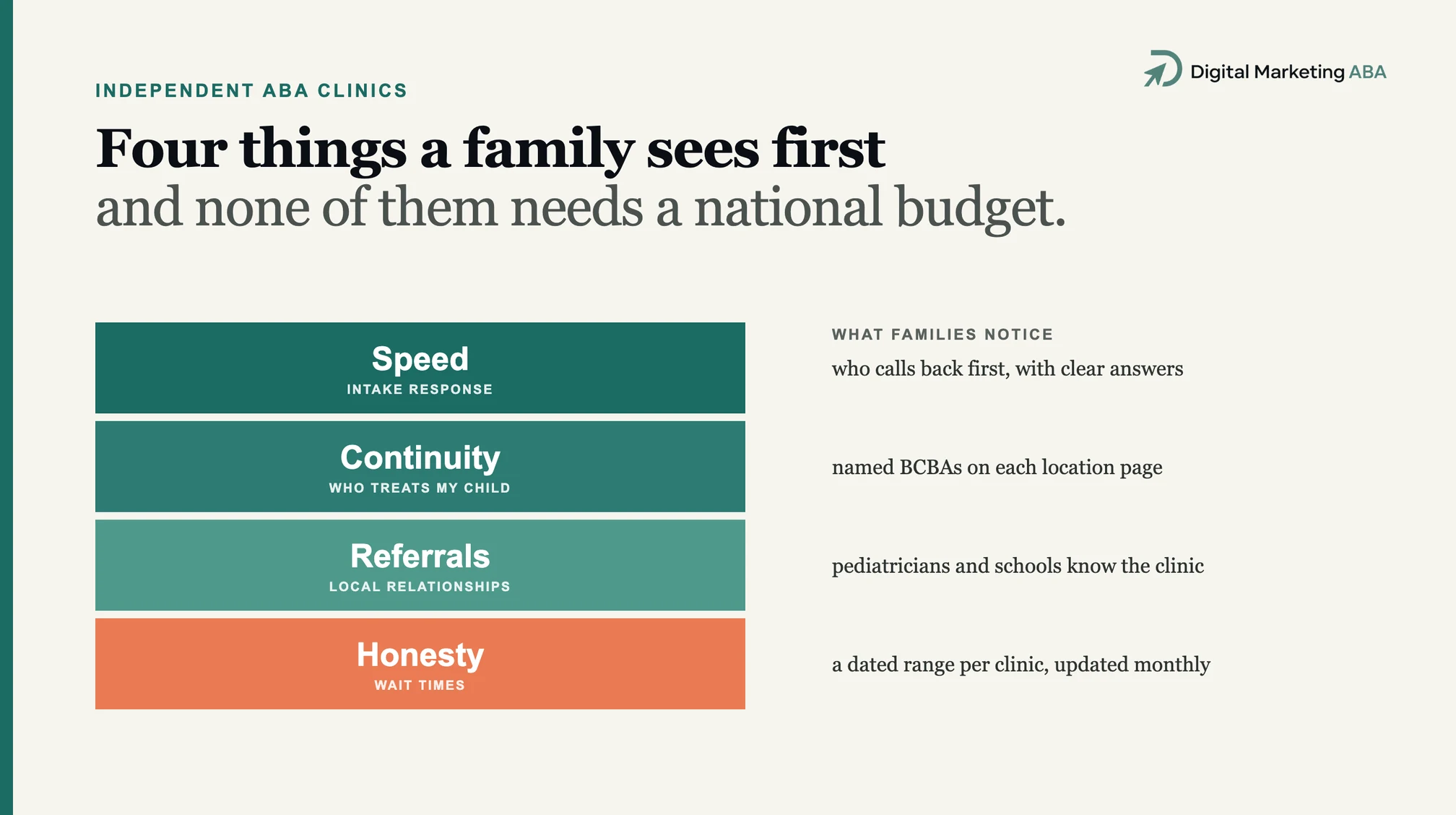
Independent ABA clinics now compete in many markets with centers owned by private equity-backed companies, which bring bigger budgets and regional brands. Budget is not where an independent multi-site owner wins. Families choose on how fast someone calls back, who will treat their child, whether their pediatrician knows you, and how honest you are about the wait. Here is how to compete on those four, without saying a word against anyone else.
By Digital Marketing ABA
Published
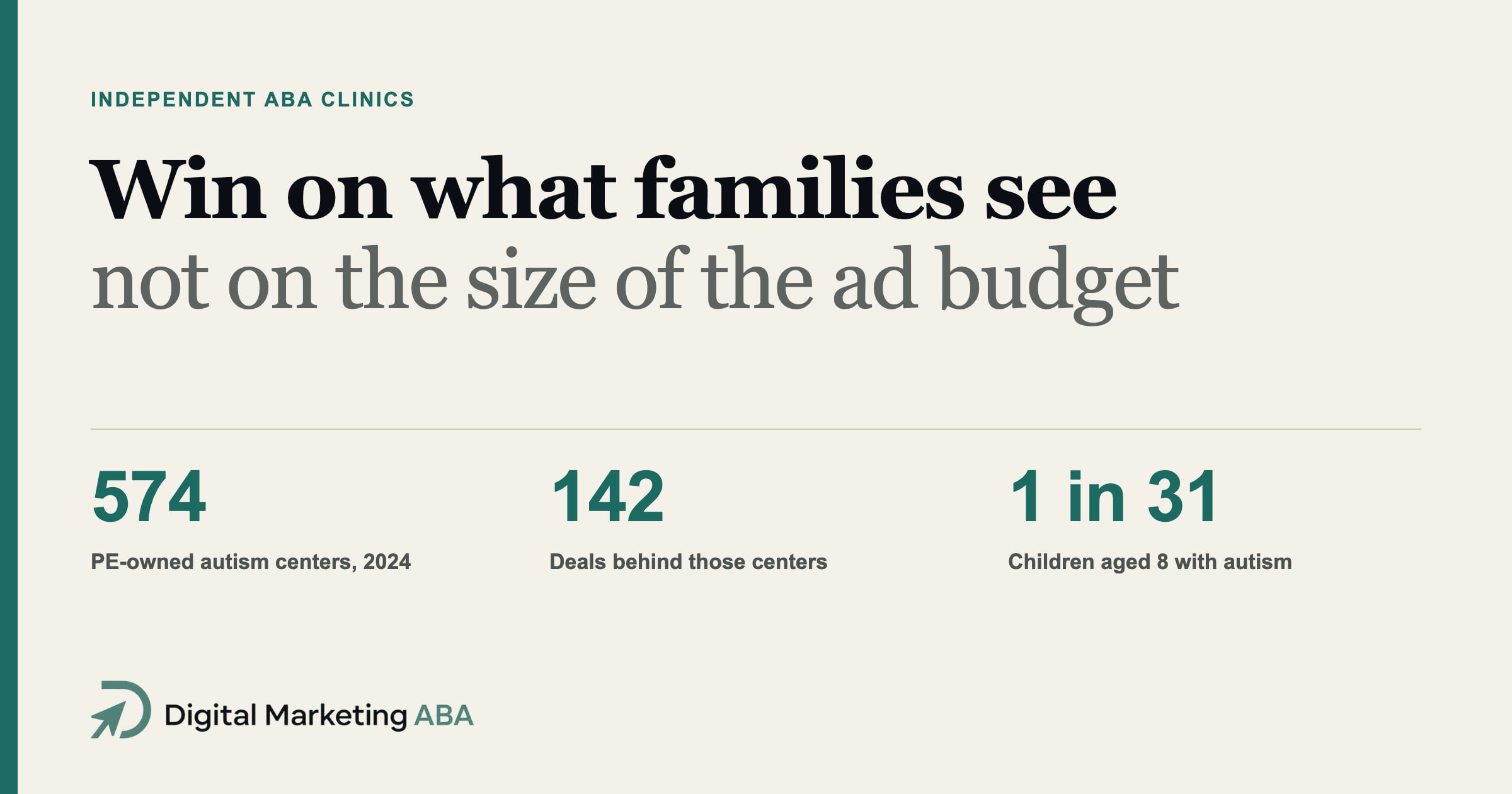
- 574
- Private equity-owned autism therapy centers in 42 states as of 2024 (Arnold, Singh et al., JAMA Pediatrics, 2026)
- 1 in 31
- Estimated autism prevalence among 8-year-olds in 2022, CDC ADDM Network, 16 sites
How many ABA centers does private equity own?
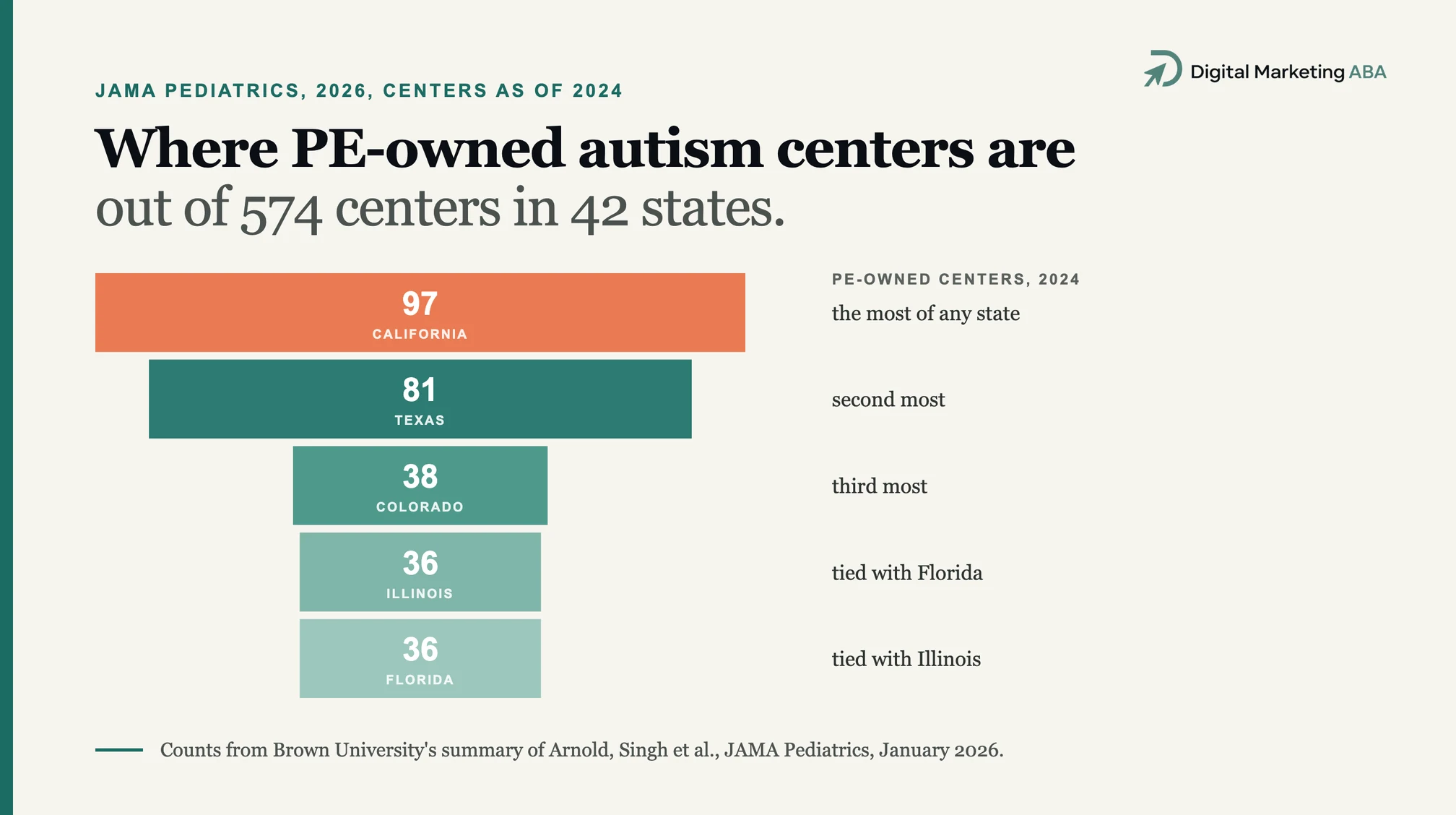
The best public count is recent. A research letter in JAMA Pediatrics (opens in a new tab), Private Equity in Autism Services by Daniel Arnold, Yashaswini Singh and colleagues, was published online on January 5, 2026. Brown University's summary of the study (opens in a new tab) reports 574 private equity-owned autism therapy centers in 42 states as of 2024, the result of 142 separate deals, with most acquired between 2018 and 2022.
The release names the states with the most: California (97), Texas (81), Colorado (38), Illinois (36) and Florida (36). It also reports that states in the top third for childhood autism prevalence were 24% more likely to have private equity-owned clinics than other states.
What the study does not show matters as much. The authors say they are seeking funding to study effects such as therapy intensity and treatment duration, so the paper does not tell anyone whether ownership changes the quality of care. It does confirm that in several states an independent owner is competing against well-funded neighbors.
Breaking News ABA covered the study in Private equity acquires over 500 autism centers in ten years (opens in a new tab).
Why demand leaves room for independent ABA clinics
This is not a fight over a shrinking pool of families. The CDC's Autism and Developmental Disabilities Monitoring Network (opens in a new tab) estimated autism prevalence at 32.2 per 1,000 children aged 8 in 2022, about 1 in 31, across 16 sites (MMWR, April 17, 2025).
For an owner, the question is less whether families need services and more why a given family picks you over the next name in the search results. That decision rests on four things a family can see in the first week, and none of them needs a national budget.
Compete on speed of intake
Speed is the first thing a family experiences. A parent with a new diagnosis can contact several providers in one evening, and the first to call back with clear answers on insurance and timing sets the standard for the rest.
An independent company can make decisions in the building. The clinic director can approve a schedule or an assessment slot without waiting on a regional office. Use that, and measure it so you can prove it.
- Track median time from inquiry to first live contact, by clinic and by source.
- Track the share of inquiries reached within one business day.
- Cover evenings and weekends, because forms keep arriving after Friday.
Make clinical continuity visible to parents
Parents worry about who will actually work with their child and whether that person will still be there in six months. An independent owner can answer that with names and faces.
Put the clinical director and the BCBAs on each location page, with their credentials and the ages they work with. Explain in plain words how a family is told about a staffing change and how the supervising BCBA stays involved. Do not promise a ratio or tenure you cannot keep at every clinic.
Own the local referral relationships
Pediatricians, school teams, occupational therapists and speech-language pathologists refer families to people they know and trust. A clinic director who visits, calls back and sends a short update after an assessment builds that trust in a way a national brand cannot buy.
Treat referral sources as a pipeline per clinic, with an owner, a contact list and a monthly count of referrals by source. Getting ABA referrals from pediatricians covers the outreach step by step.
Be honest about wait times
A family who is told "a few weeks" and waits four months does not come back, and may tell others. A family told an honest range can plan around it.
Publish an expected wait range for each clinic, by service where it differs, with the date it was last updated, and update it monthly. Tie it to the real list, not to hope. ABA waitlist management explains how to clean the list so the number you publish is true.
Free website visibility check
Get your free visibility check.
Share your name, website, and email. We will inspect your public homepage and email your human-reviewed score and three priorities.
- See where qualified search demand may be leaking
- Reviewed by a person before it reaches your inbox
- No patient or clinical information requested
Let parent reviews carry the local story
Families read reviews to answer the same four questions: did someone call back, who worked with my child, did they know our pediatrician, and was the wait what they said. Reviews that mention a clinic director or BCBA by role, a school team or a quick start are the evidence an independent clinic needs, in the parents' own words.
Ask every family at set milestones, such as the first month of treatment and the first progress meeting, and answer every review without confirming that the reviewer is a client. How ABA clinics get more Google reviews covers the request process and the privacy rules for replies.
Keep each clinic's reviews on its own Google Business Profile. A family choosing between two clinics in the same town is comparing those two profiles, not your company's average.
Compare yourself without naming anyone
The temptation is to position against "the big chains." Resist it. The FTC's Statement of Policy Regarding Comparative Advertising (opens in a new tab) (1979) says the Commission evaluates comparative advertising in the same manner as any other advertising, and the question is whether it has a tendency or capacity to be false or deceptive.
For an ABA company the safer and more persuasive route is to make specific claims about yourself that your own records support. "Most families hear from us within one business day" is checkable. "Unlike corporate centers, we care" is neither checkable nor kind, and the research above does not support it. Have counsel review any comparative claim before it runs.
An example of a claim you can prove
This is illustrative arithmetic, not a benchmark. Suppose your intake log shows 450 inquiries last quarter, and 412 of them reached a live person within one business day.
412 divided by 450 is 0.9156, or 91.6%. That supports a line on the website such as "more than 9 in 10 families hear back within one business day," with the quarter it covers. If next quarter the share drops, the claim changes. A claim tied to a log is one you can defend to a parent, a referral source or a regulator.
The same logs feed the rest of the funnel. ABA patient acquisition shows how response speed carries through to starts.
What to do this week
- Pull last quarter's inquiries and calculate the share reached within one business day, by clinic.
- Add the clinical director and BCBAs to every location page.
- Publish a dated wait-time range for each clinic.
- Name one owner for referral relationships at each clinic and start a monthly count.
- Remove any website or ad copy that compares you to unnamed chains without evidence.
Sources
Arnold, Reddy, Cantor, McBain, Yu, Whaley and Singh, Private Equity in Autism Services (opens in a new tab) (JAMA Pediatrics, published online January 5, 2026) - peer-reviewed research letter.
Brown University, Private equity firms acquired more than 500 autism centers in past decade, study shows (opens in a new tab) (January 7, 2026) - the study's center, deal and state counts.
CDC, Prevalence and Early Identification of Autism Spectrum Disorder Among Children Aged 4 and 8 Years (opens in a new tab) (MMWR Surveillance Summaries 74(2), April 17, 2025). Primary government source.
FTC, Statement of Policy Regarding Comparative Advertising (opens in a new tab) (August 13, 1979). Primary government source.
Frequently asked questions
How many ABA centers are owned by private equity?
A JAMA Pediatrics study published in January 2026 identified 574 private equity-owned autism therapy centers in 42 states as of 2024, from 142 deals, according to Brown University's summary. Most were acquired between 2018 and 2022.
Is care worse at private equity-owned ABA centers?
The study did not measure that. Its authors say they are seeking funding to study effects such as therapy intensity and treatment duration, so there is no basis in this research for claiming one ownership model gives worse care.
How can an independent ABA clinic compete with larger chains?
On things families see in the first week: how fast intake calls back, who will treat their child, whether local referral sources know the clinic, and how honest the clinic is about wait times. Measure each so you can prove it.
Can an ABA clinic compare itself to competitors in ads?
The FTC evaluates comparative advertising like any other advertising, asking whether it tends to be false or deceptive. Specific claims about your own service that your records support are safer and more persuasive. Have counsel review any comparative claim.
Keep reading
- ValuationHow Marketing Data Shapes ABA Practice Valuation
How marketing data shapes ABA practice valuation: referral concentration, cost per client, intake conversion, reviews and who owns your accounts and website.
- School DistrictsHow to Win School-Based ABA Contracts
School-based ABA contracts start with the IEP. How districts buy ABA services, getting on vendor lists, who to contact and what a capability statement needs.
- ABA Insurance CredentialingABA Insurance Credentialing and How to Plan Around It
ABA insurance credentialing can hold a new BCBA or clinic out of network for months. What sets the timeline, state deadlines and how to plan your marketing.
Compete on what families notice
Make your clinics the obvious local choice
We help independent multi-clinic ABA companies measure intake speed, publish honest location pages and build referral relationships clinic by clinic.