
ABA Patient Acquisition Is Won or Lost Before the First Session
ABA patient acquisition does not end when a family fills in a form. It ends at the first billed session, often months later, after an intake call, a benefits check, two authorizations and a staffing match. Every one of those steps loses families. Here is the funnel step by step, what to measure at each stage, and example arithmetic showing why a faster intake can matter as much as a bigger ad budget.
By Digital Marketing ABA
Published
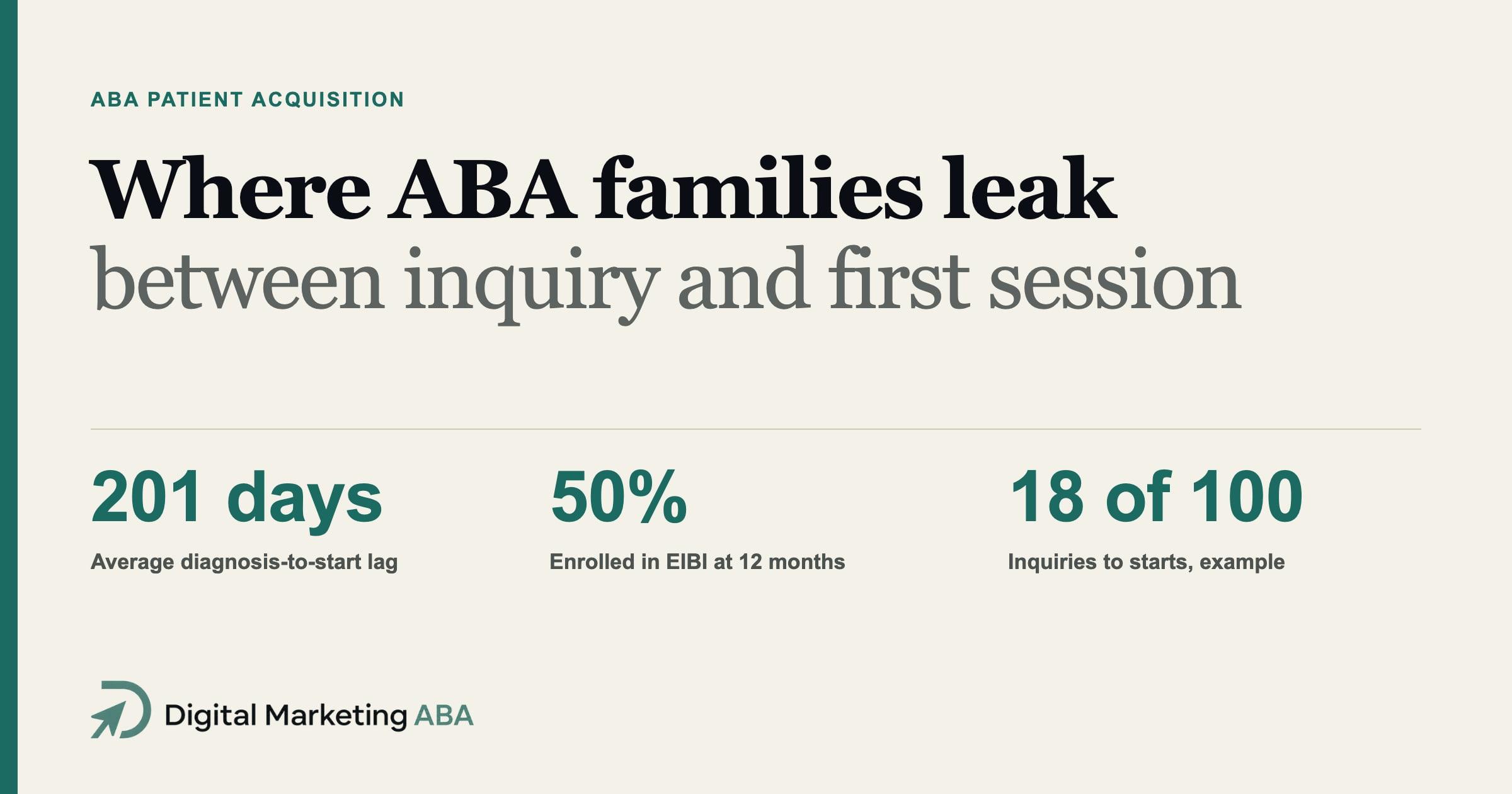
- 201 days
- Average lag from autism diagnosis to EIBI enrollment, among children who enrolled (Saunders et al., Research in Autism, 2025)
- 7 days
- Standard prior authorization decision deadline for CMS-impacted payers, generally from January 1, 2026
What ABA patient acquisition really measures
ABA patient acquisition is the whole path from a family's first inquiry to the first session you can bill. Marketing reports usually stop at the inquiry. The number an owner needs is starts: families who actually begin treatment.
The gap between the two is long and run by different people. In a 2025 brief report in Research in Autism (opens in a new tab), Saunders and colleagues followed 76 young children diagnosed with autism in primary care. More than 80% were referred for early intensive behavioral intervention at diagnosis, yet only 50% were enrolled 12 months later. For those who did enroll, the lag averaged 201 days. The study tracked families, not any one provider, but it shows how much is lost between a referral and a first session.
The nine steps from inquiry to first session
Most multi-clinic ABA companies run some version of the same sequence. Naming each step lets you count how many families enter it and how many leave.
- Inquiry. A call, form, chat or referral arrives, tagged by source.
- Response. Someone from intake makes live contact with the family.
- Intake call. Age, location, diagnosis status, schedule and payer are checked against what the clinic offers.
- Insurance verification. Benefits, network status and prior authorization rules are confirmed.
- Assessment authorization. Where the payer requires it, approval for the assessment is requested.
- Assessment. A BCBA completes the behavior identification assessment.
- Treatment authorization. The treatment plan and requested hours go to the payer.
- Staffing. A BCBA and RBTs with matching availability are assigned.
- Start. The first treatment session is delivered and billed.
Which code covers the ABA assessment?
The assessment step is usually billed under CPT 97151. The ABA Coding Coalition's code descriptors (opens in a new tab) describe 97151 as a behavior identification assessment administered by a physician or other qualified health care professional, counted in 15-minute units of that professional's face-to-face time with the patient and caregivers. Technician support during assessment has its own code, 97152.
The Coalition's page lists the code set as taking effect January 1, 2027, and the AMA has revised the adaptive behavior code set for 2027. Check the Coalition's current guidance and your payer contracts before you change any billing workflow.
How fast should ABA intake respond?
As fast as you can staff for, and measured rather than guessed. We found no published ABA benchmark for response time, so the useful target is your own median time to first live contact, by source, tracked weekly.
The best-known research on the question comes from general sales, not healthcare. In The Short Life of Online Sales Leads (opens in a new tab) (Harvard Business Review, March 2011), James Oldroyd, Kristina McElheran and David Elkington wrote that most companies are "not responding nearly fast enough" to online inquiries. Treat that as a direction, not an ABA statistic.
For an ABA company the logic is plain. A parent with a new diagnosis can contact several providers in one evening, and the first to call back with clear answers on insurance and timing sets the comparison for the rest.
Measure two numbers: median business hours from inquiry to first live contact, and the share of inquiries reached within one business hour. Split both by source and by clinic, and include weekends, because forms do not stop on Friday.
How long do ABA authorizations take?
It depends on the payer, so measure it by payer. For some plans there is now a federal clock. Under the CMS Interoperability and Prior Authorization final rule (opens in a new tab), impacted payers must decide standard prior authorization requests within seven calendar days and expedited requests within 72 hours, generally beginning January 1, 2026.
The CMS fact sheet (January 17, 2024) names the impacted payers as Medicare Advantage organizations, Medicaid and CHIP fee-for-service programs, Medicaid managed care plans, CHIP managed care entities and Qualified Health Plan issuers on the federal exchanges, with those exchange issuers excluded from the decision timeframes. Plans outside that list are not bound by these timeframes, and state law may add its own, so ask counsel or your billing lead what applies to each contract.
Also from 2026, impacted payers must give a specific reason when they deny a prior authorization. Log those reasons. A denial that repeats for the same missing document is an intake problem you can fix.
The metric is authorization days: calendar days from a complete submission to a decision, kept separately for the assessment and the treatment request, by payer. A seven-day rule does not help if the request sat incomplete for two weeks first, so also track days from intake call to submission.
Where do ABA leads leak most?
Usually in the hand-offs, not the ads. A family who stalls between steps rarely calls to say so. They simply stop answering.
- Slow first response, so the family books an assessment elsewhere.
- Inquiries counted as leads that never fit the area, age range or payers, which hides the real conversion rate.
- Benefits verified, but nobody explains to the family what it means for their cost.
- Assessment done, while the treatment request waits on a report.
- Treatment authorized, with no BCBA or RBT hours open at that clinic.
Free website visibility check
Get your free visibility check.
Share your name, website, and email. We will inspect your public homepage and email your human-reviewed score and three priorities.
- See where qualified search demand may be leaking
- Reviewed by a person before it reaches your inbox
- No patient or clinical information requested
Why the first and last leaks matter most
The second leak is a definition problem. If inquiries are not marked qualified or not, every rate below them is wrong, which is why we argue for measuring cost per qualified lead instead of cost per click.
The last leak is where marketing meets staffing. When a clinic has no capacity, more ads add families to a list instead of a schedule. ABA waitlist management covers how to match spend to capacity by location, and what it costs to recruit a BCBA puts numbers on the seat that blocks a start.
What 100 ABA inquiries turn into
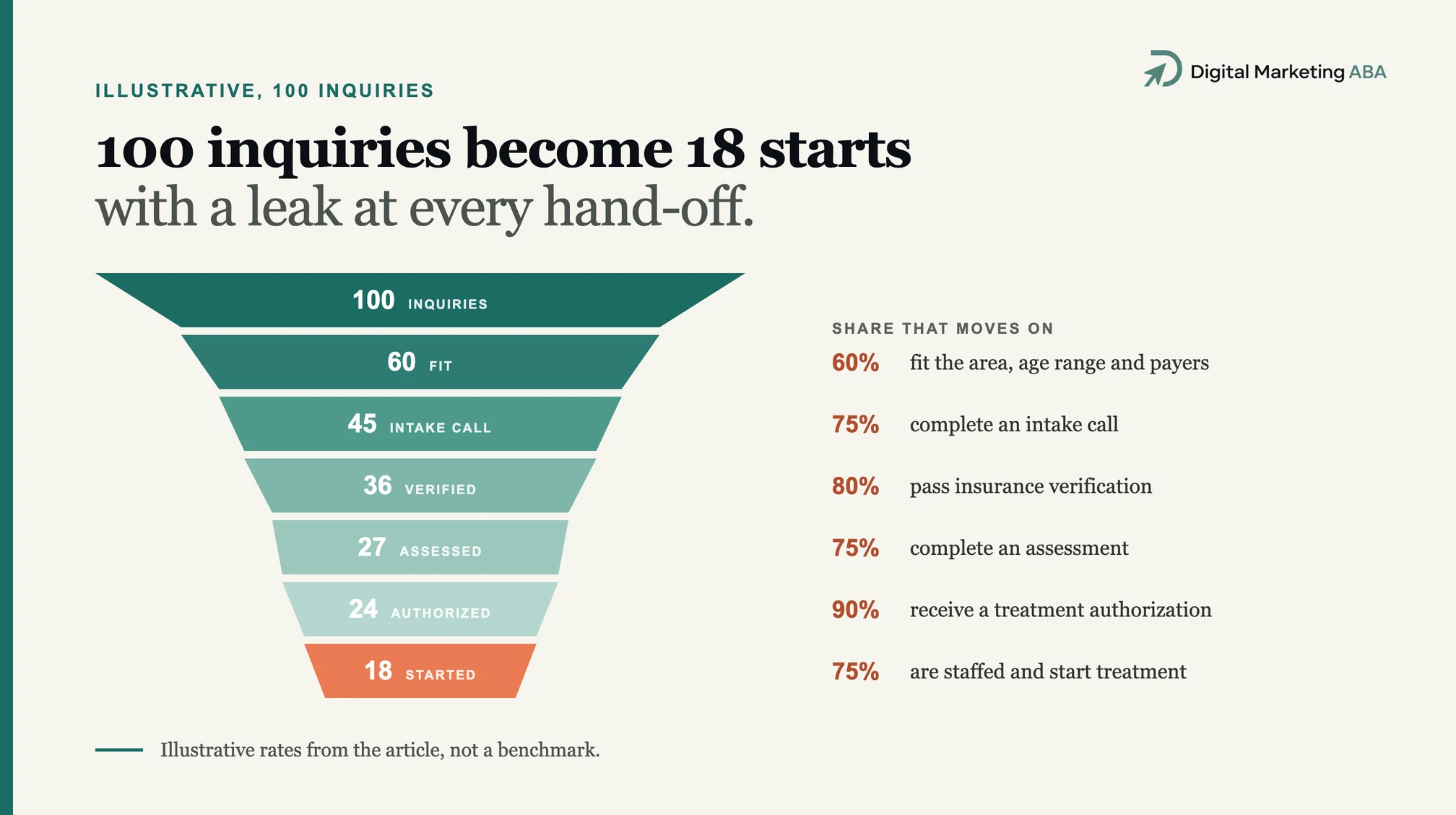
This is illustrative arithmetic, not a benchmark. The rates are assumptions chosen to show how the steps multiply. Replace them with your own.
- 100 inquiries arrive.
- 60 fit the area, age range, services and payers (60%).
- 45 complete an intake call (75%).
- 36 pass insurance verification (80%).
- 27 complete an assessment after authorization (75%).
- 24 receive a treatment authorization (90% of 27 is 24.3, rounded down).
- 18 are staffed and start treatment (75%).
What one faster step is worth
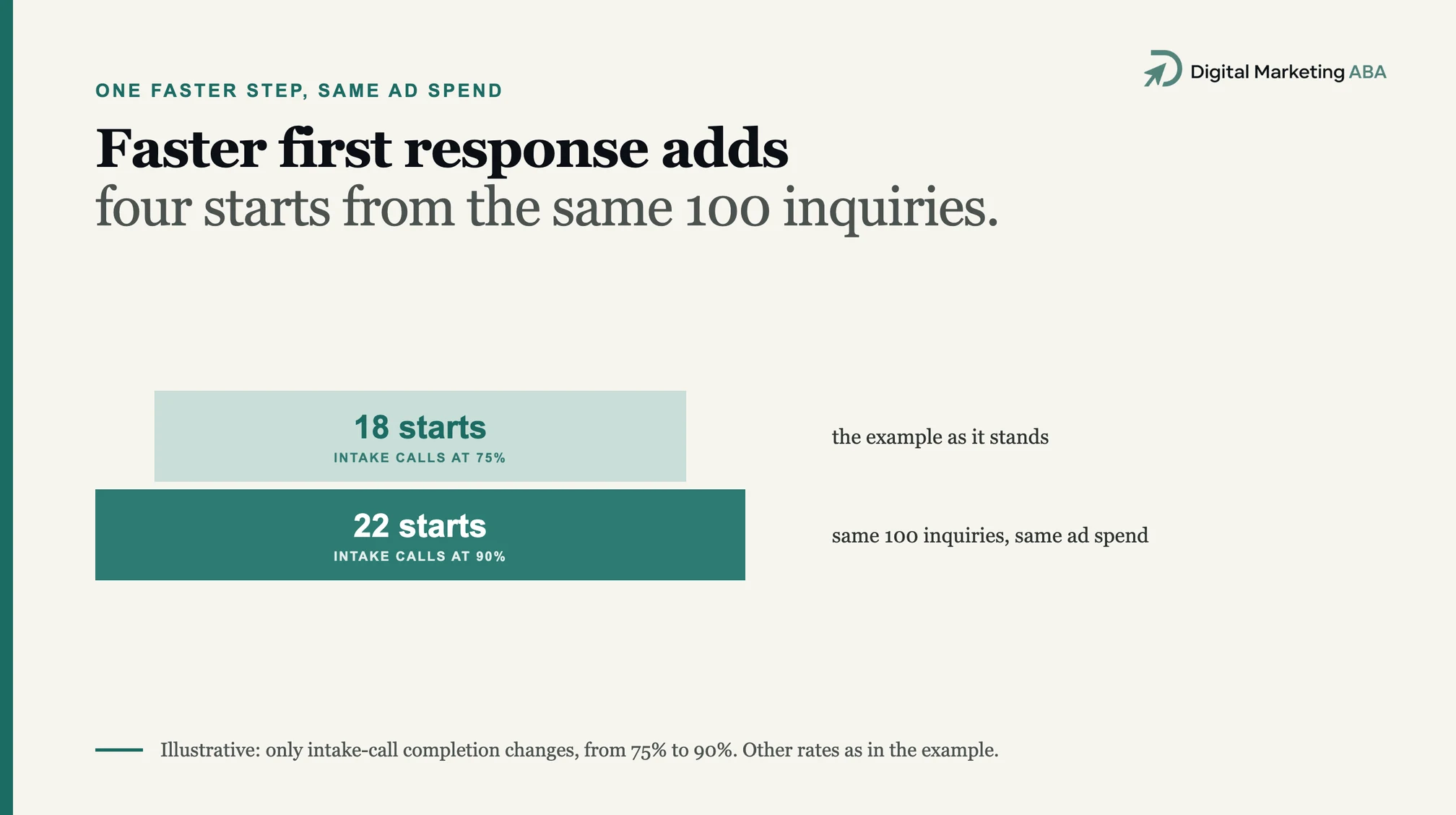
In that example, 18 of 100 inquiries become starts. Now change one rate. If faster first response lifts intake-call completion from 75% to 90%, the chain becomes 0.60 x 0.90 x 0.80 x 0.75 x 0.90 x 0.75, which is 0.2187, or about 22 starts from the same 100 inquiries and the same ad spend. That is four more families from a process change, not a budget change.
This is why the front of the funnel and the back belong in one report. What a qualified ABA lead costs depends on the ad market. What that lead is worth depends on the eight steps after it.
What should an ABA intake coordinator own?
The steps from first response to a complete authorization request, with numbers attached. An ABA intake coordinator turns inquiries into assessments, so the role needs a scorecard, not only a phone line.
- Speed to first response, as a median and as the share reached within one business hour.
- Inquiry-to-assessment rate, by source and by clinic.
- Days from intake call to a complete authorization submission.
- Authorization days and denial reasons, by payer.
- Start rate: authorized families who begin treatment within a set number of days.
What to do this week
- Write the nine steps on one page and name an owner for each.
- Pull the last 90 days of inquiries and count how many reached each step.
- Start logging time to first live contact, including evenings and weekends.
- Add submission and decision dates for both authorizations to your intake tracker, by payer.
- Report starts and cost per start by source each month, next to leads.
Sources
Saunders, Langdon, Paxton, Keehn and Keehn, Service Referral and Enrollment Following Autism Diagnosis in Primary Care (opens in a new tab) (Research in Autism, 2025) - brief report, 76 children aged 14 to 48 months. Peer-reviewed.
CMS, Interoperability and Prior Authorization Final Rule (CMS-0057-F) fact sheet (opens in a new tab) (January 17, 2024) - decision timeframes and denial reasons for impacted payers. Primary government source.
ABA Coding Coalition, code descriptors (opens in a new tab) (read November 16, 2026) - 97151 and 97152 descriptors for the code set effective January 1, 2027.
Oldroyd, McElheran and Elkington, The Short Life of Online Sales Leads (opens in a new tab) (Harvard Business Review, March 2011) - general sales research, not healthcare.
Frequently asked questions
What is ABA patient acquisition?
It is the whole path from a family's first inquiry to the first billed session: response, intake call, insurance verification, assessment authorization, assessment, treatment authorization, staffing and start. Measure it in starts, not leads.
What are the steps in the ABA intake process?
Inquiry, response, intake call, insurance verification, assessment authorization, assessment (usually CPT 97151), treatment authorization, staffing and the first session. Count how many families reach each step so you can see where they drop out.
How fast should an ABA clinic respond to a new inquiry?
There is no published ABA benchmark. Track your median time to first live contact and the share reached within one business hour, by source and clinic. General sales research in Harvard Business Review found most companies were not responding fast enough.
How long does an ABA prior authorization take?
It varies by payer. Under the CMS final rule, impacted payers such as Medicaid managed care and Medicare Advantage plans must decide standard requests within seven calendar days and expedited ones within 72 hours, generally from January 1, 2026. Other plans follow their contracts and state law.
What should an ABA intake coordinator measure?
Speed to first response, inquiry-to-assessment rate, days from intake call to a complete authorization submission, authorization days and denial reasons by payer, and the start rate of authorized families.
Keep reading
- MeasurementQualified Leads in ABA Marketing: Why Cost Per Qualified Lead Beats Cost Per Click
Clicks and form fills don't fill your schedule. Here's how ABA practices should define a qualified lead and measure marketing by cost per qualified lead and downstream intake.
- ABA Insurance CredentialingABA Insurance Credentialing and How to Plan Around It
ABA insurance credentialing can hold a new BCBA or clinic out of network for months. What sets the timeline, state deadlines and how to plan your marketing.
- ValuationHow Marketing Data Shapes ABA Practice Valuation
How marketing data shapes ABA practice valuation: referral concentration, cost per client, intake conversion, reviews and who owns your accounts and website.
Count starts, not leads
Do you know your cost per start?
We help multi-clinic ABA companies connect ads, call tracking and intake data, so every source is measured to the first session, not the first form.