
Is BHCOE Accreditation Worth It for ABA Companies?
BHCOE accreditation was for years the best-known quality seal an ABA company could put on its website. The question owners ask has changed. BHCOE is now owned by the Council of Autism Service Providers, it no longer accepts new applications, and at least one state Medicaid program will require accreditation from October 1, 2027. Here is what BHCOE is today, what the move to ACQ means, and how to decide and how to market it.
By Digital Marketing ABA
Published
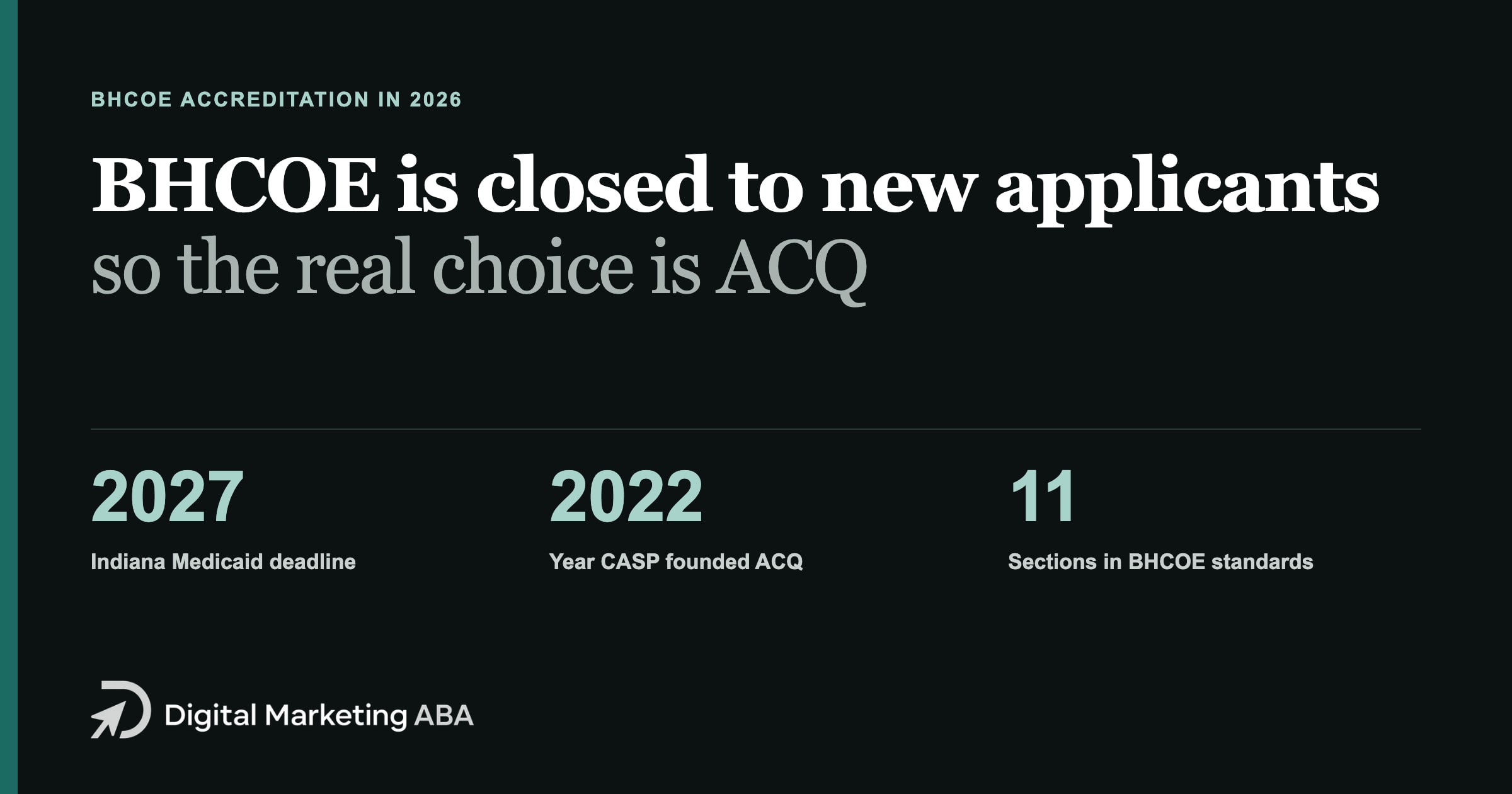
- Oct. 1, 2027
- Date Indiana Medicaid requires every ABA group enrollment to be accredited by ACQ or BHCOE (IHCP bulletin BT202646)
- 11
- Sections in BHCOE's current accreditation standards, effective April 1, 2025
What is BHCOE accreditation?
BHCOE accreditation is an organizational credential for ABA providers, granted by the Behavioral Health Center of Excellence. BHCOE's website (opens in a new tab) describes it as an earned certification that shows a commitment to quality and continuous improvement, granted to organizations of any size that meet its standards for clinical and operational quality.
The BHCOE accreditation standards (opens in a new tab) are organized in 11 sections covering clinical, professional and ethical practice. The current set, which BHCOE calls the 201 Standards of Excellence, took effect April 1, 2025, and organizations accredited earlier are reassessed against it at their next evaluation.
Several standards touch marketing directly. A.05 says the organization will not speak ill of or undermine other ABA organizations. A.08 bars offering current patients anything of value for attendance or for recruiting other patients. B.02 asks for a process to review marketing, training and therapy materials for representation of diverse individuals. C.04 expects cyber or data privacy insurance.
Who owns BHCOE now?
The Council of Autism Service Providers. In a release dated January 13, 2026 (opens in a new tab), CASP said that in late December it reached an agreement with Jade Health to acquire BHCOE and other Jade Health holdings. Once the two are fully combined, CASP says the nonprofit accreditation work will operate under the ACQ name and framework.
ACQ is the Autism Commission on Quality. According to CASP's ACQ page (opens in a new tab), CASP founded it in 2022 as a nonprofit accreditation program for ABA organizations serving people with autism. It is a wholly owned subsidiary of CASP, with accreditation decisions handled independently from CASP, and any ABA organization serving individuals with autism can apply, whatever its CASP membership, business structure or size.
Can you still get BHCOE accreditation?
Not as a new applicant. BHCOE's get started page (opens in a new tab) says BHCOE is no longer accepting new applications for accreditation and encourages organizations to pursue accreditation from ACQ instead.
For companies already in the system, CASP's transition page (opens in a new tab) sets out what happens next. Current BHCOE accreditation status will be upheld, and organizations will be invited to apply through ACQ when they are ready for reaccreditation. Pending BHCOE applications continue on the existing BHCOE platform, and a BHCOE accreditation completed that way is fully upheld. Applicants early in the process can ask to move to ACQ.
Which payers recognize BHCOE accreditation?
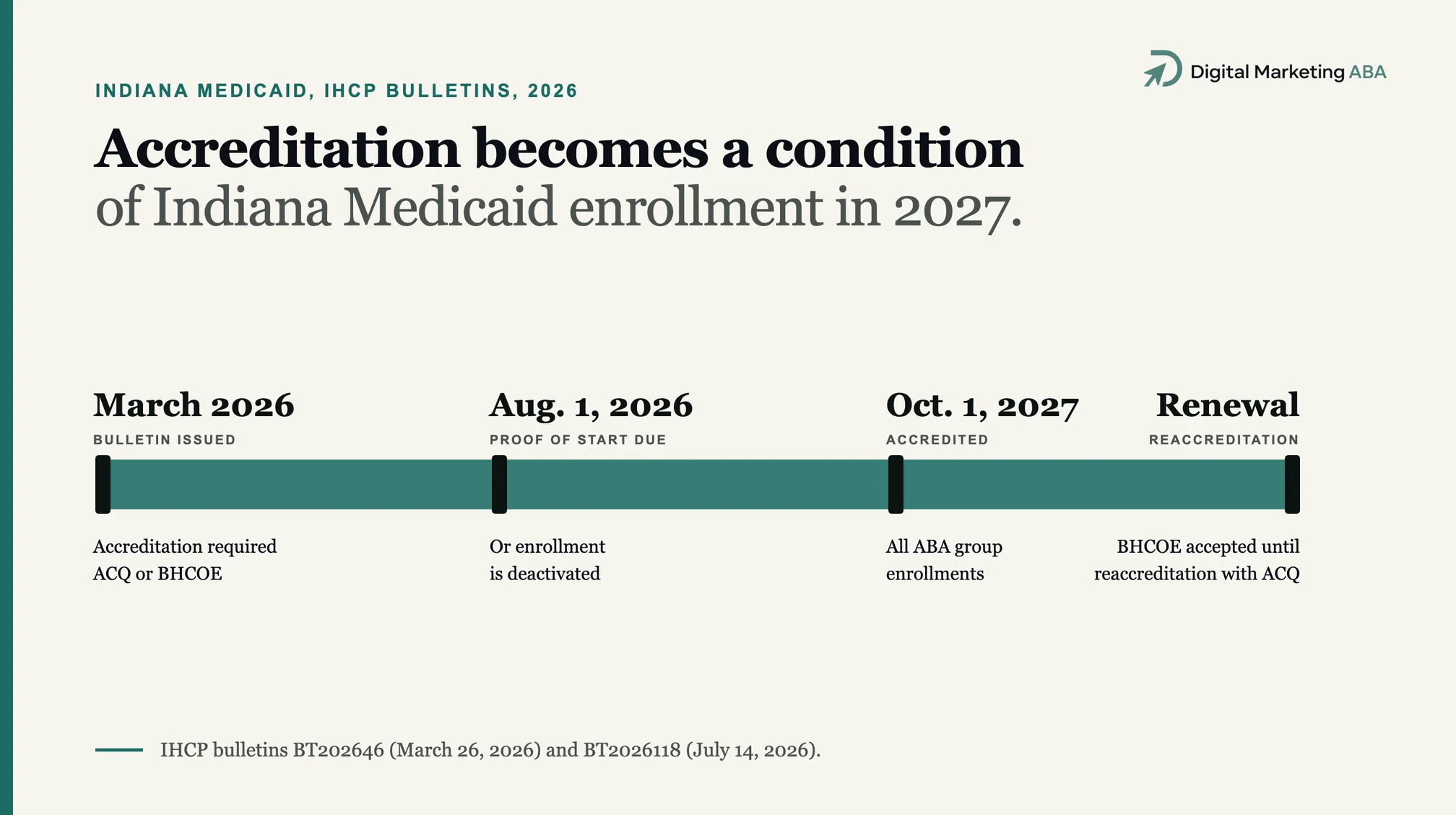
The clearest primary source we found is Indiana Medicaid. Indiana Health Coverage Programs bulletin BT202646 (March 26, 2026) (opens in a new tab) says that beginning Oct. 1, 2027, all newly enrolled and existing ABA group enrollments must be accredited, and it recognizes ACQ and BHCOE. Currently enrolled groups had to show by Aug. 1, 2026 that they had started the process, or face deactivation. A note says previous BHCOE accreditation will be accepted until an agency's reaccreditation with ACQ. A reminder bulletin, BT2026118, repeated this on July 14, 2026.
A clarification, BT202660 (April 28, 2026), adds that ACQ accredits an agency's ABA service line at the state level rather than by location, that agencies must tell ACQ when a location starts or stops offering the service line, and that a provider with enrolled locations in more than one state needs accreditation in each.
We did not find a payer recognition list on the BHCOE or CASP pages we read. Ask each payer you bill, in writing, whether accreditation affects network status, rates or audits. Breaking News ABA has covered the wider Indiana changes in Indiana's $611 million problem (opens in a new tab).
Is BHCOE accreditation worth it for you?
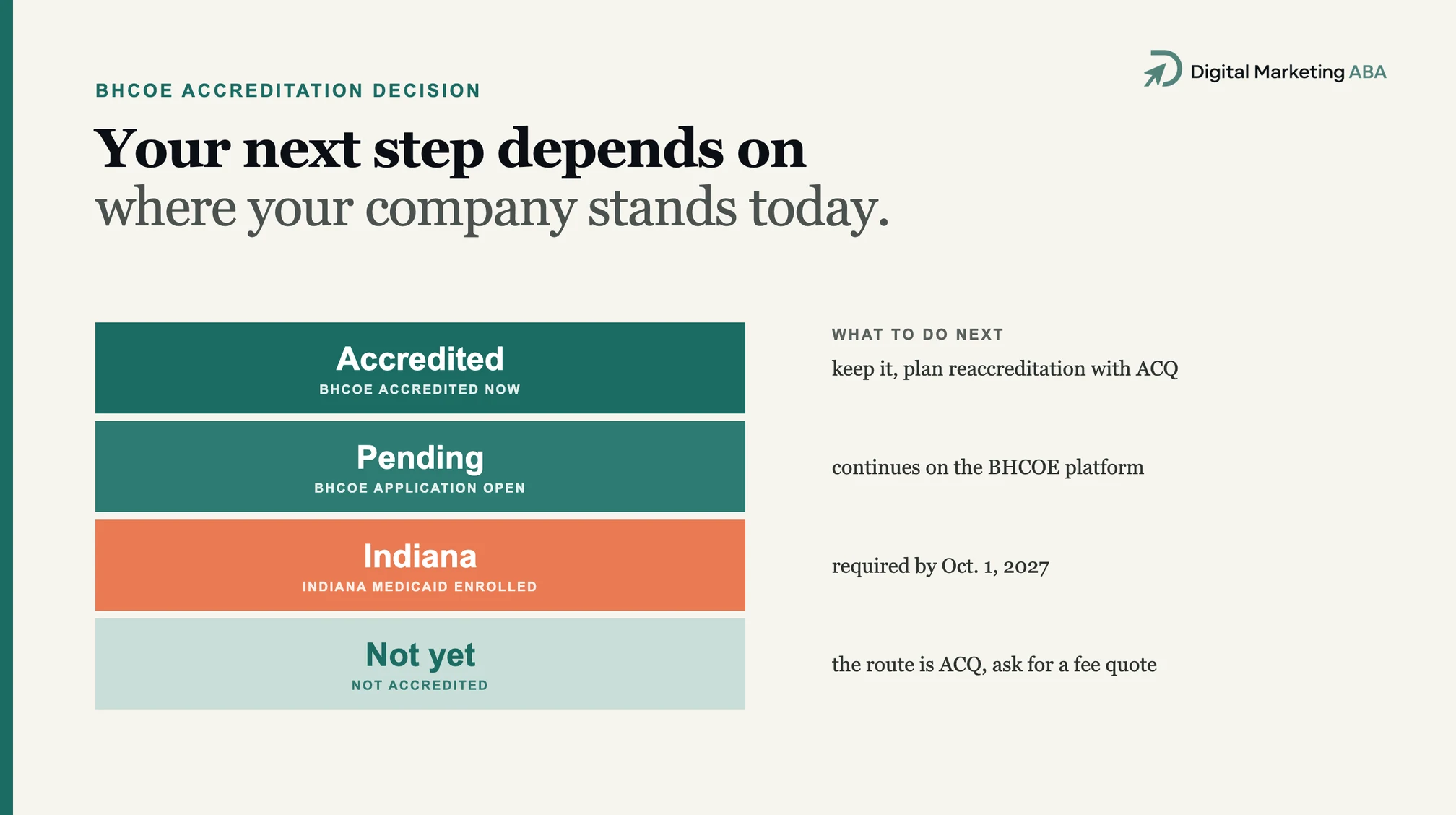
Because new BHCOE applications are closed, the real decision for most owners is about accreditation in general, and in practice about ACQ. It depends on where you stand today.
- Already BHCOE accredited. Keep it current, display it correctly, and plan reaccreditation with ACQ.
- BHCOE application pending. It continues on the BHCOE platform. Ask CASP whether moving to ACQ makes sense for your timeline.
- Enrolled with Indiana Medicaid. Accreditation is a condition of staying enrolled from Oct. 1, 2027, so the question is how fast, not whether.
- Not accredited, outside Indiana. Weigh the fee (neither site we read publishes one, so ask for a quote), the staff time to meet the standards, and whether your payers, referral sources or a future buyer will value it.
Free website visibility check
Get your free visibility check.
Share your name, website, and email. We will inspect your public homepage and email your human-reviewed score and three priorities.
- See where qualified search demand may be leaking
- Reviewed by a person before it reaches your inbox
- No patient or clinical information requested
What the accreditor says about its own results
BHCOE's benefits page (opens in a new tab) cites its own survey and evaluation data. It says turnover at accredited organizations is 5.1% lower for RBTs, 8.5% lower for clinical directors and 12.5% lower for supervisors and BCBAs.
Treat those as the accreditor's own figures, not independent research. The page does not show whether accredited organizations were already different before they applied. The stronger case for accreditation is the work itself: written policies, a review of ethics, privacy and clinical processes, and an outside check you can point to.
How to use BHCOE accreditation in marketing
Follow the accreditor's rules first. BHCOE's badge and logo guidelines (opens in a new tab) say the badge shows an organization is accredited and in good standing, but does not mean BHCOE approved its marketing. If not every location is accredited, a disclaimer naming the accredited locations must sit near the badge on websites, social posts, brochures, job postings and other public materials.
- Website. Show the badge on each accredited location page and explain in one sentence what accreditation checked.
- Payer conversations. Include the certificate and the accreditor's directory listing in contracting and recredentialing packets.
- Parents. Say what it means in plain words, such as an outside review of clinical quality, ethics and privacy, without implying a guarantee of outcomes.
- Recruiting. Mention it on the careers page and in job posts, with the same location disclaimer.
What accreditation will not do
Accreditation does not credential your clinicians with a payer, and it does not replace in-network status. ABA insurance credentialing is still the step that decides whether a family can use their benefits with you.
Nor does a badge alone bring families in. Parents decide on how fast you respond, what other parents say and whether their pediatrician knows you. How independent ABA clinics beat corporate centers covers those levers, and employer branding for ABA companies covers the recruiting side.
What to do this week
- Confirm your accreditation status and its expiry date, and note when reaccreditation with ACQ would fall.
- Check every page and post that shows the badge, and add the location disclaimer where not all sites are accredited.
- If you bill Indiana Medicaid, confirm your documentation was filed and track the Oct. 1, 2027 date.
- Ask your three largest payers in writing whether accreditation affects your network status, rates or audits.
- If you are not accredited, book an ACQ information session and get a fee quote before deciding.
Sources
BHCOE, Get started with accreditation (opens in a new tab) and BHCOE accreditation standards (opens in a new tab) (read November 16, 2026) - application status and the 201 Standards of Excellence.
BHCOE, Badge and logo usage guidelines (opens in a new tab) and Benefits of ABA provider accreditation (opens in a new tab) (read November 16, 2026) - badge rules and the accreditor's own survey figures.
CASP, CASP has acquired BHCOE Holdings (opens in a new tab), CASP acquires Jade Health (opens in a new tab) (January 13, 2026) and the Autism Commission on Quality (opens in a new tab) - ownership, transition terms and ACQ eligibility.
Indiana Health Coverage Programs, Bulletin BT202646 (opens in a new tab) (March 26, 2026), BT202660 (opens in a new tab) (April 28, 2026) and BT2026118 (opens in a new tab) (July 14, 2026) - the ABA accreditation requirement. Primary government source.
Frequently asked questions
Is BHCOE still accepting applications?
No. BHCOE's website says it is no longer accepting new applications and points organizations to the Autism Commission on Quality (ACQ). Applications already pending continue on the BHCOE platform.
Who owns BHCOE?
The Council of Autism Service Providers (CASP). CASP announced on January 13, 2026 that it had agreed in late December to acquire Jade Health, including BHCOE, and that the combined accreditation work will operate under the ACQ name and framework.
Is my BHCOE accreditation still valid?
CASP says current BHCOE accreditation status will be upheld, and accredited organizations will be invited to apply through ACQ at reaccreditation. Indiana Medicaid accepts previous BHCOE accreditation until an agency's reaccreditation with ACQ.
Do payers require ABA accreditation?
Indiana Medicaid will require all ABA group enrollments to be accredited by ACQ or BHCOE from October 1, 2027. We found no general payer list, so ask each payer in writing whether accreditation affects network status, rates or audits.
How much does BHCOE accreditation cost?
Neither the BHCOE nor the CASP pages we read publish a fee, and BHCOE no longer takes new applicants. For ACQ, ask for a quote before deciding, and include the staff time needed to meet the standards.
Keep reading
- ABA Insurance CredentialingABA Insurance Credentialing and How to Plan Around It
ABA insurance credentialing can hold a new BCBA or clinic out of network for months. What sets the timeline, state deadlines and how to plan your marketing.
- Google Business ProfileGoogle Business Profile Suspended? How to Fix It
Google Business Profile suspended? Why ABA clinic listings get suspended, how Google's one-time appeal works, and how to keep every clinic's profile safe.
- RecruitingEmployer Branding for ABA Companies
Employer branding for ABA companies: what to put on a careers page, how to use staff stories, Indeed and Glassdoor reviews, LinkedIn and referral bonuses.
Accredited? Show it properly
Turn accreditation into something families and payers notice
We help multi-clinic ABA companies present accreditation, reviews and outcomes on location pages, careers pages and referral materials, within each accreditor's rules.