
ABA Insurance Credentialing and How to Plan Around It
ABA insurance credentialing decides when a new BCBA, or a new clinic, can see a family on that family's insurance. It rarely gets a line in the marketing plan, yet it sets the date every ad, referral visit and waitlist promise depends on. Here is what drives the timeline, what some states now require of insurers, and how to plan hiring, intake and marketing around the wait.
By Digital Marketing ABA
Published
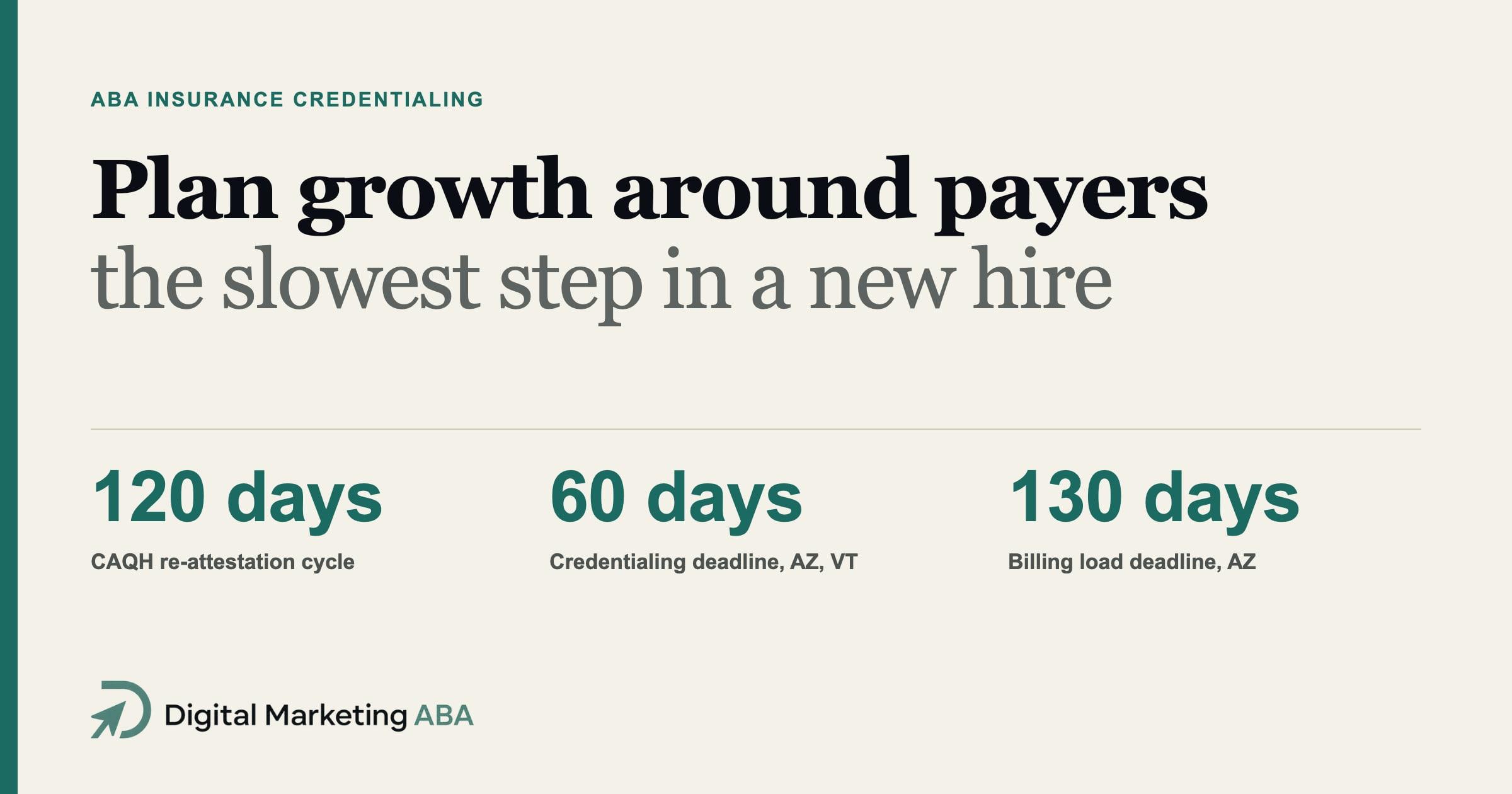
- 120 days
- How often providers re-attest a CAQH ProView profile (180 days in Illinois), per CAQH's provider quick reference
- 60 days
- Deadline for insurers to finish credentialing a complete application in Vermont and Arizona, by statute
What ABA insurance credentialing covers
Three steps sit between a new clinician and a paid in-network claim. Credentialing is the payer checking the clinician's qualifications. Contracting is the agreement on network participation and rates. Loading is the payer entering the clinician and location into its billing system, so claims for them can pay.
Owners often treat the three as one, and the gap between them is where months go missing. A clinician can be approved and still not be loaded. A new clinic address can be missing from a contract that covers every other site. Track each payer, each clinician and each location as its own line.
How long does ABA credentialing take?
It depends on the payer and the state, and we found no national standard to cite. What some states do set is a deadline for insurers, and every one we read starts the clock only when the application is complete.
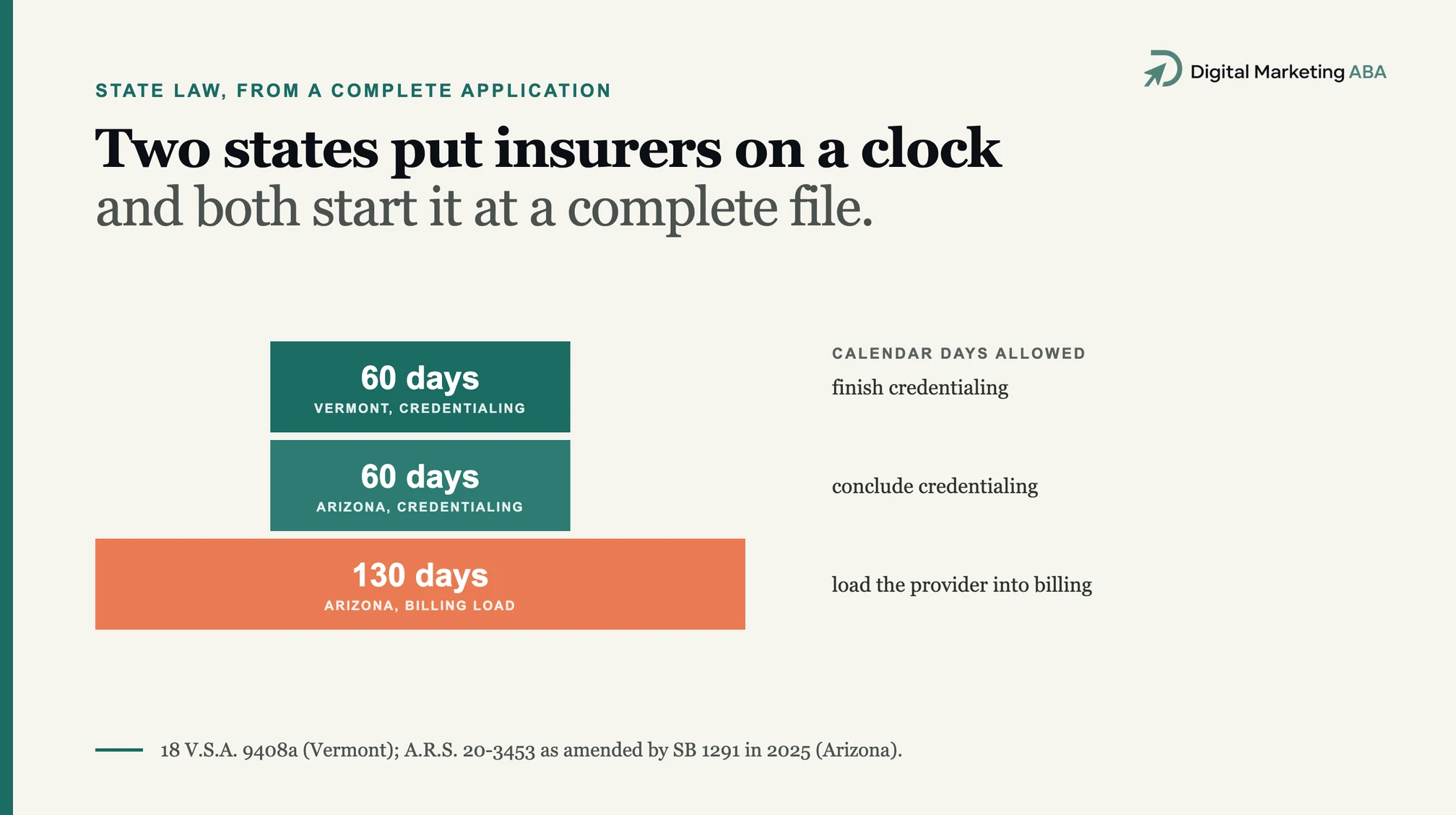
In Vermont, 18 V.S.A. 9408a (opens in a new tab) says an insurer shall act upon and finish the credentialing process of a completed application within 60 calendar days after receipt. An application counts as complete once the insurer has received all the information and documentation it needs to decide.
In Arizona, SB 1291 (Laws 2025, Chapter 97) (opens in a new tab) amended A.R.S. 20-3453. A health insurer must conclude credentialing within 60 calendar days and load the provider's information into its billing system within 130 calendar days, both from receipt of a complete application. The act took effect after March 31, 2026, and lets a provider be paid for services from the date on the insurer's notice of a complete application until the contract is signed.
A state law covers only the plans it regulates, and states differ. Ask counsel or your credentialing lead which deadlines apply to each payer you bill.
Why CAQH upkeep matters for every BCBA
CAQH ProView is the profile where providers report the data health plans and other organizations use for credentialing. Its provider quick reference guide (opens in a new tab) says the service is free to providers, suggests allowing about two hours to complete a first profile, and lets only the provider authorize which organizations can see it.
The same guide says providers receive a notice to re-attest every 120 days (180 days for providers practicing in Illinois). A lapsed attestation or an expired document is one of the simplest ways for an application to stop counting as complete. Put each clinician's attestation date on the same calendar as their license and certification renewals, and make someone other than the clinician responsible for checking it.
What makes a credentialing application complete?
Each payer defines it, so ask every payer for its checklist in writing. In practice the same items cause most delays, and you can collect them before a clinician's first day.
- A current, attested CAQH profile with every document uploaded and the payer authorized to view it.
- Licenses and BACB certification, with expiry dates that will not lapse mid-application.
- NPI numbers for the clinician and the group, matching the payer's records.
- Professional liability insurance certificate and the group's tax documents.
- Every service address where the clinician will see families, including any new clinic.
What to do while credentialing is pending
The wait is not dead time. Use it to keep families informed and to make sure the first in-network day starts with a full schedule rather than an empty one.
Keep families who are waiting on a specific payer on a list with a status and a date you update, not a vague promise. ABA waitlist management covers how to keep that list clean and honest. Train intake to say clearly which payers are in network at which clinic today, and which are pending.
Do not bill for a clinician who is not yet credentialed with that payer under someone else's credentials without written guidance from counsel and the payer. The rules vary, and getting them wrong is expensive.
Time marketing to in-network dates
Marketing should follow the payer calendar, clinic by clinic. An ad that brings a family whose plan you cannot bill at that location costs twice, once for the click and again for the call that ends in a referral elsewhere.
- List the payers accepted at each clinic on that clinic's location page, and update it the day a payer loads.
- Run payer-specific ads or keywords only where that payer is loaded.
- Tell pediatricians and school teams which plans each clinic accepts, and send an update when a new one goes live.
- Plan new clinic openings backward from the expected loading date.
Free website visibility check
Get your free visibility check.
Share your name, website, and email. We will inspect your public homepage and email your human-reviewed score and three priorities.
- See where qualified search demand may be leaking
- Reviewed by a person before it reaches your inbox
- No patient or clinical information requested
Medicaid can add requirements of its own
State Medicaid programs can set conditions beyond credentialing. Indiana is a current example. Its bulletin BT202646 (March 26, 2026) (opens in a new tab) requires all newly enrolled and existing ABA group enrollments to be accredited by Oct. 1, 2027, recognizing ACQ and BHCOE, with proof that the process had started due by Aug. 1, 2026.
If you bill Medicaid in any state, read its current provider bulletins as part of credentialing, not as a separate compliance task. Is BHCOE accreditation worth it covers the accreditation side.
An example credentialing calendar
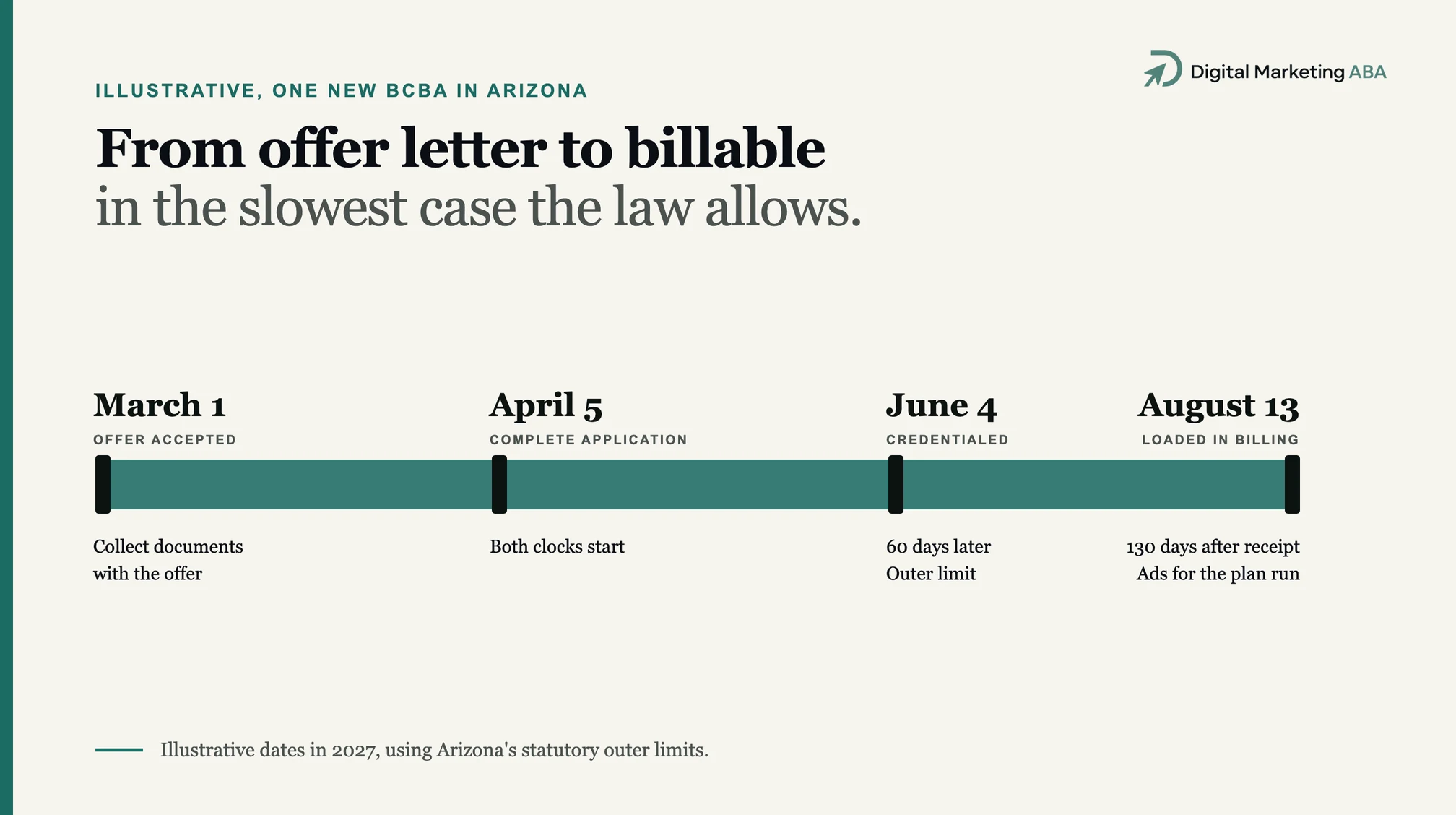
This is an illustration, not a benchmark. It assumes a BCBA accepts an offer on March 1, 2027, starts on April 1, and the practice collected every document with the offer letter, so a complete application reaches an Arizona-regulated insurer on April 5, 2027.
- April 5, 2027. The complete application is received, and both statutory clocks start.
- June 4, 2027, 60 days later. The outer limit for the credentialing decision.
- August 13, 2027, 130 days after receipt. The outer limit for loading into the billing system.
- From August 13 at the latest, families on that plan can be booked with this BCBA at in-network rates, and ads for that plan at that clinic can run.
Why the example starts with the offer letter
In the example, every day the application is incomplete pushes both dates back by a day. If documents trickle in over the first month, the loading limit moves from August into September. Collecting them with the offer letter is the cheapest way to shorten the wait.
The same logic applies to a new clinic, where the address must be added for every payer. Scaling an ABA practice with a new clinic launch plan lays out the full launch timeline, and what it costs to recruit a BCBA shows what an uncovered caseload costs while you wait.
What to do this week
- Build one tracker with a row per clinician, per payer and per location, with submission, decision and loading dates.
- Check every clinician's CAQH attestation date and set reminders before the 120-day mark.
- Ask each payer for its complete-application checklist in writing.
- Find out whether your states set credentialing deadlines, and which of your payers they cover.
- Add the payers accepted at each clinic to that clinic's location page.
Sources
CAQH, CAQH ProView Provider Quick Reference Guide (opens in a new tab) (undated PDF, read November 16, 2026) - re-attestation every 120 days, 180 days in Illinois.
Vermont Statutes, 18 V.S.A. 9408a, Uniform provider credentialing (opens in a new tab) (read November 16, 2026) - 60-day deadline for insurers. Primary source.
Arizona Laws 2025, Chapter 97 (SB 1291) (opens in a new tab) - 60-day credentialing and 130-day loading deadlines, effective after March 31, 2026. Primary source.
Indiana Health Coverage Programs, Bulletin BT202646 (opens in a new tab) (March 26, 2026) - ABA accreditation requirement. Primary government source.
Frequently asked questions
How long does ABA insurance credentialing take?
It depends on the payer and the state. Some states set deadlines: Vermont gives insurers 60 calendar days to finish credentialing a complete application, and Arizona 60 days to credential and 130 days to load the provider into billing.
How often do BCBAs need to re-attest in CAQH?
CAQH's provider quick reference says providers receive a notice to re-attest every 120 days, or every 180 days for providers practicing in Illinois. Track the date for every clinician.
When does the credentialing clock start?
In the state laws we read, when the insurer receives a complete application. Vermont treats an application as complete once the insurer has all the information and documentation it needs to make its decision.
Should an ABA clinic advertise before it is in network?
Advertise only for payers that are loaded at that clinic. List accepted payers on each location page and update it the day a payer goes live, so families are not sent elsewhere after the first call.
Does credentialing differ for Medicaid ABA providers?
State Medicaid programs can add conditions. Indiana Medicaid, for example, will require ABA group enrollments to be accredited by ACQ or BHCOE by October 1, 2027. Read your state's current provider bulletins.
Keep reading
- School DistrictsHow to Win School-Based ABA Contracts
School-based ABA contracts start with the IEP. How districts buy ABA services, getting on vendor lists, who to contact and what a capability statement needs.
- BHCOE AccreditationIs BHCOE Accreditation Worth It for ABA Companies?
BHCOE accreditation no longer takes new ABA applicants after CASP bought it. What changed, the ACQ route, Indiana Medicaid's 2027 rule and how to market it.
- Independent ABA ClinicsHow Independent ABA Clinics Beat Corporate Centers
Independent ABA clinics can beat larger chains on intake speed, clinical continuity, local referrals and honest wait times. How to position a multi-site firm.
Market what you can bill
Match your marketing to your payer dates
We help multi-clinic ABA companies run ads, location pages and referral outreach by clinic and payer, so families arrive when a clinician can actually see them.