
Facebook Ads for Healthcare and ABA Clinics
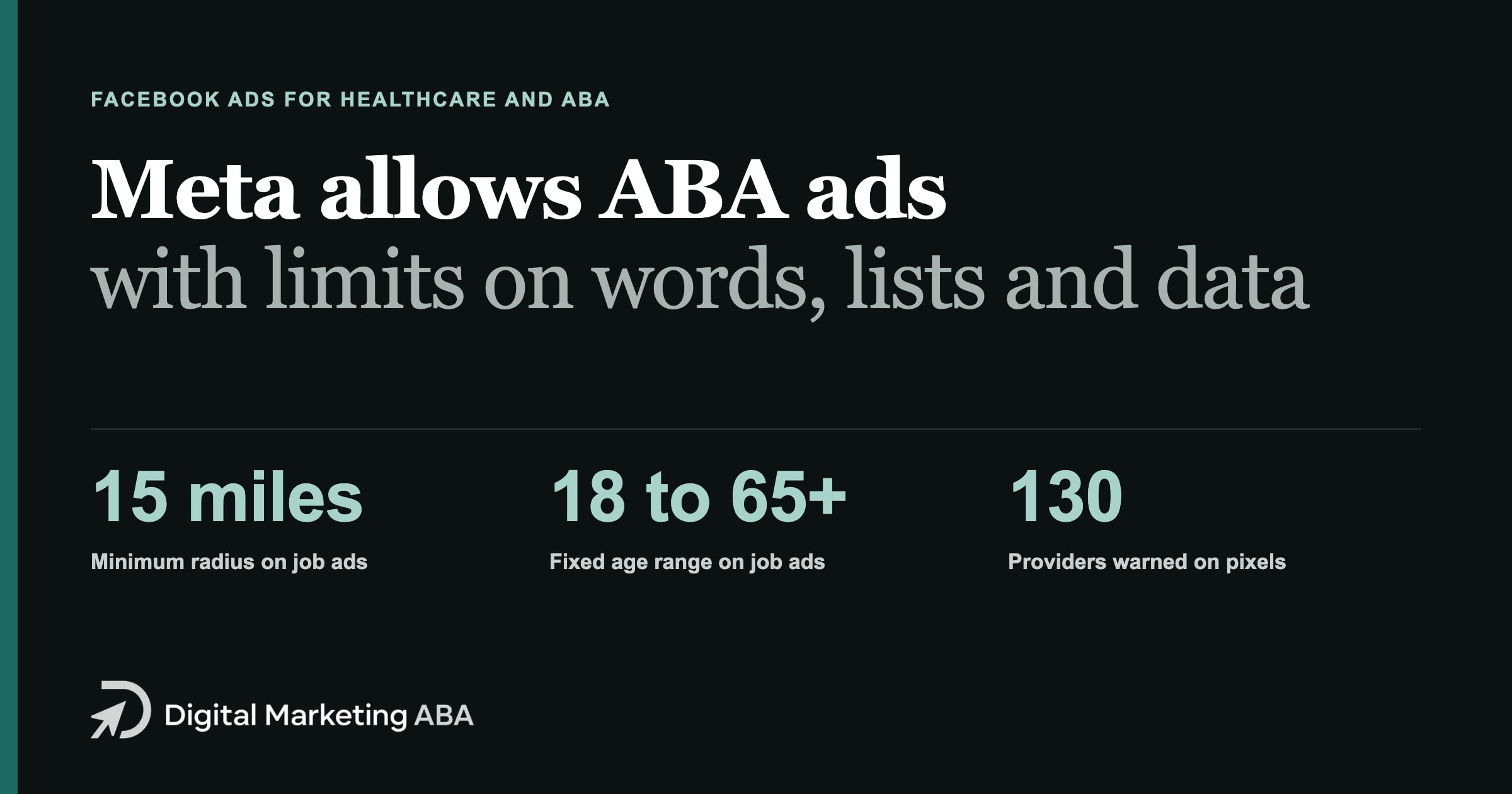
Facebook ads for healthcare run under tighter rules than ads for most businesses, and ABA sits squarely inside them. Meta limits how an ad can refer to a health condition, flags audiences that suggest one, and puts job ads under a special category with fixed targeting. Regulators have also warned providers about the Meta pixel. Here is what Meta's own pages say, and what an ABA company can still do well on Facebook and Instagram.
By Digital Marketing ABA
Published
Can ABA clinics run Facebook ads?
Yes. Health is not one of Meta's special ad categories, so an ABA clinic advertising its services does not declare one. Meta's special ad categories documentation (opens in a new tab) lists four: housing, employment, financial products and services, and issues, elections or politics.
That does not make health ads unrestricted. Three sets of rules shape what an ABA company can do on Facebook and Instagram: what the ad may say, which audiences it may use, and what data your website may send to Meta. A fourth applies the moment you advertise a job.
What can Facebook ads for healthcare say?
It can describe your service, but it cannot tell the viewer they have a condition. Meta's ad standard on privacy violations and personal attributes (opens in a new tab) (version dated June 27, 2024) says ads must not contain content that asserts or implies personal attributes, including physical or mental health and medical conditions.
Meta's own examples make the line clear. "Depression counseling" and "New diabetes treatment available" are allowed. "Do you have diabetes?" and "Depression getting you down? Get help now." are not, because they speak to the viewer's own condition.
Applied to ABA, in our reading, an ad that says ABA therapy for children, now enrolling at the Plano clinic, describes a service. An ad that asks whether your child has autism, or says your child's diagnosis deserves faster care, implies something about the person seeing it. Write about the clinic, the service, the wait and the insurance, not about the reader's family.
Which Facebook audiences are off limits?
Audiences that suggest a health condition. Meta's custom audiences documentation (opens in a new tab) says that beginning September 2, 2025, it started rolling out more proactive restrictions, and that any custom audience or lookalike audience suggesting specific health conditions, with "arthritis" and "diabetes" as examples, will be flagged and prevented from being used to run ad campaigns.
Meta's conversion tracking documentation applies the same date and the same examples to custom conversions. A conversion or audience built around a condition can be blocked even if the ad itself is worded well.
For ABA, the practical rule is to build nothing that names or points to a diagnosis: no audience called autism parents, no lookalike seeded from a list of current families, no conversion named for an assessment page about a condition. Customer lists of families are also a HIPAA question before they are a Meta question.
Is the Meta pixel safe on an ABA website?
Not by default, and regulators have said so. On July 20, 2023, the FTC and the HHS Office for Civil Rights wrote to about 130 hospital systems and telehealth providers (opens in a new tab) about the privacy risks of online tracking, naming the Meta/Facebook pixel and Google Analytics, and putting companies on notice that they must monitor the flow of health information to third parties.
HIPAA treats a health care provider that transmits health information electronically in connection with covered transactions, such as insurance claims, as a covered entity (45 CFR 160.103). For an ABA company in that position, a pixel firing on an intake form or an appointment request page can raise HIPAA questions as well as FTC ones. Our guide to HIPAA-compliant marketing for ABA walks through the OCR guidance, the 2024 court ruling and the FTC cases. Have counsel review your setup; this article is not legal advice.
What are Meta's special ad categories?
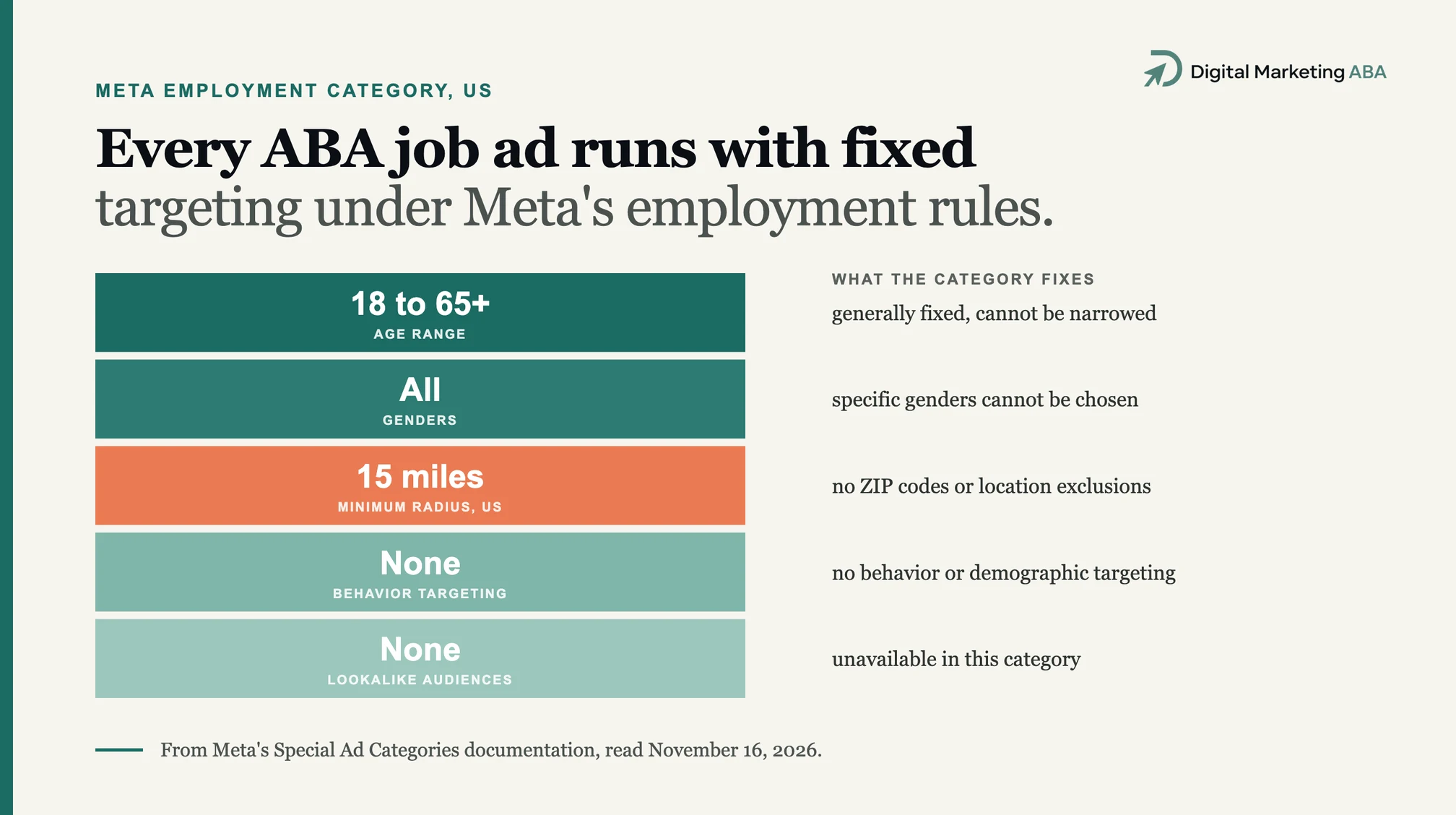
They are categories where Meta fixes targeting to prevent discrimination, and one of them, employment, covers every RBT and BCBA job ad you run. Meta's documentation says US businesses must identify campaigns that offer employment, and lists the limits for these categories.
- Age is generally fixed to include 18 to 65+.
- You cannot choose specific genders.
- Location targeting needs a radius of at least 15 miles in the US and Canada, and ZIP code targeting is not supported.
- Location exclusions, behavior and demographic targeting, and detailed targeting exclusions are not permitted.
- Lookalike audiences are unavailable.
Free website visibility check
Get your free visibility check.
Share your name, website, and email. We will inspect your public homepage and email your human-reviewed score and three priorities.
- See where qualified search demand may be leaking
- Reviewed by a person before it reaches your inbox
- No patient or clinical information requested
What still works for ABA on Facebook?
Three uses fit the rules and the audience. None depends on knowing anything about a viewer's health.
Recruiting. Job ads can be shown to people around each clinic, within the employment category's rules, including its 15 miles minimum radius. Pair the ads with a careers page that shows real staff and pay ranges, as set out in employer branding for ABA companies.
Local awareness. A new clinic, an expanded schedule or a new insurance contract are facts you can state plainly to people in a radius around the clinic. The ad describes the service. The family decides whether it applies to them.
A short, clean next step. Send people to a page or form that asks for contact details and location, not diagnosis or insurance member numbers. What your ABA intake form should ask covers which fields belong on a first-contact form and which belong in the intake packet.
Each of these can be judged on numbers you already hold: applicants and hires by source for recruiting, and inquiries and starts by clinic for patient ads. If a campaign cannot be tied to either, it is hard to defend its budget against Search or referral outreach.
How to measure Facebook ads without health data
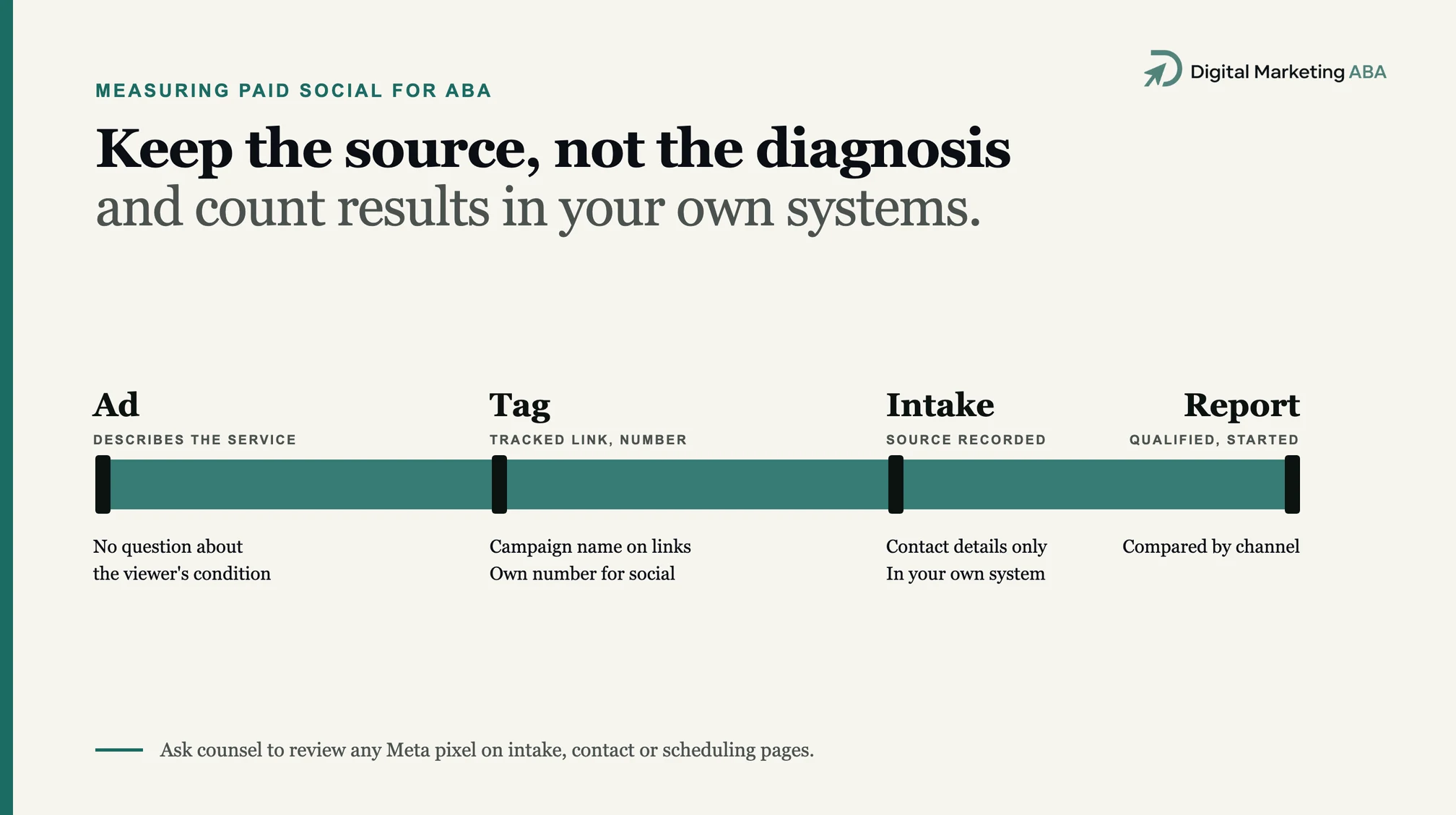
Measure in your own systems, not by sending more to Meta. The aim is to know which campaign brought a family, without the ad platform learning anything about that family's health.
Tag every ad link with the campaign name, give paid social its own tracked phone number, and record the source on each inquiry in your intake system. Our guide to healthcare call tracking for ABA clinics covers numbers and recordings. Then compare paid social with other channels on qualified inquiries and started families, the measure argued for in what a qualified ABA lead costs.
What to do this week
- Read every live Meta ad and rewrite any line that asks about or implies the viewer's or their child's condition.
- Open your custom audiences, lookalikes and custom conversions and remove any built around a diagnosis or a list of families.
- Check that every job ad runs under the employment special ad category.
- List which pages the Meta pixel fires on, and ask counsel about any intake, contact or scheduling page.
- Add a tracked number and campaign tags so paid social is counted in your intake records.
Sources
Meta for Developers, Special Ad Categories (opens in a new tab) (read November 16, 2026) - the four categories and their targeting limits.
Meta for Developers, Customer File Custom Audiences (opens in a new tab) (read November 16, 2026) - restrictions on audiences suggesting health conditions from September 2, 2025. The Conversion Tracking page states the same for custom conversions.
Meta Transparency Center, Privacy Violations and Personal Attributes (opens in a new tab) (version of June 27, 2024) - the personal attributes rule and health examples.
FTC, FTC and HHS Warn Hospital Systems and Telehealth Providers about Privacy and Security Risks from Online Tracking Technologies (opens in a new tab) (July 20, 2023) - the joint letter to about 130 providers.
Frequently asked questions
Can healthcare providers advertise on Facebook?
Yes. Health is not one of Meta's special ad categories, which are housing, employment, financial products and services, and issues, elections or politics. Health ads must still follow Meta's personal attributes rule and its limits on health-related audiences.
What can't a healthcare ad say on Facebook?
It must not assert or imply the viewer's personal attributes, including physical or mental health. Meta allows "Depression counseling" but not "Do you have diabetes?". Describe the service, not the reader's condition.
Can ABA clinics use custom audiences on Facebook?
Not ones that suggest a health condition. From September 2, 2025, Meta began flagging custom and lookalike audiences, and custom conversions, that suggest specific health conditions and preventing their use in campaigns.
Do ABA job ads need a special ad category?
Yes. Job ads fall under Meta's employment category, which fixes age to 18 to 65+, removes gender choice, requires a radius of at least 15 miles in the US and makes lookalike audiences unavailable.
Is the Meta pixel HIPAA compliant for ABA clinics?
Not by default. The FTC and HHS warned about 130 providers in July 2023 about tracking tools including the Meta pixel. Ask counsel to review any pixel on intake, contact or scheduling pages.
Keep reading
- Call TrackingHealthcare Call Tracking for ABA Clinics
Healthcare call tracking for ABA clinics: how dynamic numbers and Google Ads call conversions work, the HIPAA questions on recordings, and what to report.
- RecruitingEmployer Branding for ABA Companies
Employer branding for ABA companies: what to put on a careers page, how to use staff stories, Indeed and Glassdoor reviews, LinkedIn and referral bonuses.
- RecruitingBCBA Job Description and Interview Questions
A copy-ready BCBA job description for ABA companies, the BACB requirements behind it, and 15 BCBA interview questions with what a good answer shows.
Paid social within the rules
Are your Meta ads and pixel set up safely?
We review Meta campaigns, audiences and website tags for multi-clinic ABA companies, and rebuild them around awareness, recruiting and measurement that keeps health data out.