
What Your ABA Intake Form Should Ask
An ABA intake form on your website has one job: get a family to a phone call with someone who can help. Many forms ask too much too early, collecting diagnosis details and insurance numbers that belong in the full intake packet. Here is what a first-contact ABA intake form should ask, what to leave off it, and why a short form and a fast callback matter more than a long one.
By Digital Marketing ABA
Published
- 18
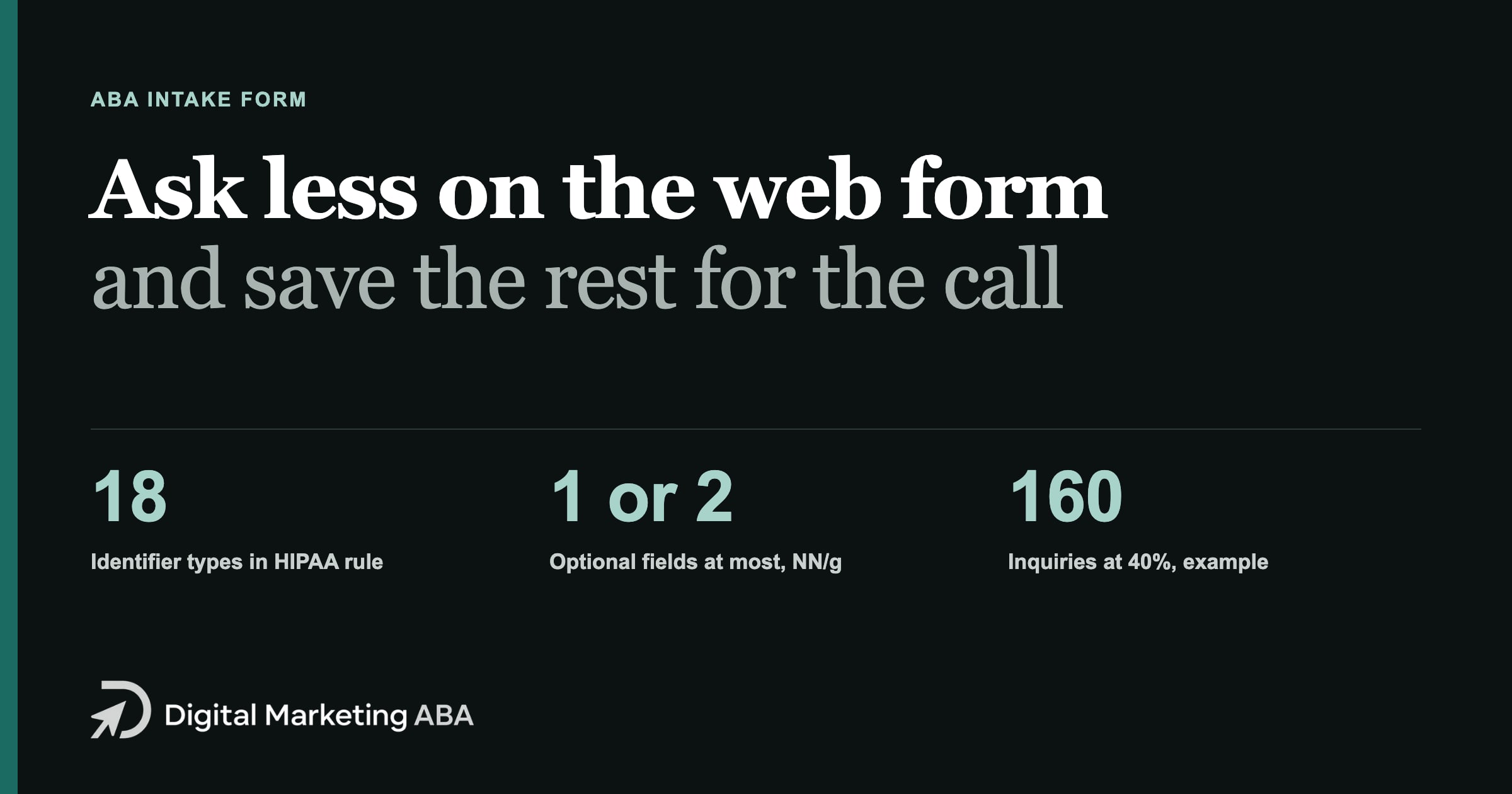
- Types of identifiers listed in HIPAA's de-identification standard (45 CFR 164.514), from names to health plan numbers
What should an ABA intake form ask?
Only what your intake coordinator needs to call the family back and route them to the right clinic. That means contact details, location, the child's age range and insurance carrier. Everything else can wait for a conversation.
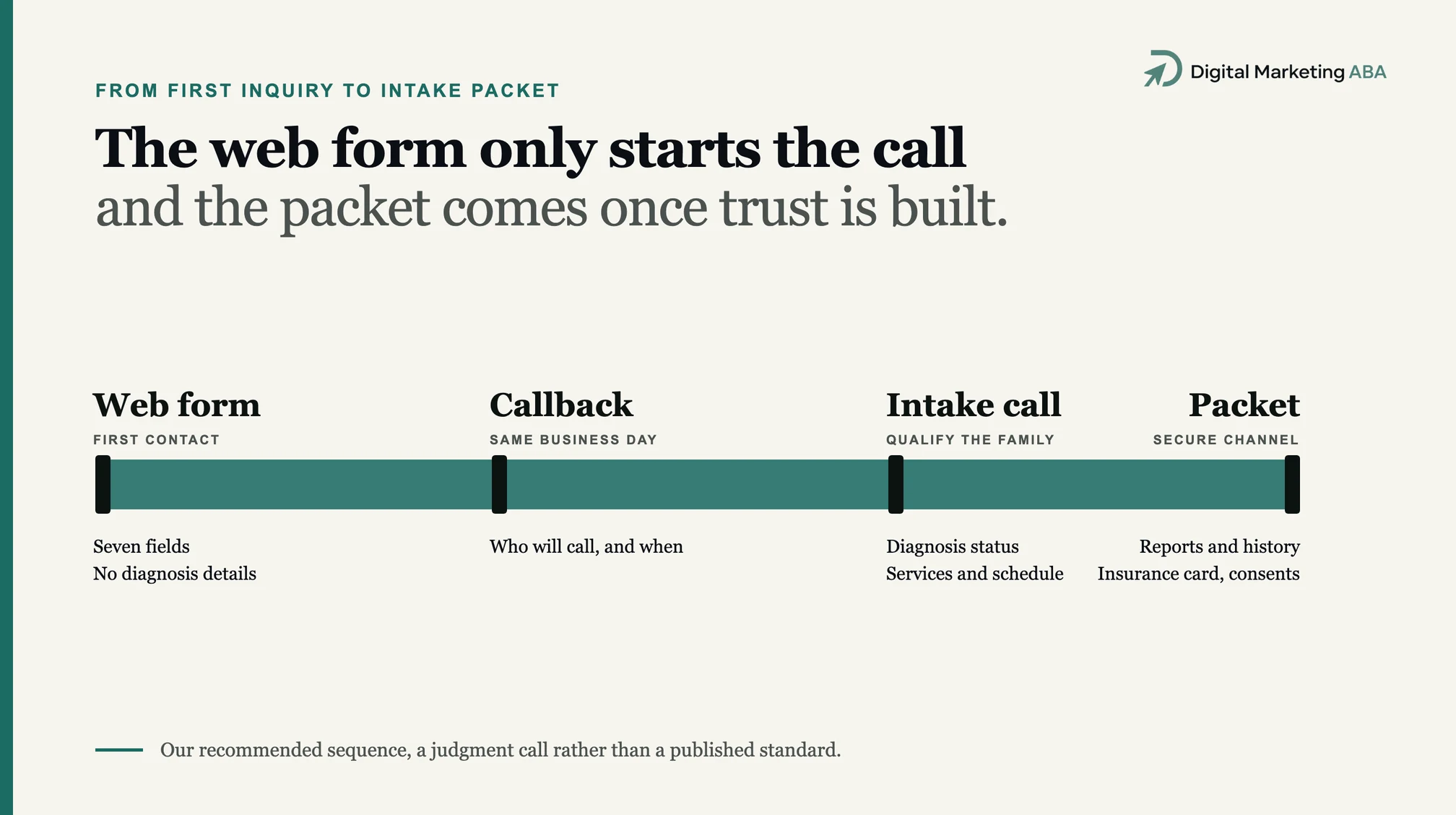
The word intake covers two different things. The form on your website is a first-contact form. The intake packet, with history, diagnostic reports, consents and insurance cards, comes later, through a secure channel, once the family has decided to go ahead. Mixing the two is the most common reason an ABA intake form grows long.
First-contact form versus intake packet
The two do different work and carry different risk. A short web form starts a conversation. The full packet supports the assessment and the payer's authorization request, and it holds details a parent should only share once they trust you.
- Web form: who to call, where they live, which clinic, the child's age range and the insurance carrier.
- Intake call: diagnosis status, services wanted (clinic, home or school), schedule, and whether your plans and openings fit.
- Intake packet: diagnostic report, developmental and medical history, insurance card, consents and authorizations, sent through your practice management system or a secure portal.
The seven fields that qualify a family
Seven fields are enough to sort most inquiries before the first call. This is our recommendation, a judgment call rather than a published standard. Five are required and two are optional.
- Parent or guardian name (required). A first name is enough to start the call.
- Phone number (required). Most intake still happens by phone.
- ZIP code or preferred clinic (required). It routes the family to the right location and shows whether in-home services reach them.
- Child's age range (required). A few bands that match the ages each clinic serves, not a date of birth.
- Insurance carrier (required). A dropdown of the plans you accept plus Other and Not sure, with no member ID.
- Email (optional), for families who prefer it.
- Best time to call (optional), so the first attempt reaches a parent who is at work or at school pickup.
Where lead source should come from
Lead source belongs in tracking, not on the form. Read it from the landing page and the ad click, and from call tracking for phone inquiries, as set out in healthcare call tracking for ABA clinics.
A how-did-you-hear-about-us question is still worth asking on the intake call. A referral from a pediatrician, a teacher or another parent rarely shows up in analytics, and it is often the source you most want to count.
Why diagnosis questions wait for the call
Diagnosis status is a real qualifying question, because your payers' rules decide what a family needs before an assessment can be authorized. It is also the most sensitive thing a parent can type into a web form, so ask it on the call, where your coordinator can explain why it matters.
The same goes for insurance detail beyond the carrier name. Plan type, member ID and group number feed a benefits check, which needs the card, and the card belongs in the packet. A carrier name alone tells the coordinator whether the call is worth having.
If you do put diagnosis status on the web form, keep it to three choices (diagnosed, being evaluated, not yet), send submissions only to systems covered by a business associate agreement, and keep third-party ad tags off that page. Ask counsel to review the setup.
What not to collect on a marketing form
Anything that identifies the child or describes their health beyond what routing needs. An inquiry to an ABA provider is health-related by nature, so every extra identifier raises the stakes if form data reaches a vendor it should not.
HIPAA's de-identification standard at 45 CFR 164.514 (opens in a new tab) lists 18 types of identifiers, including names, birth dates, geographic units smaller than a state such as ZIP codes, phone numbers, email addresses and health plan beneficiary numbers. A contact form cannot work without some of them. It can avoid adding more.
The minimum necessary standard at 45 CFR 164.502(b) (opens in a new tab) asks covered entities to make reasonable efforts to limit protected health information to the minimum necessary for a use, disclosure or request. Its wording is aimed at uses and disclosures rather than web forms, but the principle is a sound design rule for one. Leave these off the form:
- The child's full name and date of birth.
- Diagnosis details, other conditions or medications.
- Member ID, group number or a photo of the insurance card.
- Uploads of evaluations, IEPs or medical records.
- Social Security numbers for anyone in the family.
- A free-text box with no warning. If you keep one, label it to ask parents not to include medical details.
Free website visibility check
Get your free visibility check.
Share your name, website, and email. We will inspect your public homepage and email your human-reviewed score and three priorities.
- See where qualified search demand may be leaking
- Reviewed by a person before it reaches your inbox
- No patient or clinical information requested
Where the form data goes
What the form sends matters as much as what it asks. Ad pixels, session replay scripts and chat widgets on form and confirmation pages are where parents' answers can leak, a risk covered in HIPAA compliant marketing for ABA. Record conversions without the form contents, and check that the confirmation page URL carries no names or answers.
Does a shorter intake form get more inquiries?
Generally, yes. Each field is a reason to stop, and a parent filling in a form on a phone at night has little patience for questions that do not seem to matter yet.
Nielsen Norman Group's Website Forms Usability: Top 10 Recommendations (opens in a new tab) (Kathryn Whitenton, May 2016) argues that every field or question you cut raises a form's conversion rate. It also advises removing as many optional fields as possible and keeping a form to 1 or 2 optional fields, clearly labelled.
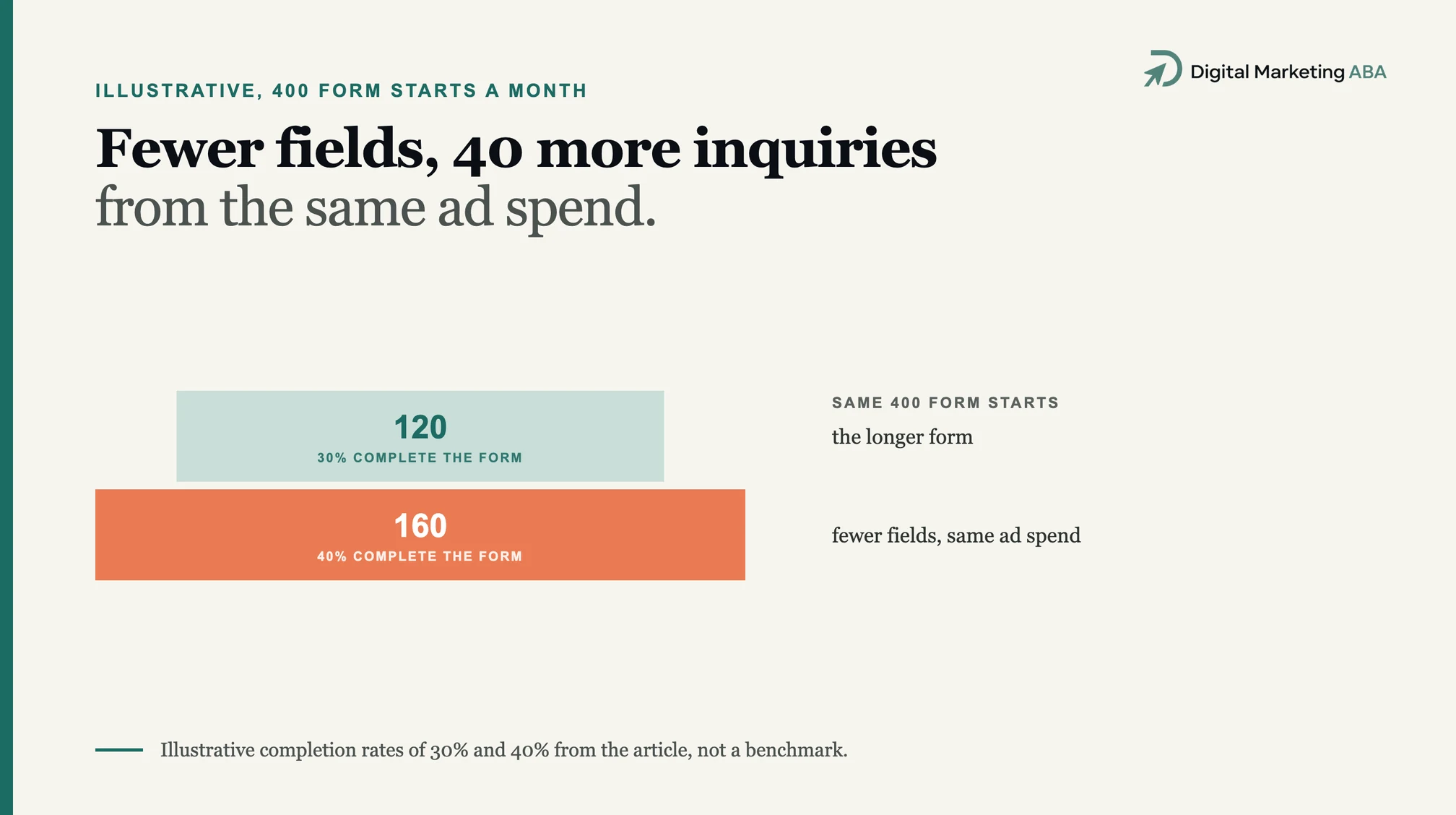
Here is illustrative arithmetic, not a benchmark. Suppose 400 parents a month start your form across all clinics and 30% submit it, which is 120 inquiries. If removing fields lifts completion to 40%, the same 400 parents produce 160 inquiries, 40 more conversations from the same ad spend. Run it with your own form analytics, counting starts and submissions separately.
More inquiries only help if they qualify, which is why the fields that remain should be the ones that sort families. We make the same case in measuring cost per qualified lead.
How fast should you call back after a form?
The same business day, and sooner if you can staff it. There is no published ABA benchmark, so measure your own median time from submission to first live contact, by clinic and by source.
General sales research points the same way. In The Short Life of Online Sales Leads (opens in a new tab) (Harvard Business Review, March 2011), James Oldroyd, Kristina McElheran and David Elkington wrote that most companies are "not responding nearly fast enough" to online inquiries. It is not healthcare research, but a parent with a new diagnosis can contact several providers in one evening.
The confirmation page should say who will call, from which number and roughly when. Then keep that promise, including for forms that arrive on a Friday night. What happens after that first call is set out in ABA patient acquisition and intake.
What to do this week
- Count the fields on every intake and contact form on your site, at every clinic.
- Cut each form to the seven fields above, and move diagnosis and insurance detail to the intake call.
- Replace any date of birth field with age bands that match each clinic's services.
- List every tag that fires on your form and confirmation pages, and send the list to whoever owns HIPAA compliance.
- Start logging time from form submission to first live contact, including weekends.
Sources
45 CFR 164.514, Other requirements relating to uses and disclosures of protected health information (opens in a new tab) (eCFR, read November 16, 2026) - the 18 identifiers in the de-identification safe harbor. Regulation text.
45 CFR 164.502, Uses and disclosures of protected health information, general rules (opens in a new tab) (eCFR, read November 16, 2026) - the minimum necessary standard at 164.502(b). Regulation text.
Kathryn Whitenton, Website Forms Usability: Top 10 Recommendations (opens in a new tab) (Nielsen Norman Group, May 1, 2016) - form length and optional fields. Usability research firm.
Oldroyd, McElheran and Elkington, The Short Life of Online Sales Leads (opens in a new tab) (Harvard Business Review, March 2011) - general sales research, not healthcare.
Frequently asked questions
What should an ABA intake form on a website ask?
Parent or guardian name, phone, ZIP code or preferred clinic, the child's age range and insurance carrier, plus optional email and best time to call. Diagnosis status and insurance details belong on the intake call, and records belong in the intake packet.
Should an ABA contact form ask for the child's diagnosis?
Ask it on the intake call instead. If you put it on the web form, keep it to three choices, send submissions only to systems covered by a business associate agreement, keep ad tags off the page, and have counsel review the setup.
What should not be on an ABA intake form?
The child's full name and date of birth, diagnosis details, member ID or insurance card photos, record uploads, Social Security numbers, and unlabelled free-text boxes. HIPAA's de-identification standard lists 18 identifier types, and a contact form should add as few as possible.
How long should an ABA intake form be?
Short. Nielsen Norman Group argues every field cut raises a form's conversion rate and advises keeping optional fields to 1 or 2. Seven fields, five required, is enough to route most families to a call.
How fast should an ABA clinic respond to a form?
The same business day, and sooner where you can staff it. There is no published ABA benchmark, so track your median time from submission to first live contact by clinic and source, including weekends.
Keep reading
- ABA Insurance CredentialingABA Insurance Credentialing and How to Plan Around It
ABA insurance credentialing can hold a new BCBA or clinic out of network for months. What sets the timeline, state deadlines and how to plan your marketing.
- HIPAAIs Your ABA Marketing HIPAA Compliant? Start With the Pixels
HIPAA compliant marketing for ABA clinics: what OCR's tracking guidance, the 2024 court ruling and the FTC mean for pixels, intake forms and testimonials.
- Reputation ManagementHow to Get More Google Reviews From ABA Families, the Right Way
How to get more Google reviews for ABA clinics: who to ask, when to ask, what Google and the FTC prohibit, and how to reply without disclosing PHI.
Fewer fields, faster calls
Is your intake form costing you families?
We help multi-clinic ABA companies rebuild intake forms, confirmation pages and tracking, so more parents reach a call and less sensitive data sits on the website.