
How to Win School-Based ABA Contracts
School-based ABA work starts with a child's IEP, not with a marketing campaign. Districts buy behavior services when an IEP calls for support their own staff cannot deliver, and they buy through purchasing rules and vendor lists most clinic owners never see. This guide explains how that buying works, how an ABA company gets approved, and what to send a special education director.
By Digital Marketing ABA
Published
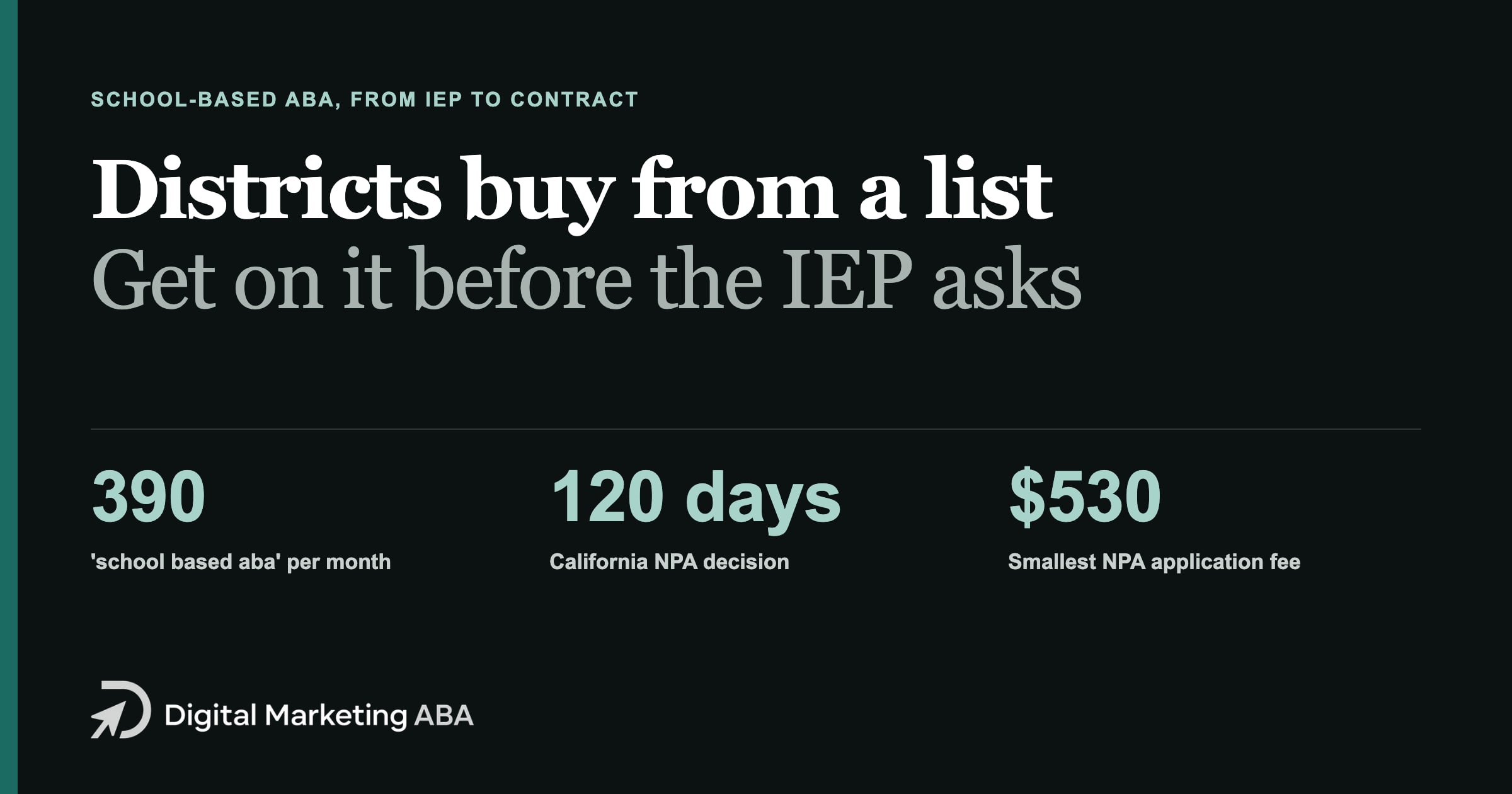
- 390
- Monthly US searches for "school based aba" (Semrush, Nov 2026)
- 120 days
- Time the California Department of Education allows itself to decide a new nonpublic agency application
How do school districts buy ABA services
Through the IEP first, then through purchasing. Under the Individuals with Disabilities Education Act (IDEA), each child's IEP lists the special education and related services the district must provide. When the district cannot staff a service itself, it contracts for it under its own purchasing rules.
IDEA does not name applied behavior analysis. It gives districts the hooks that ABA services hang on. The federal definition of related services (opens in a new tab) includes psychological services, and those include "assisting in developing positive behavioral intervention strategies." When a child's behavior impedes learning, the IEP team must consider positive behavioral interventions and supports (opens in a new tab). And the IEP must state services (opens in a new tab) "based on peer-reviewed research to the extent practicable."
That last phrase shapes the pitch. A district is not shopping for a brand. It needs a provider that can deliver what an IEP team has already written down, report progress against the IEP goals, and show the research basis for its methods.
What school-based ABA contracts cover
Scopes vary by district, so read each request closely. Before you bid, sort what a district is asking for into kinds of work you can staff:
- Direct support for individual students, delivered by behavior technicians under BCBA supervision, as written in the IEP.
- Functional behavior assessments and behavior intervention plans written by a BCBA.
- Consultation for teachers and classroom staff, with observation and feedback.
- Training for district paraprofessionals and teachers.
- Parent training, which IDEA lists among related services as "parent counseling and training".
Price each line of work separately
Each line implies different staffing. Direct support needs technicians who can be in a school building at fixed times every school day. Assessments, consultation and training need BCBA hours with travel built in. Price and staff each line on its own so a district can buy one without the others, and so you know which lines you can actually fill before you sign.
How districts choose a vendor
By the rules their state and school board set, with federal rules on top when federal money pays. Small purchases can go through quotes or a direct award; larger ones go through a formal bid or a request for proposals (RFP).
When a district spends a federal award, such as IDEA grant funds, the federal Uniform Guidance procurement rules (opens in a new tab) apply. They describe informal methods for small purchases, formal methods through sealed bids or proposals, and noncompetitive methods, and they require the buyer to keep documented procurement procedures. States and boards add their own policies and thresholds, so the method differs from place to place. Ask each district's purchasing office which method applies to the services you offer.
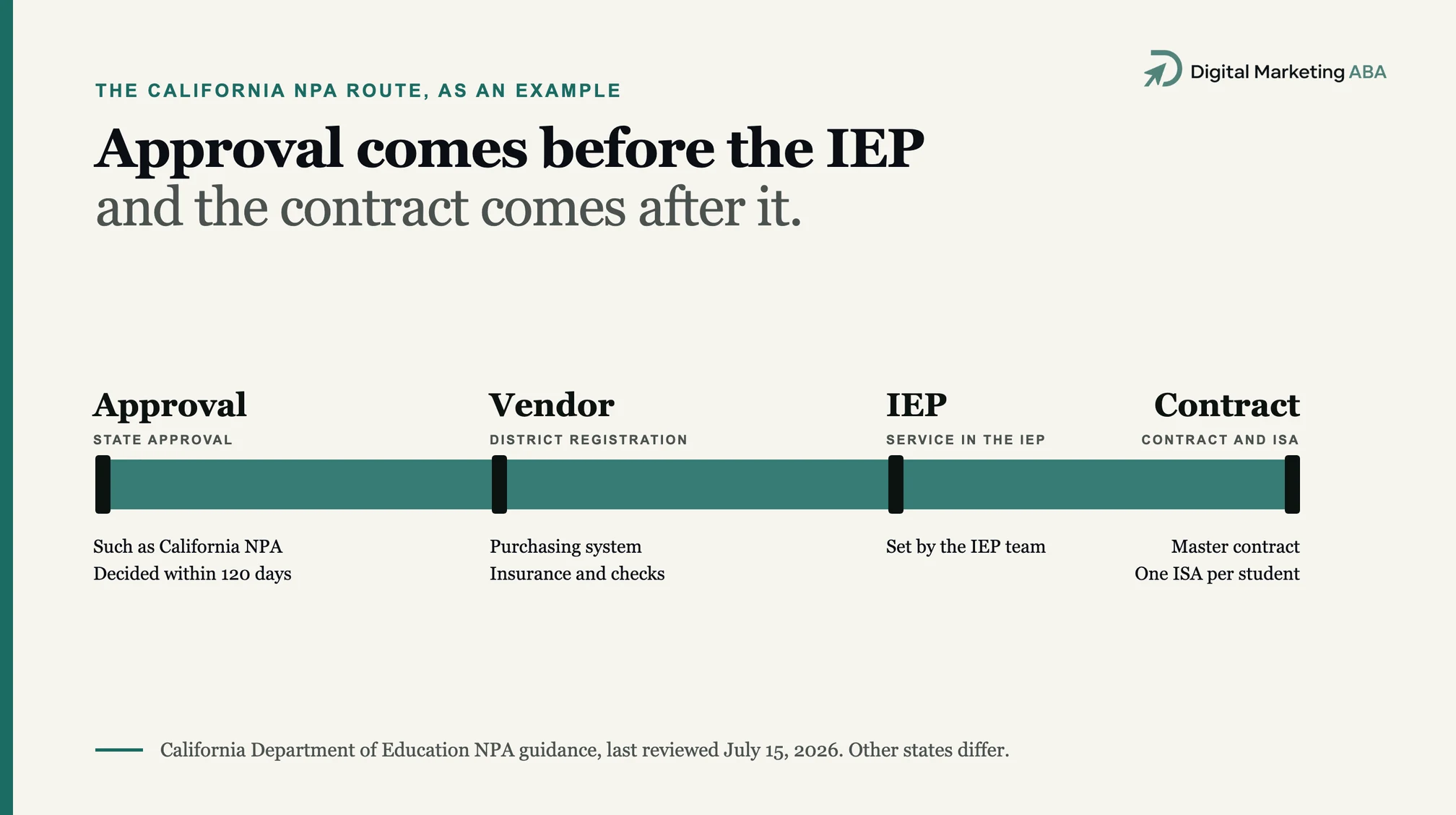
Some states also require an approval step before any contract. California is a clear example: a private provider of related services can be certified by the California Department of Education as a nonpublic agency (NPA).
How to get on a district vendor list
Register where the district buys, meet any state approval, and have the paperwork ready before a director asks. Being on a list does not guarantee referrals, but being off it rules you out.
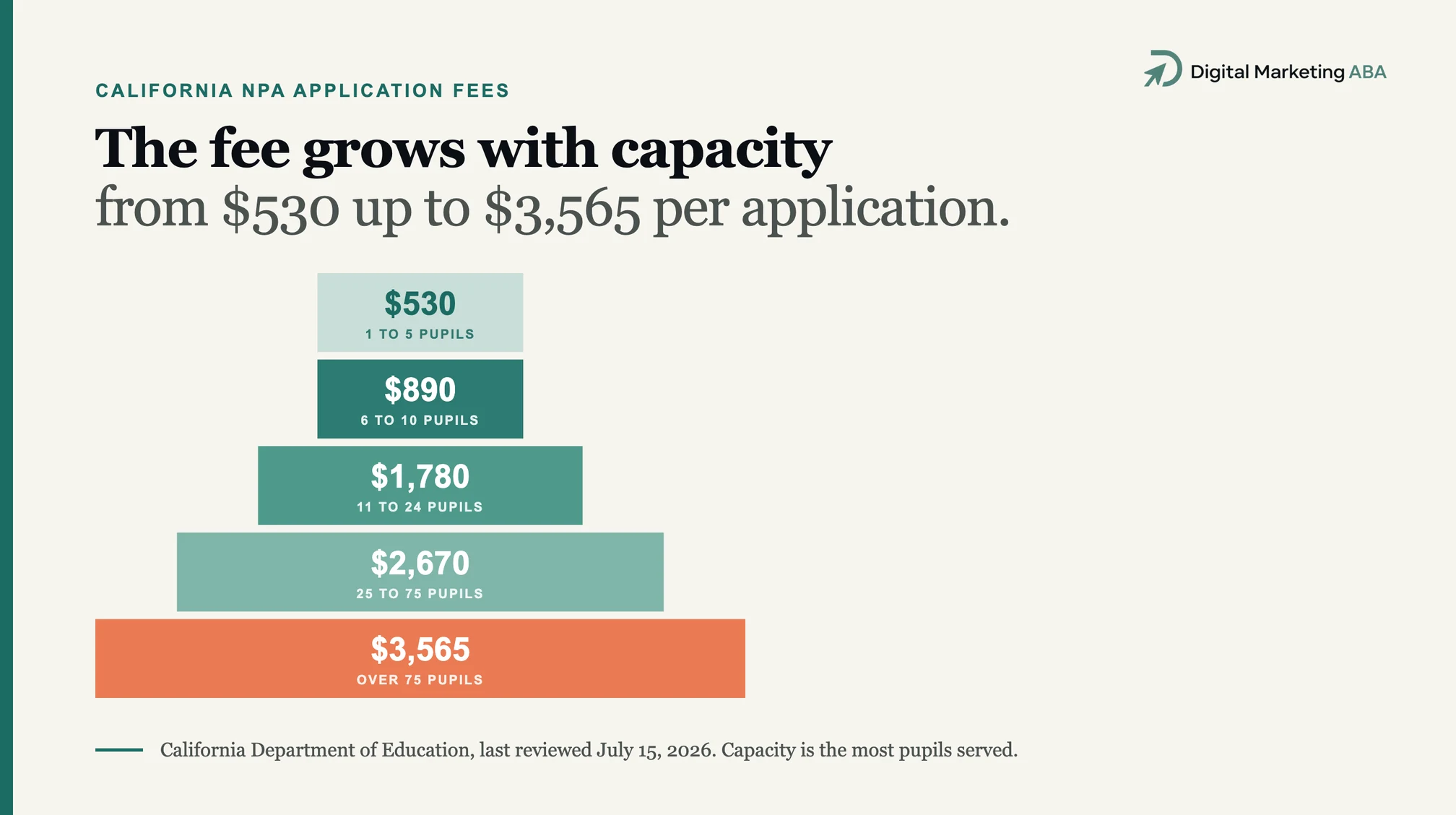
In California, the Department of Education's nonpublic agency guidance (opens in a new tab) (last reviewed July 15, 2026) says the department decides a new application within 120 days, each site an agency operates must be certified, and certification is reviewed annually, with renewals due between August 1 and October 31. A district that uses a certified agency signs a master contract with it and an individual services agreement (ISA) for each student. Application fees scale with program capacity:
- 1 to 5 pupils, $530.
- 6 to 10 pupils, $890.
- 11 to 24 pupils, $1,780.
- 25 to 75 pupils, $2,670.
- Over 75 pupils, $3,565.
What districts ask a new vendor for
Other states use other mechanisms, such as approved provider lists, regional cooperatives or plain vendor registration. Whatever the label, IDEA requires each state to set qualifications for related services personnel (opens in a new tab) consistent with state certification or licensing, so a district will check who your staff are. Expect to be asked for:
- Proof of any state approval the district needs before it can contract with you.
- Credentials for the BCBAs and RBTs who will serve students.
- Background check clearance for everyone who will work with students.
- Certificates of insurance and vendor registration in the district's purchasing system.
- Rates by service line, and the hours you can staff at each school.
Free website visibility check
Get your free visibility check.
Share your name, website, and email. We will inspect your public homepage and email your human-reviewed score and three priorities.
- See where qualified search demand may be leaking
- Reviewed by a person before it reaches your inbox
- No patient or clinical information requested
Who to contact in a school district
The director of special education owns the need; purchasing owns the process. Start with the special education office, and bring in purchasing when there is a live request or a contract to set up.
Outreach to a director works like outreach to a pediatrician's office: short, specific and repeated. Send a one-page capability statement, ask for 15 minutes, and offer something useful whether or not they buy, such as a short staff session on a behavior topic their teachers raise. Then follow up on a set rhythm. Our guide to earning ABA referrals from pediatricians covers the cadence and tracking; the same discipline applies to districts.
Keep a record per district: the director, the coordinators who manage behavior support, the purchasing contact, when the board approves contracts, and any open RFPs. Ask purchasing where solicitations are posted and check that place every month.
What to put in a capability statement
One page that lets a director check fit in two minutes. Think of it as a résumé for the company, written for a buyer with an IEP to fill:
- What you deliver in schools, by service line, in plain words.
- Where you can staff: districts, counties, and how soon you can start a new student.
- Who: the BCBAs and RBTs available for school work, and how supervision is structured.
- Credentials: state approvals (such as NPA certification in California), insurance, background checks.
- Data: how you measure progress against IEP goals and what the district receives each month.
- Method: the research basis for your procedures.
- Contact: one named person who replies within a business day.
Which privacy rules apply in schools
It depends on who keeps the record, so have counsel answer it before you sign. Records about students can fall under FERPA, the federal education privacy law, rather than HIPAA. The U.S. Department of Education and HHS published joint guidance on FERPA and HIPAA (opens in a new tab) (last updated December 2019) on how the two laws apply to student health records. Agree in the contract which law governs the records your staff create, who holds them, and how data moves between your systems and the district's.
In marketing, leave students out entirely: no names, photos or stories, even with good intentions. Our article on HIPAA-compliant marketing for ABA covers the clinic side of the same rule.
How to track schools as a growth channel
Treat each district as a referral source with its own numbers: contacts made, meetings held, RFPs answered, contracts signed, students served and hours delivered per month. When a family reaches one of your clinics through a school relationship, tag the inquiry with that district as the source.
The topic also has search demand of its own. Semrush estimates 390 US searches a month for "school based aba" and 390 for "aba in schools" (US database, November 2026). A school services page on your site, separate from the clinic pages, gives those searches somewhere to land; our guide to ABA therapy website design covers page structure. The district outreach itself is part of our Outbound Pipeline service.
What to do this week
- List the five districts closest to your clinics and find each special education director and purchasing contact.
- Check whether your state requires an approval, such as California's NPA certification, before a district can contract with you.
- Register as a vendor with each district and note where it posts RFPs.
- Write a one-page capability statement by service line and send it with a request for a short meeting.
- Add "school district" as a referral source in your intake system, with the district name.
Sources
34 CFR Part 300, IDEA Part B regulations (eCFR) (opens in a new tab) - sections 300.34 (related services), 300.156 (personnel qualifications), 300.320 (IEP content) and 300.324 (IEP development), read November 16, 2026. Primary.
2 CFR 200.320, Procurement methods (eCFR) (opens in a new tab) - informal, formal and noncompetitive procurement under federal awards, read November 16, 2026. Primary.
California Department of Education, Nonpublic Agencies general information (opens in a new tab) (last reviewed July 15, 2026) - definition, 120-day decision, site certification, master contract, ISA and fees. Primary agency guidance.
U.S. Department of Education and HHS, Joint Guidance on the Application of FERPA and HIPAA to Student Health Records (opens in a new tab) (updated December 2019). Primary.
Semrush, US database, November 2026 - monthly search volume estimates.
Frequently asked questions
Does IDEA require schools to provide ABA?
IDEA does not name ABA. It requires the services in each child's IEP, defines related services to include psychological services such as developing positive behavioral intervention strategies, and requires IEP teams to consider positive behavioral supports when behavior impedes learning.
How does an ABA company get on a school district vendor list?
Register as a vendor with each district, meet any state approval it requires, and have staff credentials, background checks, insurance and rates ready. In California, that approval can be certification as a nonpublic agency by the Department of Education.
How long does California NPA certification take?
The California Department of Education says it decides a new application within 120 days of receipt. Each site must be certified, certification is reviewed annually, and application fees range from $530 to $3,565 depending on program capacity.
Who should an ABA company contact in a school district?
Start with the director of special education, who owns the need, and the coordinators who manage behavior support. Bring in the purchasing office when there is a live request or a contract to set up.
Does HIPAA apply to ABA services in schools?
It depends on who keeps the record. Student records can fall under FERPA instead. The Department of Education and HHS joint guidance explains how the two laws apply; have counsel decide before you sign a district contract.
Keep reading
- ABA Insurance CredentialingABA Insurance Credentialing and How to Plan Around It
ABA insurance credentialing can hold a new BCBA or clinic out of network for months. What sets the timeline, state deadlines and how to plan your marketing.
- Independent ABA ClinicsHow Independent ABA Clinics Beat Corporate Centers
Independent ABA clinics can beat larger chains on intake speed, clinical continuity, local referrals and honest wait times. How to position a multi-site firm.
- ValuationHow Marketing Data Shapes ABA Practice Valuation
How marketing data shapes ABA practice valuation: referral concentration, cost per client, intake conversion, reviews and who owns your accounts and website.
Build a school referral pipeline
Want districts to know your name before the next IEP season?
Our Outbound Pipeline service runs outreach to school districts, pediatricians and other referral sources for multi-clinic ABA companies, with every contact and referral tracked by source.