
ABA Waitlist Management That Keeps Families From Going Elsewhere
ABA waitlist management usually sits with intake, but the waitlist is an owner's number. Every name on it is a family who chose you and has not started, and nothing stops them from taking the first opening somewhere else. Here is how to measure the list honestly, keep families engaged while they wait, match marketing spend to capacity clinic by clinic, and say on your website what the wait really is.
By Digital Marketing ABA
Published
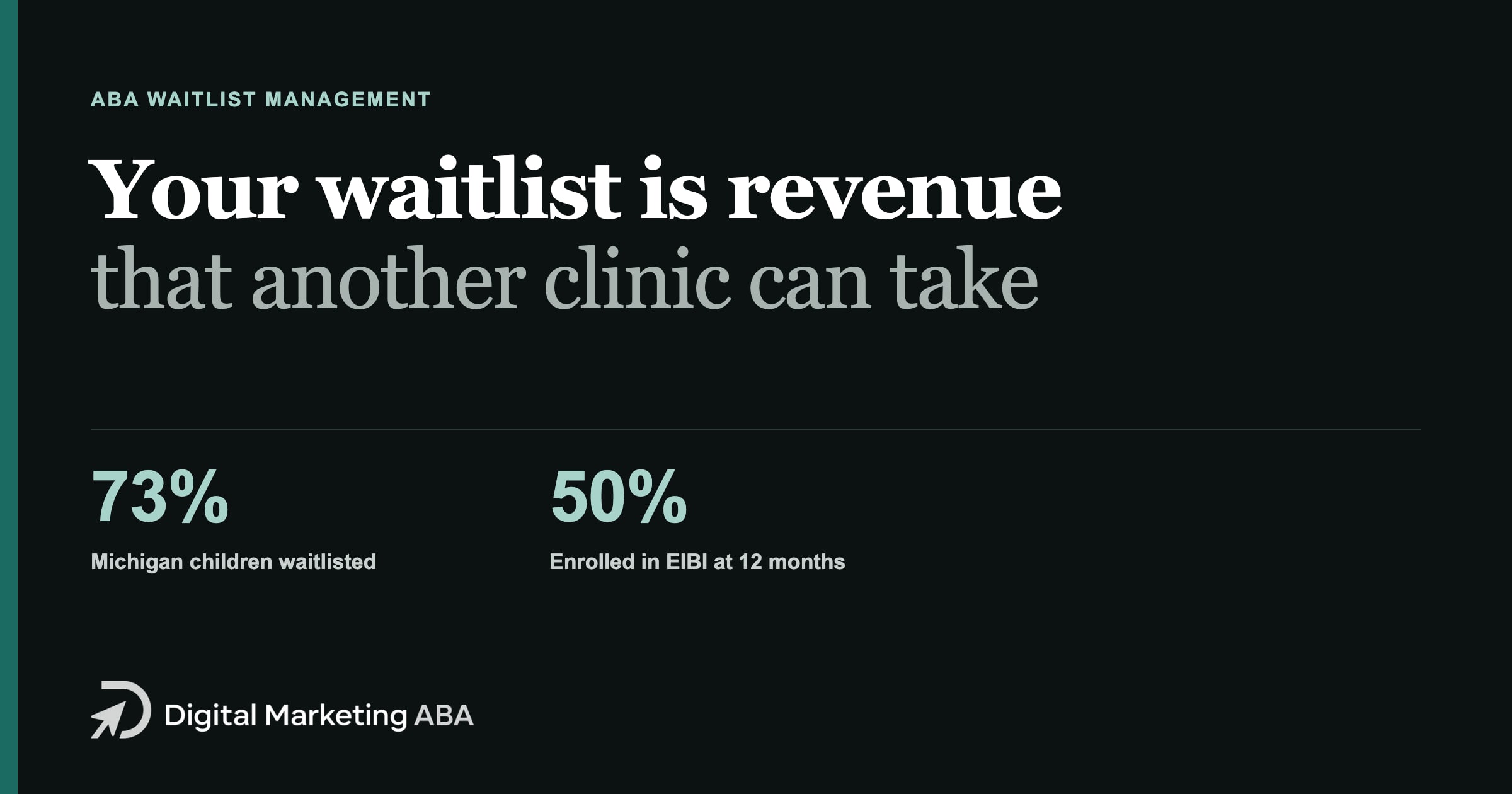
- 73%
- Children in a Michigan caregiver survey who spent time on a waitlist for ABA services (Behavior Analysis in Practice, 2025)
- 50%
- Children enrolled in early intensive behavioral intervention 12 months after diagnosis (Research in Autism, 2025)
Why a waitlist is a revenue problem
A waitlist is demand you paid to create and cannot yet bill. The longer families wait, the more of that demand you risk losing, and the marketing that produced it is already spent.
Long waits for ABA are documented. In a peer-reviewed survey of 78 Michigan families published in Behavior Analysis in Practice (opens in a new tab) (Stephens and colleagues, 2025), 73% of children spent time on a waitlist, with waits ranging from 1 month to over 1 year. Most caregivers said they were concerned about their child's behavior while they waited.
A separate 2025 brief report in Research in Autism (opens in a new tab) followed 76 young children diagnosed with autism in primary care. More than 80% were referred for early intensive behavioral intervention, but only 50% were enrolled 12 months later. Both studies are small, and neither tracks where each family went. Together they show that the time between referral and a first session is long, and that many referred families never arrive.
What ABA waitlist management should measure
Count families by clinic, payer, service type and status, and date every entry. A single company-wide total hides which clinic needs a BCBA and which names went cold months ago.
- Clinic or territory the family can realistically reach.
- Payer and plan, with the date benefits were last verified.
- Service type, such as center-based, in-home, early intervention or after-school hours.
- Status: awaiting intake call, awaiting verification, awaiting assessment, assessed and awaiting staffing, or authorized and awaiting a start date.
- Date added and date of last two-way contact.
How big is your real ABA waitlist?
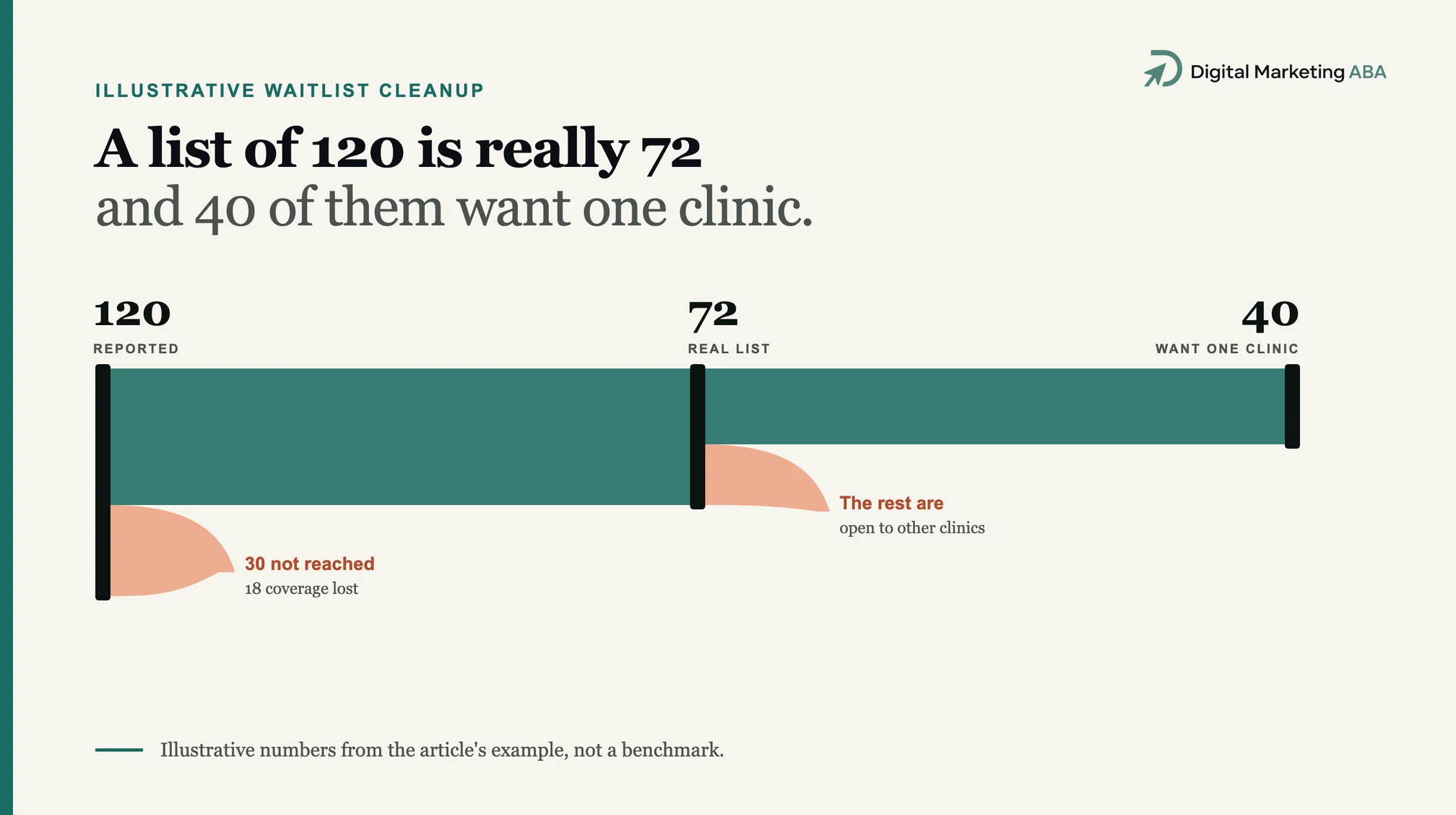
Smaller than the raw count, and more concentrated. Here is an example with illustrative numbers. A company reports a waitlist of 120 families. After removing 30 who have not been reached in 90 days and 18 whose coverage lapsed or is out of network, 72 remain. If 40 of those 72 want afternoon hours at one clinic, the problem is that clinic's staffing, not company-wide demand.
The same cleanup shows payer concentration. If most waiting families carry one plan, the constraint may be that plan's authorization process or rates, which is a contracting conversation with your billing lead rather than a marketing one.
Report the cleaned number monthly, with the median days on the list for each status. That tells you where families are stuck. A pile-up at authorization is an intake fix, covered step by step in ABA patient acquisition from inquiry to first session. A pile-up at staffing is a hiring problem.
How do you keep waiting families engaged?
Contact them on a schedule they can count on, and give them something useful to do while they wait. Silence gives a family no reason to wait for you rather than for the next clinic that calls back.
- A dated update at a fixed interval (every two weeks, for example) with their status and an honest range for the next step.
- One named person to contact, not a shared inbox.
- A fresh benefits check before a start date is offered, so the opening is not lost to a changed plan.
- Caregiver resources your clinical director has approved.
What the research says about caregiver support
The research supports caregiver support as a need, not yet as a proven way to keep families on your list. In the Michigan survey, most caregivers said they would have been interested in training to manage behavior and teach new skills while waiting.
A small single-case study in the Journal of Clinical Medicine (opens in a new tab) (Kunze and colleagues, 2021) coached six mothers by telehealth while their toddlers waited for a diagnostic appointment, and reported a strong effect on parents' use of the strategies and on the children's behavior. That study was about waiting for a diagnosis, not for ABA, and it had six families.
What you offer clinically is your clinical director's decision, and whether any of it is billable depends on the payer and the authorization. Free resources, such as a recorded orientation or a guide to what the assessment involves, are a marketing decision and quicker to start.
Free website visibility check
Get your free visibility check.
Share your name, website, and email. We will inspect your public homepage and email your human-reviewed score and three priorities.
- See where qualified search demand may be leaking
- Reviewed by a person before it reaches your inbox
- No patient or clinical information requested
Should you pause ads where there is no capacity?
Usually yes, by location. Ads that send families to a clinic with a long staffing wait add names to a list, not starts. Move that budget to clinics with open hours, or to recruiting where demand outruns staff.
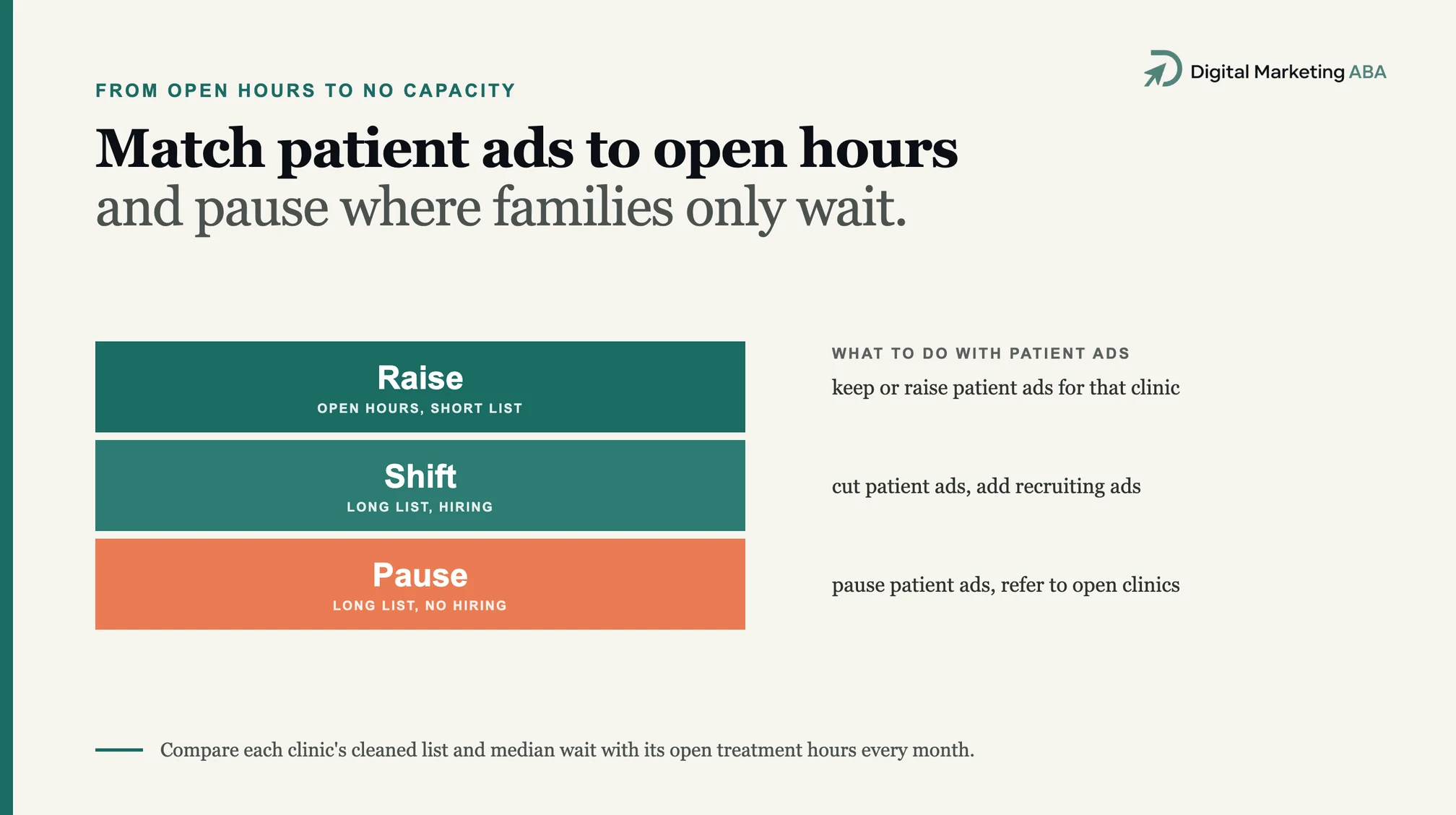
Google Ads lets you show ads only in the geographic locations you select (opens in a new tab), so a multi-clinic company can raise, cut or pause spend clinic by clinic instead of running one account-wide budget. Compare each clinic's cleaned list and median wait with its open treatment hours every month, then apply a simple rule.
- Open hours and a short list: keep or raise patient-facing ads for that clinic.
- Long list and open job requisitions: reduce patient ads and increase recruiting ads in the same area.
- Long list and no hiring plan: pause patient ads there, and refer inquiries to clinics with capacity when families can reach them.
Recruiting is what shortens the list
Most waitlists clear when a seat is filled, not when an ad is paused. What it costs to recruit a BCBA puts numbers on a vacant caseload, and RBT hiring and recruitment marketing covers the technician side. Run recruiting campaigns against the same clinic-level waitlist report, so hiring spend goes where families are waiting.
Should your website show ABA wait times?
Yes, as a range for each clinic with the date it was last updated. Families will hear the wait on the intake call anyway. Saying it first lets families who cannot wait look elsewhere early, and gives the ones who can a reason to trust what you tell them next.
Parents are searching for this. Semrush shows phrases such as "aba therapy for children with autism no waitlist" at 50 searches a month (US database, November 2026). A clinic page that claims no wait when there is one will be tested on the first call. A range such as "8 to 12 weeks for afternoon hours, updated November 2026" (an example, not a benchmark) sets an expectation you can keep. Update it monthly from the cleaned list.
This is the other half of How AI Can Fill Your ABA Clinic's Waitlist, which is about getting found by searching parents. Getting found fills the list. Managing it decides how many of those families start.
What to do this week
- Export the waitlist and add clinic, payer, service type, status and last-contact date to every row.
- Re-contact or remove anyone not reached in 90 days, and report the cleaned count.
- Set a fixed update schedule and one named contact for waiting families.
- Compare each clinic's list with its open hours, and shift patient and recruiting ads by location.
- Publish a dated wait-time range on each clinic page.
Sources
Stephens, Briggs, Loder, Barr and Miller, Delays to Behavioral Therapy in Michigan for Children Diagnosed with Autism (opens in a new tab) (Behavior Analysis in Practice, 2025) - caregiver survey, n=78, Michigan only. Peer-reviewed.
Saunders, Langdon, Paxton, Keehn and Keehn, Service Referral and Enrollment Following Autism Diagnosis in Primary Care (opens in a new tab) (Research in Autism, 2025) - brief report, 76 children aged 14 to 48 months. Peer-reviewed.
Kunze, Machalicek, Wei and St Joseph, Coaching via Telehealth (opens in a new tab) (Journal of Clinical Medicine, 2021) - single-case design, six caregiver-child pairs waiting for diagnosis. Peer-reviewed.
Google Ads Help, Target ads to geographic locations (opens in a new tab) (read November 16, 2026) - platform documentation.
Frequently asked questions
What is ABA waitlist management?
It is how an ABA company measures, contacts and clears the families who have chosen it but not yet started. Done well, it tracks each family by clinic, payer, service type and status, and ties marketing and recruiting spend to each clinic's capacity.
How long are ABA waitlists?
There is no single national figure. In a 2025 peer-reviewed Michigan survey of 78 families, 73% of children spent time on a waitlist, with waits from 1 month to over 1 year. Measure your own median wait by clinic and status.
How can an ABA clinic support families while they wait?
Send dated updates on a fixed schedule, give each family a named contact, re-check benefits before offering a start, and share caregiver resources your clinical director approves. Most caregivers in the Michigan survey said they would have been interested in training while waiting.
Should an ABA clinic stop advertising when it has a waitlist?
Usually by location rather than everywhere. Pause or cut patient ads for clinics with long staffing waits, keep them where there are open hours, and shift budget to recruiting where demand outruns staff.
Should an ABA clinic publish its wait time?
Yes, as a dated range for each clinic, updated monthly from a cleaned waitlist. It sets an honest expectation before the intake call, and parents do search for providers without a waitlist.
Keep reading
- Google AdsCan ABA Clinics Use Google Local Services Ads?
Can ABA clinics run Google Local Services Ads? What Google's US category list shows for ABA and behavioral health, and the ad options that work instead.
- ABA Insurance CredentialingABA Insurance Credentialing and How to Plan Around It
ABA insurance credentialing can hold a new BCBA or clinic out of network for months. What sets the timeline, state deadlines and how to plan your marketing.
- ABA Intake FormWhat Your ABA Intake Form Should Ask
What an ABA intake form on your website should ask, what to leave for the intake call, and why form length and callback speed decide which families start.
Spend where you can start families
Is your ad budget filling schedules or lists?
We help multi-clinic ABA companies tie campaigns, location pages and recruiting to each clinic's real capacity, so spend goes where a family can actually start.